
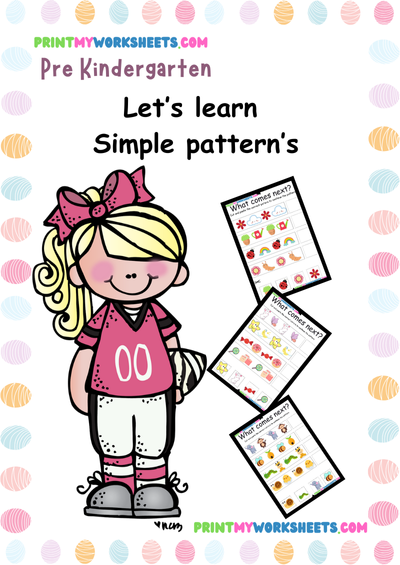
Pre-K Pattern Worksheets PDF | Free Math Downloadable
Are you looking for a fun and educational way to introduce your preschooler to early math concepts? Our Pre-K Pattern Worksheets PDF to build foundational math skills through hands-on, engaging pattern recognition activities. Specially designed for Pre-Kindergarten children in the U.S., this printable worksheet is ideal for homeschool parents, preschool teachers, and caregivers seeking screen-free, curriculum-aligned resources that promote problem-solving and logical thinking.
📥 Download your FREE Pattern Math Worksheet for Pre-K now, and watch your child build math confidence and critical thinking skills—one pattern at a time! It is completely aligned with U.S Curriculum.
Click below to access the Pre-K Pattern Worksheets PDF
Pre-K Pattern Worksheets PDF
The Pre-K Pattern Worksheets PDF is a helpful early learning resource designed to introduce young children to the concept of patterns in a fun and structured way. These free printable worksheets are ideal for U.S. parents, preschool teachers, and homeschool families who want to support early math and cognitive development through engaging activities.
Recognizing patterns is one of the foundational skills children develop before learning more advanced math concepts. At the Pre-K level, students begin identifying simple repeating sequences using colors, shapes, pictures, and objects. These early experiences help children understand how patterns work in everyday learning.
The Pre-K Pattern Worksheets PDF provides structured practice that allows children to explore patterns through clear and age-appropriate activities. Students practice identifying repeating sequences, completing missing elements, and recognizing patterns in visual forms. These exercises encourage observation, logical thinking, and early problem-solving skills.
With consistent practice, young learners begin to recognize patterns quickly and confidently, preparing them for future math concepts such as counting, sequencing, and early algebraic thinking.
What Students Will Learn?
Pattern worksheets help Pre-K students understand how sequences repeat and how objects can follow a predictable order. Learning to recognize patterns is an important early math skill that supports logical thinking and observation.
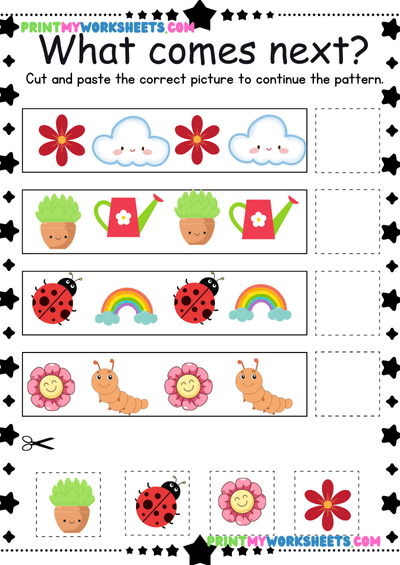
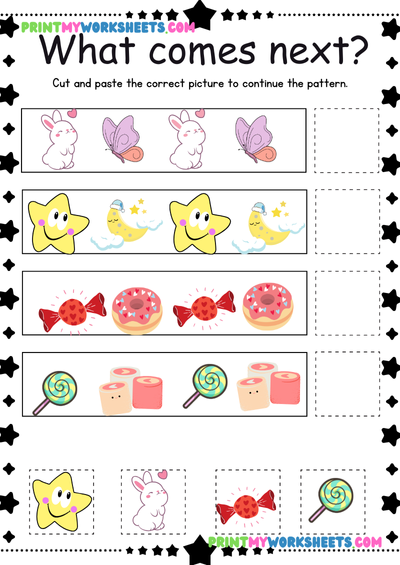
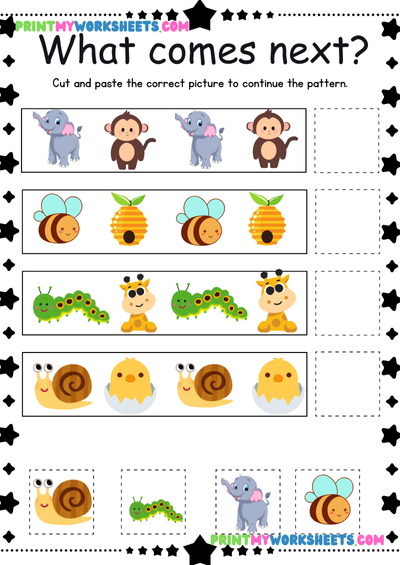
Students begin by identifying simple repeating patterns such as AB, AAB, or ABC patterns using shapes, colors, and pictures. These basic patterns allow children to see how objects repeat in a sequence.
Many activities ask students to complete unfinished patterns by identifying what comes next. This encourages children to carefully observe the sequence and determine the correct continuation.
Other exercises may include matching patterns, circling repeating groups, or coloring objects to complete a pattern. These activities strengthen visual recognition and attention to detail.
The worksheets are designed with simple instructions and clear illustrations that support independent practice. Young learners can easily follow the patterns and understand what they need to do to complete each activity.
Through repeated practice with engaging visuals, children develop a stronger understanding of sequencing and logical order. These early pattern-recognition activities support foundational math skills that children will build upon throughout elementary school.
Educational Value & Skill Development
The Pre-K Pattern Worksheets PDF supports several areas of early childhood development, particularly in the areas of mathematics, cognitive skills, and visual recognition.
One of the main benefits is strengthening logical thinking. When children recognize patterns, they learn to identify relationships between objects and predict what will come next in a sequence.
Pattern recognition also supports early problem-solving skills. Students must carefully analyze a sequence and determine which object completes the pattern correctly. This process encourages critical thinking and reasoning.
Another important benefit is visual discrimination. Children practice noticing differences in shapes, colors, and images, which helps improve attention to detail.
The Pre-K Pattern Worksheets PDF also supports early math readiness. Patterns are closely connected to later math concepts such as counting, number patterns, and early algebra. By learning to recognize sequences early, students develop a foundation for future mathematical learning.
In addition to academic benefits, these activities help build confidence in young learners. Completing patterns successfully encourages children to continue exploring and learning through hands-on practice.
Over time, repeated exposure to patterns helps students become more comfortable recognizing sequences in both classroom activities and everyday situations.
Why Focus on Pattern Recognition?
Pattern recognition is a fundamental skill in early childhood education because it helps children understand how sequences and relationships work. Recognizing patterns allows students to identify order, predict outcomes, and organize information logically.
For preschool learners, patterns often appear through simple visual sequences such as alternating colors, repeating shapes, or picture patterns. These early activities make learning interactive and engaging.
Developing pattern recognition also supports early mathematical thinking. Understanding how patterns repeat prepares children for more advanced topics such as number sequences, multiplication patterns, and algebraic reasoning in later grades.
Patterns also appear frequently in everyday life. Children may notice patterns in music, clothing designs, nature, and daily routines. Recognizing these patterns helps them connect classroom learning with real-world observations.
Repetition and guided practice are important when teaching pattern recognition. When students repeatedly identify and complete patterns, they become more confident in recognizing sequences independently.
Early exposure to pattern activities aligns with preschool learning standards in the United States. These skills help prepare children for kindergarten math and problem-solving tasks.
How to Use These Worksheets?
The Pre-K Pattern Worksheets PDF can be used in a variety of learning environments, including preschool classrooms, homeschool settings, and small-group learning activities.
Teachers often include pattern worksheets as part of early math centers or hands-on learning stations. Students can complete pattern activities independently or work together in small groups to identify repeating sequences.
Teachers may guide students through the first few exercises by discussing what they observe in the pattern. Asking questions such as “What comes next?” or “What repeats?” helps children think about the sequence more carefully.
Parents who homeschool can include these worksheets as part of daily preschool activities. Children may practice identifying patterns through coloring, circling, or drawing objects that complete a sequence.
Because the worksheets are available as a free printable PDF, they are easy to download and print whenever needed. Families and educators can reuse the worksheets for additional practice sessions or review activities.
The clear layout and simple instructions also make the worksheets suitable for independent practice. Young learners can work through the activities at their own pace while strengthening early math skills.
Related Worksheets / Extensions:
Frequently Asked Questions
Q1. Is this worksheet free to download?
Yes, this worksheet is 100% free to download and print. No account, subscription, or payment is required. Click the Download Now button to get your free PDF instantly.
Q2. What format is this worksheet available in?
This worksheet is available as a printable PDF file. It is black-and-white, printer-friendly, and works on any standard home or classroom printer using A4 or US Letter paper.
Q3. Can I use this worksheet for both classroom and home learning?
Yes, these worksheets are designed for use by classroom teachers, homeschool parents, and tutors. They can be used as morning work, homework, revision practice, or learning centre activities.
Q4. How long does it take to complete this math worksheet?
Most students complete this worksheet in 10 to 20 minutes depending on grade level and familiarity with the topic.
Q5. Does this math worksheet include an answer key?
Yes, an answer key is included in the PDF so parents and teachers can quickly check student responses without manual calculation.