
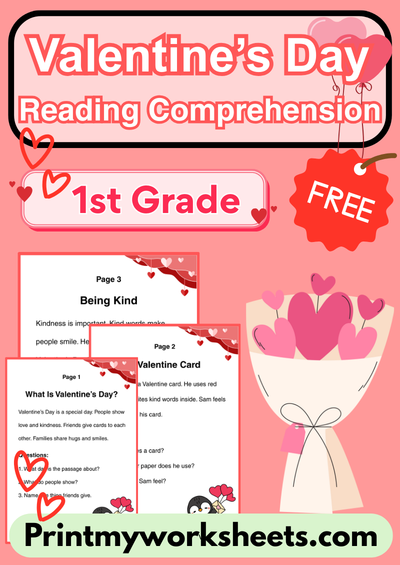
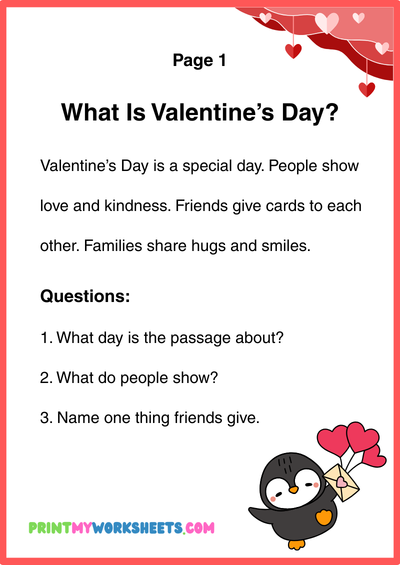


1st Grade Valentine’s Day Reading Worksheets PDF – Free
Click below to access the free 1st Grade Valentine’s Day Reading Worksheets PDF
Continue Learning
Explore more worksheets to build your child’s English skills.

1st Grade Valentine’s Day Reading Worksheets PDF
Seasonal themes can make reading practice more engaging while still supporting important academic goals. These 1st Grade Valentine’s Day Reading Worksheets PDF are designed to help young readers strengthen essential literacy skills through age-appropriate, structured activities. Created for U.S. parents, classroom teachers, and homeschool families, this free printable resource blends meaningful reading practice with a familiar holiday theme that keeps students interested and focused.
In first grade, children move beyond basic decoding and begin developing reading fluency, comprehension, and confidence. Consistent practice with short passages, phonics-based activities, and simple comprehension tasks helps reinforce these skills. Valentine’s Day-themed worksheets provide a fresh way to revisit reading concepts without disrupting established routines. This printable set supports daily literacy instruction, review, or extra practice while keeping learning calm, purposeful, and developmentally appropriate for first-grade learners.
What Students Will Learn ?
This worksheet set is designed to support first-grade reading development through structured, skill-focused activities. Students will practice reading short passages, identifying key details, and responding to simple questions that check understanding. These activities help strengthen decoding skills, fluency, and early comprehension.
The worksheets include a variety of reading tasks that encourage students to engage with text in meaningful ways. Learners may read short sentences or passages, answer comprehension questions, and practice phonics-based skills aligned with first-grade expectations. Each activity focuses on one objective at a time, helping students stay focused and successful.
The layout and content are carefully designed for first graders. Instructions are clear, text is readable, and tasks are manageable for independent or guided practice. These worksheets fit well within U.S. first-grade literacy goals by reinforcing foundational reading skills while gently introducing higher-level thinking, such as recalling details and understanding simple story elements.
Educational Value & Skill Development
Reading worksheets play an important role in reinforcing classroom instruction, and the 1st Grade Valentine’s Day Reading Worksheets PDF offer meaningful educational value beyond seasonal appeal. Academically, these worksheets support reading fluency by giving students repeated exposure to age-appropriate text. As children practice reading smoothly and accurately, they build confidence and stamina.
Cognitively, reading activities encourage focus, memory, and comprehension. Students learn to process information, recall details, and make simple connections within a text. These skills are essential for success in all subject areas as reading becomes a primary way students access information.
Using the 1st Grade Valentine’s Day Reading Worksheets PDF also supports independence. Familiar formats and predictable routines help students understand expectations and complete tasks with less assistance. Over time, this independence contributes to stronger self-confidence and a positive attitude toward reading. The progression of activities supports skill growth from basic decoding to more thoughtful engagement with text, preparing students for the increasing reading demands of later grades.
Why Focus on 1st Grade Valentine’s Day Reading Worksheets ?
Why Focus on 1st Grade Valentine’s Day Reading Worksheets? First grade is a critical year for reading development. Students are expected to move from learning to read toward reading with purpose and understanding. Focused reading practice helps solidify this transition.
Holiday-themed worksheets provide an opportunity to revisit core skills while maintaining student interest. Valentine’s Day themes feel familiar and enjoyable, which can help reduce resistance to practice and encourage participation. When students are engaged, they are more likely to complete tasks carefully and retain what they learn.
Repetition and guided practice are essential for developing fluency and comprehension. Reading skills improve when students interact with text regularly in structured ways. These worksheets align with early learning standards commonly used in U.S. schools by reinforcing phonics, fluency, and comprehension skills. Consistent reading practice at this stage builds a strong foundation for second grade and supports long-term academic success.
How to Use These Worksheets ?
These worksheets are flexible and easy to use in different learning environments. In homeschool settings, parents can include them as part of a daily reading routine or use them as seasonal enrichment. In classrooms, teachers may use the pages for morning work, literacy centers, small-group instruction, or independent practice.
The worksheets are also effective for review and reinforcement. Students can revisit reading concepts they have already learned, helping strengthen retention through repeated exposure. Because the resource is offered as a free printable PDF, it is easy to download and print as needed. Pages can be reused by placing them in sheet protectors or laminating for continued practice.
For educators and families looking for themed reading support, 1st Grade Valentine’s Day Reading Worksheets PDF provide a simple, practical way to reinforce literacy skills while keeping instruction engaging and purposeful.
What’s Included in This PDF ?
This printable worksheet set is designed to support first-grade reading instruction in a clear and organized way. Each page focuses on meaningful skill practice without unnecessary distractions. Inside this PDF, you’ll find:
Multiple printable worksheets focused on first-grade reading skills
Short reading passages with comprehension activities
Phonics and reading-based exercises appropriate for first grade
A clean, kid-friendly layout that supports focus
Black-and-white, print-friendly pages
Worksheets aligned with U.S. first-grade curriculum expectations
A free downloadable PDF format for convenient access
You may also like:

Related Worksheets / Extensions :
To extend learning beyond this set, consider pairing these worksheets with additional first-grade literacy resources. Phonics review pages, sight word practice, or simple writing prompts can complement reading instruction and support balanced literacy development.
You may also explore similar seasonal or holiday-themed reading printables for different times of the year. Resources like 1st Grade Valentine’s Day Reading Worksheets PDF work well alongside year-round reading practice, helping students strengthen comprehension and fluency through consistent, engaging activities that support ongoing reading growth.
Frequently Asked Questions
Q1. What format is this worksheet available in?
This worksheet is available as a printable PDF file. It is black-and-white, printer-friendly, and works on any standard home or classroom printer using A4 or US Letter paper.
Q2. Is this worksheet free to download?
Yes, this worksheet is 100% free to download and print. No account, subscription, or payment is required. Click the Download Now button to get your free PDF instantly.
Q3. Can I use this worksheet for both classroom and home learning?
Yes, these worksheets are designed for use by classroom teachers, homeschool parents, and tutors. They can be used as morning work, homework, revision practice, or learning centre activities.
Q4. Is this worksheet aligned with Common Core ELA standards?
Yes, this English worksheet is aligned with U.S. Common Core English Language Arts standards and supports foundational literacy development.
Q5. Can this worksheet be used for phonics instruction?
Yes, this worksheet supports phonics-based reading instruction and is suitable for early readers building letter-sound recognition skills.
You may also like…
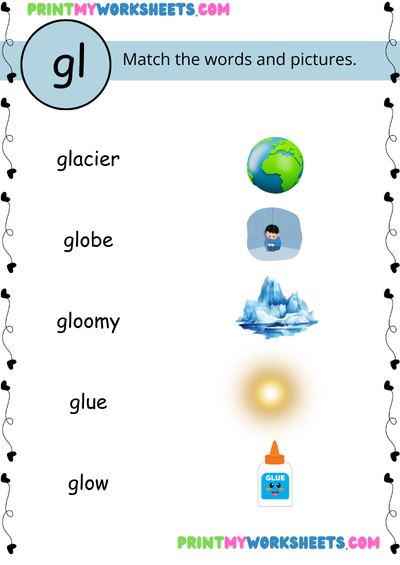
1st Grade Consonant Blends Worksheets PDF – Free Printable
1st Grade Consonant Blends Worksheets PDF
Why Focus on Consonant Blends?
Consonant blends are a key part of early phonics instruction because they appear frequently in everyday reading. Understanding blends allows students to read common words more efficiently and with greater accuracy.
This skill supports future learning by preparing students for digraphs, multisyllabic words, and spelling patterns introduced in higher grades. Consistent practice helps students recognize blends automatically, freeing up mental energy for comprehension.
The 1st Grade Consonant Blends Worksheets PDF supports U.S. reading standards by emphasizing repetition, guided practice, and gradual mastery. When students are comfortable with blends, they are better equipped to handle grade-level texts and participate confidently in reading activities across subjects.
How to Use These Worksheets?
These worksheets are flexible and easy to incorporate into daily learning routines. In classrooms, teachers can use them during phonics lessons, literacy centers, or independent work time. They also work well for small-group instruction or targeted intervention.
Homeschool families can include the worksheets in structured reading lessons or use them for extra practice. Parents can read instructions aloud, model blending sounds, and review answers together with their child. This interaction reinforces learning and builds confidence.
The free printable PDF format makes downloading and printing quick and convenient. Worksheets can be reused for review or reinforcement as needed. The 1st Grade Consonant Blends Worksheets PDF supports independent practice while remaining adaptable to guided instruction and individualized learning plans.
Related Worksheets / Extensions:
To further support reading development, students may also benefit from short vowel worksheets, digraph practice pages, and simple sentence reading activities. Combining blend practice with oral reading and word games can strengthen understanding.
The 1st Grade Consonant Blends Worksheets PDF pairs well with other phonics and fluency resources, helping students build a strong reading foundation that supports success throughout elementary school.
Frequently Asked Questions
Q1. Is this worksheet free to download?Yes, this worksheet is 100% free to download and print. No account, subscription, or payment is required. Click the Download Now button to get your free PDF instantly.Q2. What format is this worksheet available in?This worksheet is available as a printable PDF file. It is black-and-white, printer-friendly, and works on any standard home or classroom printer using A4 or US Letter paper.Q3. Can I use this worksheet for both classroom and home learning?Yes, these worksheets are designed for use by classroom teachers, homeschool parents, and tutors. They can be used as morning work, homework, revision practice, or learning centre activities.Q4. Is this worksheet aligned with Common Core ELA standards?Yes, this English worksheet is aligned with U.S. Common Core English Language Arts standards and supports foundational literacy development.Q5. Can this worksheet be used for phonics instruction?Yes, this worksheet supports phonics-based reading instruction and is suitable for early readers building letter-sound recognition skills.1st Grade Consonant Blends Worksheets PDF – Free Printable
1st Grade Consonant Blends Worksheets PDF
Why Focus on Consonant Blends?
Consonant blends are a key part of early phonics instruction because they appear frequently in everyday reading. Understanding blends allows students to read common words more efficiently and with greater accuracy.
This skill supports future learning by preparing students for digraphs, multisyllabic words, and spelling patterns introduced in higher grades. Consistent practice helps students recognize blends automatically, freeing up mental energy for comprehension.
The 1st Grade Consonant Blends Worksheets PDF supports U.S. reading standards by emphasizing repetition, guided practice, and gradual mastery. When students are comfortable with blends, they are better equipped to handle grade-level texts and participate confidently in reading activities across subjects.
How to Use These Worksheets?
These worksheets are flexible and easy to incorporate into daily learning routines. In classrooms, teachers can use them during phonics lessons, literacy centers, or independent work time. They also work well for small-group instruction or targeted intervention.
Homeschool families can include the worksheets in structured reading lessons or use them for extra practice. Parents can read instructions aloud, model blending sounds, and review answers together with their child. This interaction reinforces learning and builds confidence.
The free printable PDF format makes downloading and printing quick and convenient. Worksheets can be reused for review or reinforcement as needed. The 1st Grade Consonant Blends Worksheets PDF supports independent practice while remaining adaptable to guided instruction and individualized learning plans.
Related Worksheets / Extensions:
To further support reading development, students may also benefit from short vowel worksheets, digraph practice pages, and simple sentence reading activities. Combining blend practice with oral reading and word games can strengthen understanding.
The 1st Grade Consonant Blends Worksheets PDF pairs well with other phonics and fluency resources, helping students build a strong reading foundation that supports success throughout elementary school.
Frequently Asked Questions
Q1. Is this worksheet free to download?Yes, this worksheet is 100% free to download and print. No account, subscription, or payment is required. Click the Download Now button to get your free PDF instantly.Q2. What format is this worksheet available in?This worksheet is available as a printable PDF file. It is black-and-white, printer-friendly, and works on any standard home or classroom printer using A4 or US Letter paper.Q3. Can I use this worksheet for both classroom and home learning?Yes, these worksheets are designed for use by classroom teachers, homeschool parents, and tutors. They can be used as morning work, homework, revision practice, or learning centre activities.Q4. Is this worksheet aligned with Common Core ELA standards?Yes, this English worksheet is aligned with U.S. Common Core English Language Arts standards and supports foundational literacy development.Q5. Can this worksheet be used for phonics instruction?Yes, this worksheet supports phonics-based reading instruction and is suitable for early readers building letter-sound recognition skills.
1st Grade Dance and Motion Rhymes Worksheets PDF – Free
1st Grade Dance and Motion Rhymes Worksheets PDF
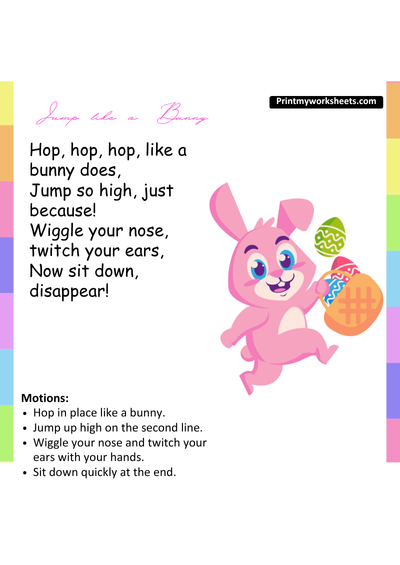
Young learners often enjoy activities that combine movement, rhythm, and language. The 1st Grade Dance and Motion Rhymes Worksheets PDF introduces students to simple rhymes that encourage physical movement while supporting early literacy development. These printable worksheets are designed for U.S. teachers, parents, and homeschool families who want to make learning more engaging through rhythm, rhyme, and motion-based activities.
In first grade, students continue developing reading fluency, listening skills, and coordination. Dance and motion rhymes provide a fun way for children to practice language patterns while actively participating in movement activities. Rhymes that include actions such as clapping, jumping, or spinning help students connect language with physical movement, making learning more memorable.
The 1st Grade Dance and Motion Rhymes Worksheets PDF provides simple rhymes and related activities that allow children to read, recite, and perform actions while learning. These worksheets help students build reading confidence, improve listening skills, and enjoy creative expression through movement-based learning experiences.
What Students Will Learn?
Dance and motion rhyme worksheets introduce first grade students to rhythmic language while encouraging movement and participation. These activities combine reading practice with physical actions, helping students engage with language in a creative way.
Students begin by reading or listening to short rhymes that include simple action words. These rhymes may describe movements such as clapping hands, tapping feet, spinning around, or jumping in place.
As students read the rhymes, they are encouraged to perform the actions described in the text. This combination of reading and movement helps reinforce comprehension and keeps students actively involved in the activity.
The worksheets may also include follow-up tasks such as identifying action words within the rhyme or sequencing movements in the correct order.
Students practice recognizing rhyming words and rhythm patterns in the text. These activities strengthen phonological awareness and help students understand how sounds work in language.
Some worksheets may encourage students to create their own movement rhymes using simple action verbs. This creative exercise helps students practice writing while thinking about rhythm and movement.
Through these activities, students develop stronger reading skills, listening abilities, and physical coordination while enjoying interactive learning experiences.
Educational Value & Skill Development
The 1st Grade Dance and Motion Rhymes Worksheets PDF supports several important areas of development for first grade learners.
One of the primary benefits is strengthening phonological awareness. Rhymes help students recognize sound patterns in language, which is essential for reading fluency and decoding skills.
The 1st Grade Dance and Motion Rhymes Worksheets PDF also improves reading confidence. Short, rhythmic texts are easier for young readers to follow, allowing them to practice reading aloud with expression.
Movement-based learning also supports physical development. Performing simple actions such as clapping, jumping, or stretching helps students improve coordination and motor skills.
These worksheets also encourage listening comprehension. Students must listen carefully to instructions within the rhyme in order to perform the correct movement.
Another benefit is improved memory retention. When language is combined with actions, students are more likely to remember the rhyme and its vocabulary.
Dance and motion rhymes also create a positive learning environment. Students often feel more relaxed and engaged when learning involves movement and creativity.
By combining literacy practice with physical activity, these worksheets provide a balanced learning experience that supports both cognitive and physical growth.
Why Focus on Dance and Motion Rhymes?
Movement and rhythm play an important role in early childhood learning. When students connect language with physical actions, they engage multiple parts of the brain, which strengthens learning and memory.
Dance and motion rhymes introduce students to language in a playful and interactive format. Instead of simply reading text, students become active participants in the learning process.
These activities also support kinesthetic learners who benefit from hands-on or movement-based experiences. Physical movement allows these students to stay focused and involved in classroom activities.
Rhymes also reinforce sound patterns and vocabulary development. Repeating rhythmic language helps students recognize similar sounds and understand how words connect.
In many first grade classrooms across the United States, teachers use songs, rhymes, and movement activities as part of daily instruction. These strategies help maintain student attention and encourage participation.
Dance and motion rhymes also promote social interaction. Students may perform actions together in small groups, which builds cooperation and communication skills.
Incorporating movement into literacy activities allows students to enjoy learning while strengthening both language and physical development.
How to Use These Worksheets?
The 1st Grade Dance and Motion Rhymes Worksheets PDF can be used in classrooms, homeschool lessons, or small-group learning environments.
Teachers often use motion rhymes during morning meetings, literacy centers, or transition activities between lessons. Students can read the rhyme together and perform the movements described in the text.
In classroom settings, teachers may first read the rhyme aloud while demonstrating the actions. Students then repeat the rhyme and perform the movements themselves.
Parents who homeschool can use these worksheets as part of daily reading practice. Children may read the rhyme aloud and follow the movement instructions, creating an interactive learning experience at home.
Because the worksheets are available as a free printable PDF, they can be easily downloaded and printed whenever additional activities are needed.
These worksheets are also helpful during group activities. Students can work together to perform the actions and practice reading the rhyme with expression.
The printable format allows teachers and parents to reuse the rhymes for repeated practice, helping students become more confident with the language and movements.
Related Worksheets / Extensions:
Frequently Asked Questions
Q1. Is this worksheet free to download?Yes, this worksheet is 100% free to download and print. No account, subscription, or payment is required. Click the Download Now button to get your free PDF instantly.Q2. What format is this worksheet available in?This worksheet is available as a printable PDF file. It is black-and-white, printer-friendly, and works on any standard home or classroom printer using A4 or US Letter paper.Q3. Can I use this worksheet for both classroom and home learning?Yes, these worksheets are designed for use by classroom teachers, homeschool parents, and tutors. They can be used as morning work, homework, revision practice, or learning centre activities.Q4. Is this worksheet aligned with Common Core ELA standards?Yes, this English worksheet is aligned with U.S. Common Core English Language Arts standards and supports foundational literacy development.Q5. Can this worksheet be used for phonics instruction?Yes, this worksheet supports phonics-based reading instruction and is suitable for early readers building letter-sound recognition skills.1st Grade Dance and Motion Rhymes Worksheets PDF – Free
1st Grade Dance and Motion Rhymes Worksheets PDF
Young learners often enjoy activities that combine movement, rhythm, and language. The 1st Grade Dance and Motion Rhymes Worksheets PDF introduces students to simple rhymes that encourage physical movement while supporting early literacy development. These printable worksheets are designed for U.S. teachers, parents, and homeschool families who want to make learning more engaging through rhythm, rhyme, and motion-based activities.
In first grade, students continue developing reading fluency, listening skills, and coordination. Dance and motion rhymes provide a fun way for children to practice language patterns while actively participating in movement activities. Rhymes that include actions such as clapping, jumping, or spinning help students connect language with physical movement, making learning more memorable.
The 1st Grade Dance and Motion Rhymes Worksheets PDF provides simple rhymes and related activities that allow children to read, recite, and perform actions while learning. These worksheets help students build reading confidence, improve listening skills, and enjoy creative expression through movement-based learning experiences.
What Students Will Learn?
Dance and motion rhyme worksheets introduce first grade students to rhythmic language while encouraging movement and participation. These activities combine reading practice with physical actions, helping students engage with language in a creative way.
Students begin by reading or listening to short rhymes that include simple action words. These rhymes may describe movements such as clapping hands, tapping feet, spinning around, or jumping in place.
As students read the rhymes, they are encouraged to perform the actions described in the text. This combination of reading and movement helps reinforce comprehension and keeps students actively involved in the activity.
The worksheets may also include follow-up tasks such as identifying action words within the rhyme or sequencing movements in the correct order.
Students practice recognizing rhyming words and rhythm patterns in the text. These activities strengthen phonological awareness and help students understand how sounds work in language.
Some worksheets may encourage students to create their own movement rhymes using simple action verbs. This creative exercise helps students practice writing while thinking about rhythm and movement.
Through these activities, students develop stronger reading skills, listening abilities, and physical coordination while enjoying interactive learning experiences.
Educational Value & Skill Development
The 1st Grade Dance and Motion Rhymes Worksheets PDF supports several important areas of development for first grade learners.
One of the primary benefits is strengthening phonological awareness. Rhymes help students recognize sound patterns in language, which is essential for reading fluency and decoding skills.
The 1st Grade Dance and Motion Rhymes Worksheets PDF also improves reading confidence. Short, rhythmic texts are easier for young readers to follow, allowing them to practice reading aloud with expression.
Movement-based learning also supports physical development. Performing simple actions such as clapping, jumping, or stretching helps students improve coordination and motor skills.
These worksheets also encourage listening comprehension. Students must listen carefully to instructions within the rhyme in order to perform the correct movement.
Another benefit is improved memory retention. When language is combined with actions, students are more likely to remember the rhyme and its vocabulary.
Dance and motion rhymes also create a positive learning environment. Students often feel more relaxed and engaged when learning involves movement and creativity.
By combining literacy practice with physical activity, these worksheets provide a balanced learning experience that supports both cognitive and physical growth.
Why Focus on Dance and Motion Rhymes?
Movement and rhythm play an important role in early childhood learning. When students connect language with physical actions, they engage multiple parts of the brain, which strengthens learning and memory.
Dance and motion rhymes introduce students to language in a playful and interactive format. Instead of simply reading text, students become active participants in the learning process.
These activities also support kinesthetic learners who benefit from hands-on or movement-based experiences. Physical movement allows these students to stay focused and involved in classroom activities.
Rhymes also reinforce sound patterns and vocabulary development. Repeating rhythmic language helps students recognize similar sounds and understand how words connect.
In many first grade classrooms across the United States, teachers use songs, rhymes, and movement activities as part of daily instruction. These strategies help maintain student attention and encourage participation.
Dance and motion rhymes also promote social interaction. Students may perform actions together in small groups, which builds cooperation and communication skills.
Incorporating movement into literacy activities allows students to enjoy learning while strengthening both language and physical development.
How to Use These Worksheets?
The 1st Grade Dance and Motion Rhymes Worksheets PDF can be used in classrooms, homeschool lessons, or small-group learning environments.
Teachers often use motion rhymes during morning meetings, literacy centers, or transition activities between lessons. Students can read the rhyme together and perform the movements described in the text.
In classroom settings, teachers may first read the rhyme aloud while demonstrating the actions. Students then repeat the rhyme and perform the movements themselves.
Parents who homeschool can use these worksheets as part of daily reading practice. Children may read the rhyme aloud and follow the movement instructions, creating an interactive learning experience at home.
Because the worksheets are available as a free printable PDF, they can be easily downloaded and printed whenever additional activities are needed.
These worksheets are also helpful during group activities. Students can work together to perform the actions and practice reading the rhyme with expression.
The printable format allows teachers and parents to reuse the rhymes for repeated practice, helping students become more confident with the language and movements.
Related Worksheets / Extensions:
Frequently Asked Questions
Q1. Is this worksheet free to download?Yes, this worksheet is 100% free to download and print. No account, subscription, or payment is required. Click the Download Now button to get your free PDF instantly.Q2. What format is this worksheet available in?This worksheet is available as a printable PDF file. It is black-and-white, printer-friendly, and works on any standard home or classroom printer using A4 or US Letter paper.Q3. Can I use this worksheet for both classroom and home learning?Yes, these worksheets are designed for use by classroom teachers, homeschool parents, and tutors. They can be used as morning work, homework, revision practice, or learning centre activities.Q4. Is this worksheet aligned with Common Core ELA standards?Yes, this English worksheet is aligned with U.S. Common Core English Language Arts standards and supports foundational literacy development.Q5. Can this worksheet be used for phonics instruction?Yes, this worksheet supports phonics-based reading instruction and is suitable for early readers building letter-sound recognition skills.
1st Grade Counting Forward and Backward Worksheets PDF
1st Grade Counting Forward and Backward Worksheets PDF
The 1st Grade Counting Forward and Backward Worksheets PDF is designed to help young learners build strong number sense through structured counting practice. This free printable PDF is ideal for U.S. parents, teachers, and homeschool families who want clear, standards-aligned math activities that support first grade learning goals.
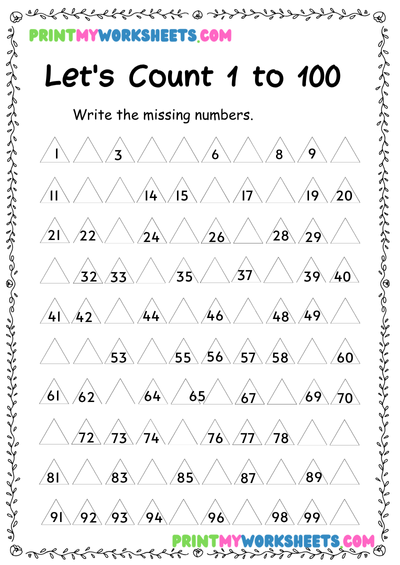
Counting forward and backward is a foundational skill in first grade mathematics. Students are expected to confidently count within 120, starting at any given number, and understand how numbers increase and decrease in sequence. These worksheets provide guided practice that helps children recognize number patterns, fill in missing numbers, and strengthen their understanding of place value. By reinforcing counting skills early, students develop confidence and accuracy, which supports addition, subtraction, and more advanced math concepts in later grades.
What Students Will Learn?
These first grade counting worksheets focus on strengthening number sequencing skills in a clear and age-appropriate way. Students practice counting forward from various starting points and counting backward to build flexibility with numbers.
Through engaging exercises, children will learn how to:
Count forward within 120 starting from any number
Count backward from a given number
Identify missing numbers in a sequence
Understand patterns in number lines
Strengthen place value awareness
Activities include filling in number charts, completing counting sequences, and solving simple number puzzles. Students may count by ones to find the next number or determine which number comes before a given value. These exercises reinforce logical thinking and pattern recognition.
The worksheets are designed to meet first grade math standards in the United States. The structured format ensures that students progress gradually from basic counting tasks to more challenging number sequences. Repeated exposure helps children gain fluency and accuracy while building a deeper understanding of how numbers relate to one another.
Educational Value & Skill Development
The 1st Grade Counting Forward and Backward Worksheets PDF supports both academic growth and cognitive development. Counting is more than reciting numbers in order—it requires understanding number relationships and patterns.
Academically, counting forward and backward lays the groundwork for addition and subtraction. When students count forward, they are preparing to add. When they count backward, they are practicing the thinking process required for subtraction. These skills are directly connected to first grade math expectations and future grade-level standards.
Cognitively, counting sequences strengthen memory, concentration, and logical reasoning. Students must pay attention to patterns and determine what number comes next or before. This process supports critical thinking and problem-solving skills.
Confidence increases as children become more fluent with number sequences. Mastering counting within 120 helps students feel capable when tackling more complex math tasks. As they complete each page successfully, they develop independence and a stronger sense of mathematical understanding.
Why Focus on Counting Forward and Backward?
Counting forward and backward is a critical building block in early elementary math. In first grade, students move beyond counting from one and begin counting from any number. This shift requires deeper number understanding.
When children practice counting forward, they learn how numbers increase in predictable patterns. When they count backward, they understand how numbers decrease and how subtraction works conceptually. These skills connect directly to addition, subtraction, and place value lessons later in the year.
Consistent practice helps children recognize patterns within number sequences. This strengthens mental math abilities and prepares students for skip counting and multiplication in future grades. Repetition and guided instruction are essential at this stage because students are developing fluency and accuracy.
By mastering counting skills early, students build a strong mathematical foundation that supports long-term academic success.
How to Use These Worksheets?
The 1st Grade Counting Forward and Backward Worksheets PDF can be used in a variety of learning settings. In classrooms, teachers can incorporate these worksheets into math centers, small group instruction, or independent practice time. They also work well as quick review pages at the beginning or end of a lesson.
Homeschool families can include the worksheets as part of a daily math routine. Start by reviewing number sequences verbally, then allow your child to complete a worksheet independently. Encourage students to use number lines or hundred charts as needed.
Because this resource is a free printable PDF, it is easy to download and print for repeated use. Parents and teachers may print multiple copies for extra practice or laminate pages for reusable learning with dry-erase markers. The clear layout helps students focus on number patterns without distractions, making practice efficient and productive.
Related Worksheets / Extensions:
You may also like:
First grade addition and subtraction worksheets
Number bonds practice pages
Place value worksheets for first grade
Skip counting activities
Second grade number sequencing worksheets
The 1st Grade Counting Forward and Backward Worksheets PDF pairs well with other early math resources that focus on number sense and foundational skills. Combining counting practice with addition and place value activities helps students see how mathematical concepts connect. With consistent practice and review, children strengthen their understanding of number relationships and develop the confidence needed to succeed in higher-level math.
Frequently Asked Questions
Q1. Is this worksheet free to download?Yes, this worksheet is 100% free to download and print. No account, subscription, or payment is required. Click the Download Now button to get your free PDF instantly.Q2. What format is this worksheet available in?This worksheet is available as a printable PDF file. It is black-and-white, printer-friendly, and works on any standard home or classroom printer using A4 or US Letter paper.Q3. Can I use this worksheet for both classroom and home learning?Yes, these worksheets are designed for use by classroom teachers, homeschool parents, and tutors. They can be used as morning work, homework, revision practice, or learning centre activities.Q4. Is this worksheet suitable for extra practice or exam preparation?Yes, this worksheet is ideal for supplemental practice, homework reinforcement, test preparation, and homeschool math lessons.Q5. Does this math worksheet include an answer key?Yes, an answer key is included in the PDF so parents and teachers can quickly check student responses without manual calculation.1st Grade Counting Forward and Backward Worksheets PDF
1st Grade Counting Forward and Backward Worksheets PDF
The 1st Grade Counting Forward and Backward Worksheets PDF is designed to help young learners build strong number sense through structured counting practice. This free printable PDF is ideal for U.S. parents, teachers, and homeschool families who want clear, standards-aligned math activities that support first grade learning goals.
Counting forward and backward is a foundational skill in first grade mathematics. Students are expected to confidently count within 120, starting at any given number, and understand how numbers increase and decrease in sequence. These worksheets provide guided practice that helps children recognize number patterns, fill in missing numbers, and strengthen their understanding of place value. By reinforcing counting skills early, students develop confidence and accuracy, which supports addition, subtraction, and more advanced math concepts in later grades.
What Students Will Learn?
These first grade counting worksheets focus on strengthening number sequencing skills in a clear and age-appropriate way. Students practice counting forward from various starting points and counting backward to build flexibility with numbers.
Through engaging exercises, children will learn how to:
Count forward within 120 starting from any number
Count backward from a given number
Identify missing numbers in a sequence
Understand patterns in number lines
Strengthen place value awareness
Activities include filling in number charts, completing counting sequences, and solving simple number puzzles. Students may count by ones to find the next number or determine which number comes before a given value. These exercises reinforce logical thinking and pattern recognition.
The worksheets are designed to meet first grade math standards in the United States. The structured format ensures that students progress gradually from basic counting tasks to more challenging number sequences. Repeated exposure helps children gain fluency and accuracy while building a deeper understanding of how numbers relate to one another.
Educational Value & Skill Development
The 1st Grade Counting Forward and Backward Worksheets PDF supports both academic growth and cognitive development. Counting is more than reciting numbers in order—it requires understanding number relationships and patterns.
Academically, counting forward and backward lays the groundwork for addition and subtraction. When students count forward, they are preparing to add. When they count backward, they are practicing the thinking process required for subtraction. These skills are directly connected to first grade math expectations and future grade-level standards.
Cognitively, counting sequences strengthen memory, concentration, and logical reasoning. Students must pay attention to patterns and determine what number comes next or before. This process supports critical thinking and problem-solving skills.
Confidence increases as children become more fluent with number sequences. Mastering counting within 120 helps students feel capable when tackling more complex math tasks. As they complete each page successfully, they develop independence and a stronger sense of mathematical understanding.
Why Focus on Counting Forward and Backward?
Counting forward and backward is a critical building block in early elementary math. In first grade, students move beyond counting from one and begin counting from any number. This shift requires deeper number understanding.
When children practice counting forward, they learn how numbers increase in predictable patterns. When they count backward, they understand how numbers decrease and how subtraction works conceptually. These skills connect directly to addition, subtraction, and place value lessons later in the year.
Consistent practice helps children recognize patterns within number sequences. This strengthens mental math abilities and prepares students for skip counting and multiplication in future grades. Repetition and guided instruction are essential at this stage because students are developing fluency and accuracy.
By mastering counting skills early, students build a strong mathematical foundation that supports long-term academic success.
How to Use These Worksheets?
The 1st Grade Counting Forward and Backward Worksheets PDF can be used in a variety of learning settings. In classrooms, teachers can incorporate these worksheets into math centers, small group instruction, or independent practice time. They also work well as quick review pages at the beginning or end of a lesson.
Homeschool families can include the worksheets as part of a daily math routine. Start by reviewing number sequences verbally, then allow your child to complete a worksheet independently. Encourage students to use number lines or hundred charts as needed.
Because this resource is a free printable PDF, it is easy to download and print for repeated use. Parents and teachers may print multiple copies for extra practice or laminate pages for reusable learning with dry-erase markers. The clear layout helps students focus on number patterns without distractions, making practice efficient and productive.
Related Worksheets / Extensions:
You may also like:
First grade addition and subtraction worksheets
Number bonds practice pages
Place value worksheets for first grade
Skip counting activities
Second grade number sequencing worksheets
The 1st Grade Counting Forward and Backward Worksheets PDF pairs well with other early math resources that focus on number sense and foundational skills. Combining counting practice with addition and place value activities helps students see how mathematical concepts connect. With consistent practice and review, children strengthen their understanding of number relationships and develop the confidence needed to succeed in higher-level math.