1st Grade Length, Weight and Height Worksheets PDF | Free Math Downloadable
Make learning measurements fun with our 1st Grade Length, Weight and Height Worksheets PDF for first graders! Kids explore comparing, estimating, and measuring everyday objects. Perfect for homeschool and classroom use, these printables boost understanding of real-world math through interactive, hands-on learning. Download and start exploring today! It is completely aligned with U.S Curriculum.
What’s Included in This PDF?
This printable measurement resource includes:
-
Multiple first grade measurement worksheets
-
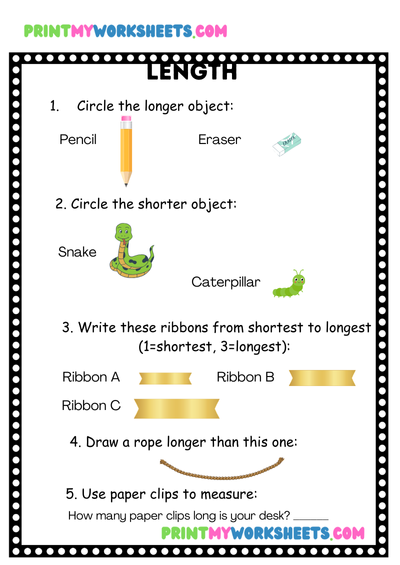
Length comparison activities
-
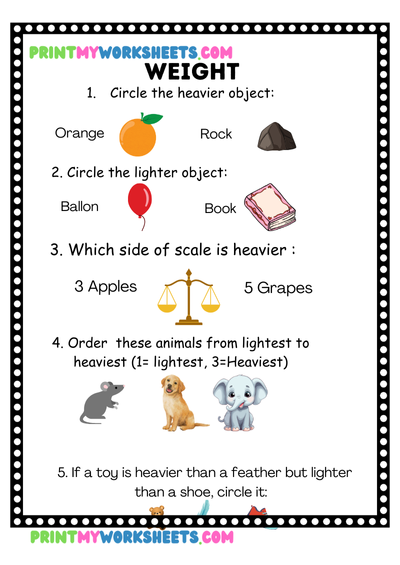
Weight comparison exercises
-
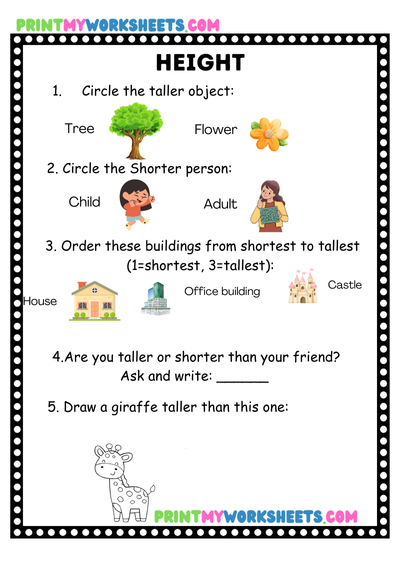
Height ordering and matching tasks
-
Nonstandard unit measuring practice
-
Clear and easy-to-follow directions
-
Large, student-friendly layout
-
Black-and-white, print-friendly design
-
Alignment with U.S. first grade math standards
-
Free downloadable PDF format for convenient use
Each worksheet is designed to support clear understanding and consistent skill development.
Click below to access the 1st Grade Length, Weight and Height Worksheets PDF
1st Grade Length, Weight and Height Worksheets PDF
The 1st Grade Length, Weight and Height Worksheets PDF is designed to help young learners explore measurement concepts in a clear and age-appropriate way. This free printable PDF is ideal for U.S. parents, teachers, and homeschool families who want structured math practice aligned with first grade standards.
In first grade, students begin comparing and measuring objects using nonstandard and standard units. They learn to describe length, weight, and height using words such as longer, shorter, heavier, lighter, taller, and shorter. Developing these skills strengthens number sense and real-world math understanding. Measurement activities help children connect math to everyday life, whether they are comparing the height of classmates or weighing classroom objects. With guided practice and simple visual exercises, students gain confidence while building foundational skills that prepare them for more advanced measurement topics in later grades.
What Students Will Learn?
These first grade measurement worksheets focus on helping students understand how to compare and measure length, weight, and height using simple tools and visual models. Children practice identifying which object is longer or shorter, heavier or lighter, taller or shorter.
Students will learn how to:
-
Compare two objects using measurement vocabulary
-
Order objects from shortest to tallest
-
Identify heavier and lighter items
-
Use nonstandard units such as cubes or paper clips to measure length
-
Record measurements using numbers and simple charts
The activities move from visual comparisons to hands-on measuring practice. For example, students may circle the taller object, measure a line using cubes, or compare the weight of illustrated objects. These exercises help children understand that measurement is about comparing quantities in meaningful ways.
The worksheets align with U.S. first grade math standards, which emphasize understanding and describing measurable attributes. Through repeated practice, students become comfortable using correct measurement language and interpreting simple data related to size and weight.
Educational Value & Skill Development?
The 1st Grade Length, Weight and Height Worksheets PDF supports academic growth while strengthening critical thinking skills. Measurement activities encourage students to observe carefully, compare logically, and explain their reasoning.
Academically, first grade measurement is an essential step before learning to use rulers and scales in later grades. Understanding how to compare objects and describe measurable attributes prepares students for second grade topics such as standard units and more precise measurements.
Cognitively, comparing and measuring objects builds problem-solving skills. Students must analyze differences and make decisions based on observation. This supports logical reasoning and attention to detail. When children measure using nonstandard units, they also practice counting and addition skills, integrating multiple math concepts into one activity.
Confidence develops as students master measurement vocabulary and complete activities independently. Clear instructions and structured practice reduce confusion and support independent learning. Over time, students become more accurate in their comparisons and more confident in discussing mathematical ideas related to size and weight.
Why Focus on Length, Weight and Height?
Measurement is a practical math skill that students use daily, even outside the classroom. Understanding how to compare length, weight, and height helps children make sense of the world around them. They begin to notice which objects are taller, which items are heavier, and how sizes differ.
In first grade, students are expected to describe measurable attributes and compare objects directly. These early experiences build a foundation for future learning about inches, feet, pounds, and other standard units. Without a strong understanding of comparison and basic measurement concepts, later math lessons can feel abstract and difficult.
Repetition and guided practice help children internalize measurement vocabulary and concepts. By exploring these ideas in a structured worksheet format, students gain familiarity and build readiness for more advanced math topics in second and third grade.
How to Use These Worksheets?
The 1st Grade Length, Weight and Height Worksheets PDF can be used in multiple learning environments. In classrooms, teachers may include these worksheets during math centers, small group instruction, or independent practice time. They also work well as quick review activities at the start of a lesson.
Homeschool families can use the worksheets as part of a daily math routine. Begin by discussing real-life examples of length, weight, and height around the home. Then guide your child through the first few questions before encouraging independent work.
Because this resource is a free printable PDF, it can be downloaded and printed as needed. Teachers and parents can revisit the worksheets throughout the year for review and reinforcement. For repeated practice, pages can be placed in sheet protectors so students can use dry-erase markers.
The simple and print-friendly format keeps students focused on measurement tasks without unnecessary distractions.
Related Worksheets / Extensions: