
Pre-K Odd One Out Worksheets PDF | Free English Downloadable
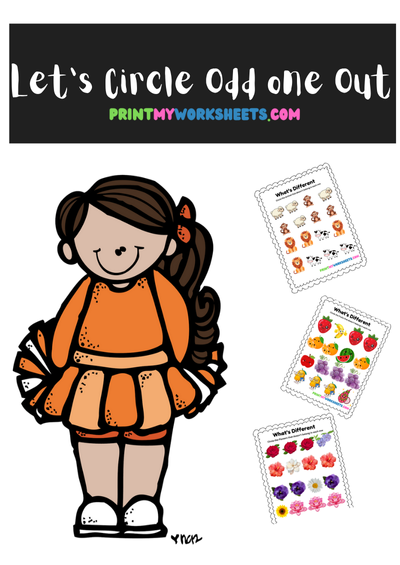
Looking for a fun and educational activity to boost your preschooler’s thinking and observation skills? Our Pre-K Odd One Out Worksheets PDF designed specifically for Pre-Kindergarten children in the United States. This early learning activity is perfect for homeschool parents, preschool teachers, caregivers, and anyone looking to support a child’s cognitive, language, and logic development.
📥 Download your FREE Circle the Odd One Out Worksheet PDF now and support your child’s early logic, language, and thinking skills—one fun puzzle at a time! It is completely aligned with U.S Curriculum.
Click below to access the Pre-K Odd One Out Worksheets PDF
Pre-K Odd One Out Worksheets PDF
The Pre-K Odd One Out Worksheets PDF is a simple and engaging learning resource designed to help preschool children strengthen observation and thinking skills through fun visual activities. This free printable PDF is ideal for U.S. parents, preschool teachers, and homeschool families who want to support early cognitive development in an interactive way.
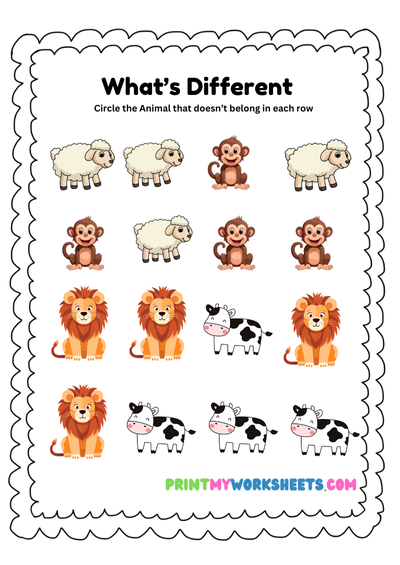
At the Pre-K level, children begin learning how to recognize patterns, compare objects, and identify differences between images. Odd-one-out activities encourage children to look carefully at a group of pictures and determine which item does not belong. This type of activity helps young learners practice logical thinking, attention to detail, and early problem-solving skills.
The Pre-K Odd One Out Worksheets PDF provides colorful and easy-to-understand picture-based tasks that are suitable for preschool students. Through repeated practice, children become more confident in identifying patterns and differences. These worksheets combine learning with play, making them a valuable addition to preschool classrooms, homeschool lessons, and early learning centers.
What Students Will Learn?
Odd-one-out worksheets are designed to help preschool learners develop important observation and reasoning skills through simple picture-based activities. These exercises encourage children to examine objects closely and determine which item in a group is different from the others.
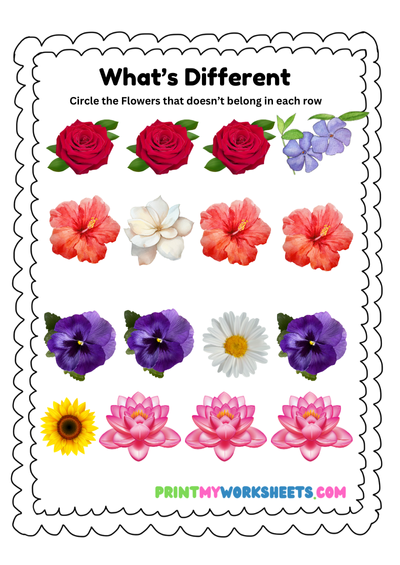
Students will practice visual comparison skills by looking at groups of images and identifying the picture that does not match. This process helps strengthen attention to detail and teaches children how to notice small differences in shapes, colors, or objects.
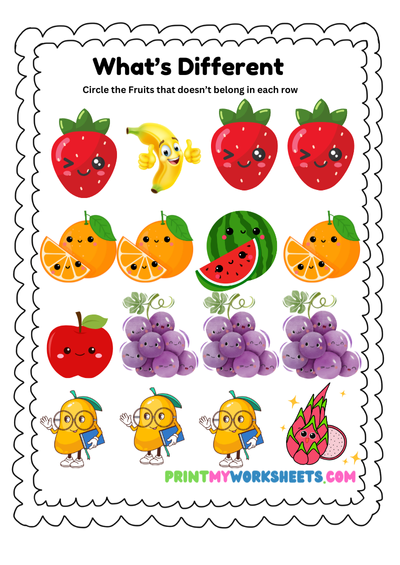
The activities also support early categorization skills. Preschool learners begin understanding that objects can belong to specific groups based on shared characteristics. For example, a group may contain three fruits and one animal, and children must recognize which picture does not belong.
Many worksheets include familiar items such as animals, fruits, vehicles, shapes, and everyday objects. These relatable visuals help children connect the activity to real-life experiences.
Through consistent practice, children gradually improve their ability to focus, analyze images, and make logical decisions. These skills are important foundations for later academic subjects such as math, reading, and science, where recognizing patterns and differences plays a significant role.
Educational Value & Skill Development
The Pre-K Odd One Out Worksheets PDF supports several key areas of early childhood development. Although the activity appears simple, it encourages children to practice critical thinking and strengthens important cognitive skills.
One of the most valuable benefits is the development of visual discrimination. Children learn to identify differences between images by examining details carefully. This skill later becomes important when learning letters, numbers, and words in reading and writing activities.
The worksheets also encourage logical reasoning. When children identify which item does not belong, they are practicing early forms of problem-solving. They must think about how objects are related and determine which one is different.
Another important benefit is improved concentration. Preschool learners practice focusing on the task and analyzing images before making a choice. This helps strengthen attention span and encourages persistence when solving problems.
Using the Pre-K Odd One Out Worksheets PDF also helps build confidence. As children successfully identify the correct answers, they develop a sense of accomplishment and become more motivated to complete similar activities.
By combining visual learning with problem-solving, these worksheets provide a strong foundation for early academic development and prepare children for more advanced learning tasks.
Why Focus on Odd One Out?
Odd-one-out activities are widely used in early childhood education because they help children develop essential thinking skills in a simple and enjoyable format. Preschool learners are naturally curious, and visual puzzles capture their attention while encouraging exploration.
These activities promote early analytical thinking. Children must compare objects and determine which one is different. This process strengthens reasoning skills and encourages children to think carefully about the relationships between items.
Odd-one-out exercises also help children recognize patterns and categories. Learning how objects can be grouped based on shared features supports early math concepts and classification skills.
Repetition plays an important role in skill development. Each worksheet provides additional opportunities for children to practice observation and logical thinking. As they complete more activities, their confidence and accuracy improve.
These early reasoning exercises are closely connected to foundational learning standards used in U.S. preschool education. Developing observation and comparison skills at a young age prepares students for future lessons involving numbers, letters, patterns, and scientific thinking.
How to Use These Worksheets?
The Pre-K Odd One Out Worksheets PDF can be used in a variety of learning environments, making it a flexible resource for teachers and parents.
In preschool classrooms, teachers can include the worksheets as part of a learning center or small-group activity. Students may work independently or discuss their answers with classmates. Teachers can guide children by asking questions such as “Which picture is different?” or “Why does this one not belong?”
Parents can also use these worksheets at home as part of a daily learning routine. Homeschool families may incorporate them into visual thinking or early math practice sessions.
Because the worksheets are available as a free printable PDF, they can be downloaded and printed quickly. This makes them convenient for classroom use, homeschool activities, or additional practice.
These worksheets are also useful for independent learning time. The picture-based format is easy for preschool learners to understand without complicated instructions. Whether used for practice, review, or fun learning activities, the worksheets provide meaningful opportunities for skill development.
Related Worksheets / Extensions:
Frequently Asked Questions
Q1. Is this worksheet free to download?
Yes, this worksheet is 100% free to download and print. No account, subscription, or payment is required. Click the Download Now button to get your free PDF instantly.
Q2. What format is this worksheet available in?
This worksheet is available as a printable PDF file. It is black-and-white, printer-friendly, and works on any standard home or classroom printer using A4 or US Letter paper.
Q3. Can I use this worksheet for both classroom and home learning?
Yes, these worksheets are designed for use by classroom teachers, homeschool parents, and tutors. They can be used as morning work, homework, revision practice, or learning centre activities.
Q4. How long does it take to complete this math worksheet?
Most students complete this worksheet in 10 to 20 minutes depending on grade level and familiarity with the topic.
Q5. Does this math worksheet include an answer key?
Yes, an answer key is included in the PDF so parents and teachers can quickly check student responses without manual calculation.