
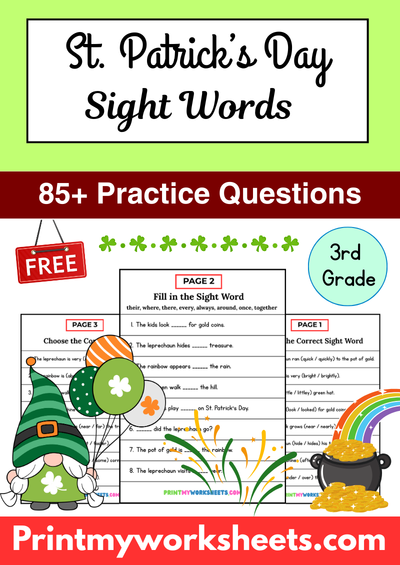


3rd Grade St Patricks Day Sight Words Worksheets PDF
$0.00
Our 3rd Grade St Patricks Day Sight Words Worksheets PDF help students strengthen word recognition, vocabulary, and reading fluency. These free printable PDFs support U.S. curriculum-aligned literacy instruction while providing engaging seasonal activities that build confidence and comprehension. This is completely aligned with U.S Curriculum.
Click below to access the free 3rd Grade St Patricks Day Sight Words Worksheets PDF
Continue Learning
Explore more worksheets to build your child’s English skills.

3rd Grade St Patricks Day Sight Words Worksheets PDF
The 3rd Grade St Patricks Day Sight Words Worksheets PDF provides an engaging way for students to strengthen reading fluency while celebrating a seasonal classroom theme. This free printable PDF is designed for U.S. parents, teachers, and homeschool families who want to support literacy development through fun and structured learning activities.
Sight words are an essential part of reading instruction, especially as students progress through elementary school. By third grade, children are expected to recognize a wide range of high-frequency words quickly and accurately. Practicing these words regularly helps students read more smoothly and focus on understanding the meaning of what they read.
The 3rd Grade St Patricks Day Sight Words Worksheets PDF combines essential reading practice with a festive theme inspired by St. Patrick’s Day. Students work through engaging activities that help reinforce sight word recognition while keeping learning enjoyable. These worksheets encourage reading confidence, vocabulary development, and sentence understanding while providing an interactive approach to literacy practice during seasonal classroom activities.
What Students Will Learn?
Sight word practice at the third-grade level focuses on improving reading speed, word recognition, and comprehension. These worksheets help students strengthen their ability to recognize commonly used words automatically while developing deeper reading skills.
Students will practice identifying high-frequency words that appear regularly in grade-level reading materials. Recognizing these words quickly allows students to focus more on understanding stories, informational text, and classroom reading assignments.
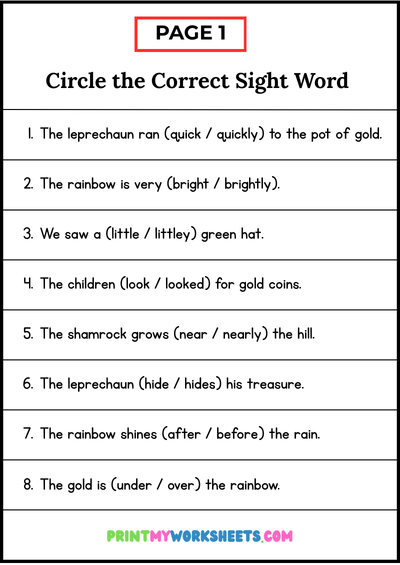
Many activities encourage students to read words within sentences rather than in isolation. This helps children understand how words function in context and supports overall comprehension.
The worksheets may also include matching exercises, fill-in-the-blank sentences, word searches, and short reading tasks. These activities allow students to engage with sight words in multiple ways, reinforcing recognition through repetition and varied practice.
Because the worksheets include a seasonal St. Patrick’s Day theme, they also encourage engagement and motivation. The combination of themed learning and literacy practice helps students remain interested while strengthening reading skills.
Through consistent practice with structured activities, students improve reading fluency and become more confident readers.
Educational Value & Skill Development
The 3rd Grade St Patricks Day Sight Words Worksheets PDF supports several important areas of literacy development. One of the primary benefits is improved reading fluency. When students recognize high-frequency words instantly, they can read more smoothly and focus on understanding the meaning of the text.
Sight word mastery also strengthens overall reading comprehension. Instead of stopping to decode every word, students can move through sentences more easily and concentrate on the message of the passage.
Another important benefit is vocabulary growth. As children practice reading and using common words in sentences, they develop a stronger understanding of how language works in everyday communication.
The worksheets also promote independent learning. Many activities encourage students to work through exercises on their own, which helps build confidence and responsibility in their academic work.
The 3rd Grade St Patricks Day Sight Words Worksheets PDF also supports cognitive development by encouraging pattern recognition, attention to detail, and language processing skills. Students must read carefully, identify correct words, and understand how words fit within a sentence structure.
Seasonal learning activities can also make literacy practice more engaging. The St. Patrick’s Day theme provides a creative context for practicing reading skills while maintaining a focus on academic growth.
Why Focus on St Patricks Day Sight Words?
Sight words play a key role in reading fluency because they appear frequently in everyday text. By the time students reach third grade, they are expected to recognize many of these words automatically.
Practicing sight words regularly helps students read more efficiently. When children no longer need to pause to decode common words, they can concentrate on understanding longer sentences and more complex passages.
Themed activities, such as those related to St. Patrick’s Day, can make reading practice more engaging. Seasonal worksheets encourage participation and help maintain student interest during literacy instruction.
Integrating themed content into reading activities also allows teachers to connect academic learning with classroom celebrations and seasonal lessons. This helps create a more dynamic learning environment while still reinforcing essential reading skills.
Sight word practice also supports writing development. As students become familiar with frequently used words, they can use them more confidently when writing their own sentences and stories.
Consistent exposure to high-frequency words prepares students for more advanced reading materials in later grades. Strong sight word recognition is an important foundation for lifelong reading success.
Related Worksheets / Extensions:
You may also like:
• 3rd grade sight word worksheets
• St. Patrick’s Day reading comprehension activities
• Seasonal vocabulary worksheets for elementary students
• Reading fluency worksheets for grades 2–4
• Word recognition and vocabulary practice activities
The 3rd Grade St Patricks Day Sight Words Worksheets PDF works well alongside other literacy resources that focus on vocabulary development and reading comprehension. Combining sight word practice with sentence reading and short passages helps students develop stronger reading skills.
Teachers and parents may also extend learning by encouraging students to write their own sentences using the sight words they practice. Creative writing activities help reinforce vocabulary while allowing students to apply their reading skills in meaningful ways.
With regular practice and engaging activities, third-grade students can continue building the reading fluency and language skills needed for more advanced academic learning.
You may also like:

Frequently Asked Questions
Q1. What format is this worksheet available in?
This worksheet is available as a printable PDF file. It is black-and-white, printer-friendly, and works on any standard home or classroom printer using A4 or US Letter paper.
Q2. Do I need to create an account to download this worksheet?
No account or sign-up is required. All worksheets on Print My Worksheets are freely accessible to teachers, parents, and homeschool families without any registration.
Q3. Can I use this worksheet for both classroom and home learning?
Yes, these worksheets are designed for use by classroom teachers, homeschool parents, and tutors. They can be used as morning work, homework, revision practice, or learning centre activities.
Q4. Can this worksheet be used for phonics instruction?
Yes, this worksheet supports phonics-based reading instruction and is suitable for early readers building letter-sound recognition skills.
Q5. Is this worksheet suitable for ESL or ELL students?
This worksheet can be used as a supplemental resource for ESL and ELL students, particularly for vocabulary building and language pattern practice.
You may also like…
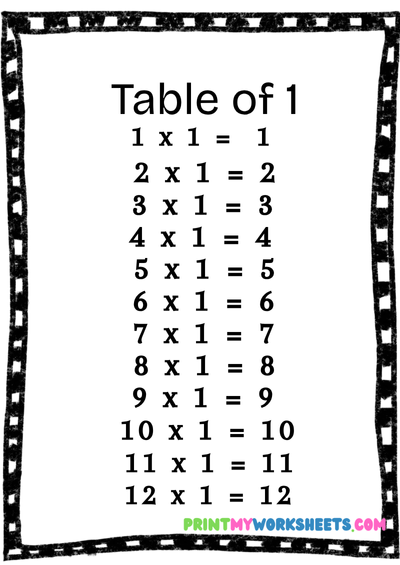
3rd Grade Multiplication Tables 1–3 Worksheet | Free PDF Download for Kids
3rd Grade Multiplication Tables 1–3 Worksheet
The 3rd Grade Multiplication Tables 1–3 Worksheet is designed to help students build a strong foundation in early multiplication skills. This free printable PDF is ideal for U.S. parents, teachers, and homeschool families who want structured, grade-level practice that aligns with elementary math standards.
In 3rd grade, students transition from repeated addition to understanding multiplication as equal groups and arrays. Mastering multiplication tables 1 through 3 is a key milestone that supports more advanced multiplication facts later in the year. This worksheet provides focused practice that helps children develop speed, accuracy, and confidence with basic multiplication facts. Through clear instructions and engaging exercises, students strengthen their understanding of number patterns and relationships while reinforcing essential math skills that are critical for long-term success.
What Students Will Learn?
With this multiplication resource, students focus on mastering the 1, 2, and 3 times tables through structured and progressive activities. They practice recognizing multiplication patterns, solving basic fact problems, and understanding multiplication as repeated addition.
Activities may include fill-in-the-blank equations, matching problems, number line multiplication, and simple word problems involving equal groups. Students also practice writing multiplication sentences based on visual models such as arrays or groups of objects. These exercises help connect conceptual understanding with memorization of facts.
The worksheet supports structured learning by starting with straightforward multiplication problems and gradually increasing difficulty. Students move from guided examples to independent practice, reinforcing both conceptual and procedural knowledge. This approach aligns with 3rd grade math expectations in the United States, where fluency with basic multiplication facts is a core objective.
By focusing on smaller sets of multiplication tables, students can build accuracy and confidence before progressing to higher-number facts.
Educational Value & Skill Development
The 3rd Grade Multiplication Tables 1–3 Worksheet provides meaningful academic benefits beyond simple fact memorization. Understanding early multiplication tables strengthens number sense and prepares students for more complex mathematical operations such as multi-digit multiplication and division.
Academically, students develop fluency with foundational multiplication facts. Fluency means they can solve problems accurately and efficiently without relying solely on counting strategies. This skill becomes increasingly important as math problems grow more complex in later grades.
Cognitively, practicing multiplication facts improves memory, concentration, and pattern recognition. Students begin to notice relationships between numbers, such as skip counting and repeated addition patterns. These observations strengthen logical reasoning skills.
As students gain confidence in solving multiplication problems independently, they become more comfortable tackling new mathematical challenges. Regular practice supports long-term retention and reduces frustration when students encounter more advanced multiplication and division concepts in upper elementary grades.
Why Focus on Multiplication Tables 1–3?
Early mastery of basic multiplication tables sets the stage for success in elementary mathematics. The 1, 2, and 3 times tables are often the first multiplication facts introduced in 3rd grade, making them essential building blocks for future learning.
When students fully understand these foundational facts, they are better prepared to learn higher multiplication tables with confidence. Strong fluency also supports division skills, as division is directly connected to multiplication. Without a solid understanding of these early facts, students may struggle with multi-step word problems, fractions, and later algebraic reasoning.
Repetition and guided practice are critical at this stage. Children benefit from repeated exposure to multiplication patterns through structured exercises. Consistent practice helps move knowledge from short-term memory to long-term understanding.
Building confidence with early multiplication tables helps students approach math with a positive attitude and readiness for more advanced topics.
How to Use These Worksheets?
The 3rd Grade Multiplication Tables 1–3 Worksheet can be used in a variety of instructional settings. In classrooms, teachers may assign it as guided practice after introducing multiplication concepts. It works well for small group instruction, math centers, homework assignments, or review sessions.
Homeschool families can incorporate the worksheet into daily or weekly math lessons. Parents may review skip counting and repeated addition before allowing students to complete the practice problems independently. Afterward, reviewing answers together reinforces understanding and corrects misconceptions.
Because this resource is provided as a free printable PDF, it is easy to download and print as needed. Teachers can provide additional copies for reinforcement or assessment preparation. The reusable format makes it convenient for ongoing practice throughout the school year.
The clear layout and focused content make it suitable for both structured lessons and independent practice time.
Related Worksheets / Extensions:
You may also like:
3rd grade multiplication tables 4–6 worksheets
Multiplication and division fact families practice
Array and equal groups visual models worksheets
Multi-digit multiplication introduction worksheets
The 3rd Grade Multiplication Tables 1–3 Worksheet pairs well with additional fact fluency resources and word problem practice. Expanding practice to higher multiplication tables and related division concepts helps students develop a complete understanding of multiplication relationships. By building on these foundational skills, learners strengthen their overall math fluency and prepare for more advanced problem-solving in upper elementary grades.
Frequently Asked Questions
Q1. Is this worksheet free to download?Yes, this worksheet is 100% free to download and print. No account, subscription, or payment is required. Click the Download Now button to get your free PDF instantly.Q2. What format is this worksheet available in?This worksheet is available as a printable PDF file. It is black-and-white, printer-friendly, and works on any standard home or classroom printer using A4 or US Letter paper.Q3. Can I use this worksheet for both classroom and home learning?Yes, these worksheets are designed for use by classroom teachers, homeschool parents, and tutors. They can be used as morning work, homework, revision practice, or learning centre activities.Q4. Is this worksheet suitable for extra practice or exam preparation?Yes, this worksheet is ideal for supplemental practice, homework reinforcement, test preparation, and homeschool math lessons.Q5. Does this math worksheet include an answer key?Yes, an answer key is included in the PDF so parents and teachers can quickly check student responses without manual calculation.3rd Grade Multiplication Tables 1–3 Worksheet | Free PDF Download for Kids
3rd Grade Multiplication Tables 1–3 Worksheet
The 3rd Grade Multiplication Tables 1–3 Worksheet is designed to help students build a strong foundation in early multiplication skills. This free printable PDF is ideal for U.S. parents, teachers, and homeschool families who want structured, grade-level practice that aligns with elementary math standards.
In 3rd grade, students transition from repeated addition to understanding multiplication as equal groups and arrays. Mastering multiplication tables 1 through 3 is a key milestone that supports more advanced multiplication facts later in the year. This worksheet provides focused practice that helps children develop speed, accuracy, and confidence with basic multiplication facts. Through clear instructions and engaging exercises, students strengthen their understanding of number patterns and relationships while reinforcing essential math skills that are critical for long-term success.
What Students Will Learn?
With this multiplication resource, students focus on mastering the 1, 2, and 3 times tables through structured and progressive activities. They practice recognizing multiplication patterns, solving basic fact problems, and understanding multiplication as repeated addition.
Activities may include fill-in-the-blank equations, matching problems, number line multiplication, and simple word problems involving equal groups. Students also practice writing multiplication sentences based on visual models such as arrays or groups of objects. These exercises help connect conceptual understanding with memorization of facts.
The worksheet supports structured learning by starting with straightforward multiplication problems and gradually increasing difficulty. Students move from guided examples to independent practice, reinforcing both conceptual and procedural knowledge. This approach aligns with 3rd grade math expectations in the United States, where fluency with basic multiplication facts is a core objective.
By focusing on smaller sets of multiplication tables, students can build accuracy and confidence before progressing to higher-number facts.
Educational Value & Skill Development
The 3rd Grade Multiplication Tables 1–3 Worksheet provides meaningful academic benefits beyond simple fact memorization. Understanding early multiplication tables strengthens number sense and prepares students for more complex mathematical operations such as multi-digit multiplication and division.
Academically, students develop fluency with foundational multiplication facts. Fluency means they can solve problems accurately and efficiently without relying solely on counting strategies. This skill becomes increasingly important as math problems grow more complex in later grades.
Cognitively, practicing multiplication facts improves memory, concentration, and pattern recognition. Students begin to notice relationships between numbers, such as skip counting and repeated addition patterns. These observations strengthen logical reasoning skills.
As students gain confidence in solving multiplication problems independently, they become more comfortable tackling new mathematical challenges. Regular practice supports long-term retention and reduces frustration when students encounter more advanced multiplication and division concepts in upper elementary grades.
Why Focus on Multiplication Tables 1–3?
Early mastery of basic multiplication tables sets the stage for success in elementary mathematics. The 1, 2, and 3 times tables are often the first multiplication facts introduced in 3rd grade, making them essential building blocks for future learning.
When students fully understand these foundational facts, they are better prepared to learn higher multiplication tables with confidence. Strong fluency also supports division skills, as division is directly connected to multiplication. Without a solid understanding of these early facts, students may struggle with multi-step word problems, fractions, and later algebraic reasoning.
Repetition and guided practice are critical at this stage. Children benefit from repeated exposure to multiplication patterns through structured exercises. Consistent practice helps move knowledge from short-term memory to long-term understanding.
Building confidence with early multiplication tables helps students approach math with a positive attitude and readiness for more advanced topics.
How to Use These Worksheets?
The 3rd Grade Multiplication Tables 1–3 Worksheet can be used in a variety of instructional settings. In classrooms, teachers may assign it as guided practice after introducing multiplication concepts. It works well for small group instruction, math centers, homework assignments, or review sessions.
Homeschool families can incorporate the worksheet into daily or weekly math lessons. Parents may review skip counting and repeated addition before allowing students to complete the practice problems independently. Afterward, reviewing answers together reinforces understanding and corrects misconceptions.
Because this resource is provided as a free printable PDF, it is easy to download and print as needed. Teachers can provide additional copies for reinforcement or assessment preparation. The reusable format makes it convenient for ongoing practice throughout the school year.
The clear layout and focused content make it suitable for both structured lessons and independent practice time.
Related Worksheets / Extensions:
You may also like:
3rd grade multiplication tables 4–6 worksheets
Multiplication and division fact families practice
Array and equal groups visual models worksheets
Multi-digit multiplication introduction worksheets
The 3rd Grade Multiplication Tables 1–3 Worksheet pairs well with additional fact fluency resources and word problem practice. Expanding practice to higher multiplication tables and related division concepts helps students develop a complete understanding of multiplication relationships. By building on these foundational skills, learners strengthen their overall math fluency and prepare for more advanced problem-solving in upper elementary grades.
Frequently Asked Questions
Q1. Is this worksheet free to download?Yes, this worksheet is 100% free to download and print. No account, subscription, or payment is required. Click the Download Now button to get your free PDF instantly.Q2. What format is this worksheet available in?This worksheet is available as a printable PDF file. It is black-and-white, printer-friendly, and works on any standard home or classroom printer using A4 or US Letter paper.Q3. Can I use this worksheet for both classroom and home learning?Yes, these worksheets are designed for use by classroom teachers, homeschool parents, and tutors. They can be used as morning work, homework, revision practice, or learning centre activities.Q4. Is this worksheet suitable for extra practice or exam preparation?Yes, this worksheet is ideal for supplemental practice, homework reinforcement, test preparation, and homeschool math lessons.Q5. Does this math worksheet include an answer key?Yes, an answer key is included in the PDF so parents and teachers can quickly check student responses without manual calculation.
3rd Grade Long and Short Vowel Sounds Worksheet | Free Spelling & Phonics PDF Downloadable
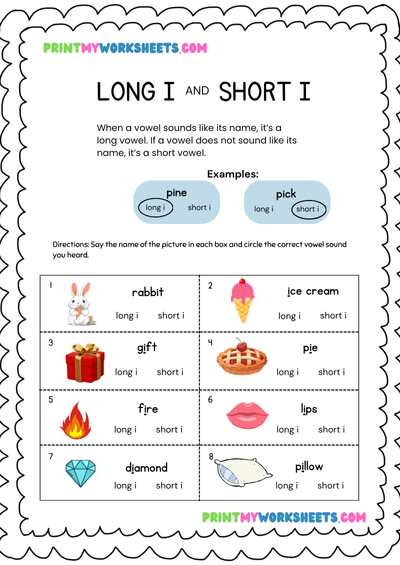
3rd Grade Long and Short Vowel Sounds Worksheet
The 3rd Grade Long and Short Vowel Sounds Worksheet is designed to help students strengthen their understanding of vowel patterns and pronunciation through focused, skill-based practice. This free printable PDF is ideal for U.S. parents, classroom teachers, and homeschool families who want structured phonics reinforcement at the third grade level.
By third grade, students are expected to read with greater fluency and accuracy. Mastering long and short vowel sounds plays a key role in improving decoding skills, spelling patterns, and overall reading comprehension. When students can confidently distinguish between vowel sounds, they are better prepared to tackle multisyllabic words and more complex texts. This worksheet supports foundational phonics skills while encouraging independent learning and meaningful literacy growth in both classroom and home settings.
What Students Will Learn?
This vowel-focused worksheet helps students clearly identify, compare, and apply long and short vowel sounds in different word contexts. Learners practice distinguishing between similar spellings that produce different sounds, such as short “a” in cat and long “a” in cake.
Activities may include sorting words by vowel sound, circling correct spellings, completing sentences with the appropriate word choice, and identifying vowel patterns such as silent “e,” vowel teams, and open syllables. Students also practice reading short passages and highlighting specific vowel sounds to reinforce recognition in connected text.
The structured format allows students to move from simple word identification to more applied tasks, such as writing their own examples or correcting incorrect vowel usage. These exercises align with U.S. third grade language arts standards, which emphasize decoding multisyllabic words and understanding common spelling-sound correspondences.
Through guided practice and repetition, students strengthen both their reading fluency and spelling accuracy while building confidence in phonics skills.
Educational Value & Skill Development
The 3rd Grade Long and Short Vowel Sounds Worksheet provides meaningful phonics practice that supports reading development in multiple ways. Academically, understanding vowel patterns improves word recognition and reading speed. When students can quickly identify vowel sounds, they spend less time decoding and more time focusing on comprehension.
This type of phonics work also strengthens spelling skills. Recognizing patterns such as silent “e” or vowel digraphs helps students make logical spelling choices rather than guessing. Over time, consistent practice leads to greater independence in both reading and writing tasks.
Cognitively, identifying vowel sounds requires attention to detail and pattern recognition. Students learn to analyze word structures, compare similar spellings, and apply rules in new situations. These skills support critical thinking and language processing.
Confidence plays a significant role in literacy development. As students successfully complete phonics exercises and notice improvement in their reading, they become more willing to tackle challenging texts. This worksheet offers structured repetition that encourages steady progress while maintaining engagement appropriate for third graders.
Why Focus on Long and Short Vowel Sounds?
Vowel sounds form the foundation of English word pronunciation. Even small differences in vowel sounds can completely change the meaning of a word. For example, confusing short and long vowels may lead to reading errors that affect comprehension.
In third grade, students move beyond basic phonics into more complex spelling patterns and longer words. A strong grasp of vowel distinctions helps them decode unfamiliar words with greater accuracy. It also supports fluency, as students no longer need to pause frequently to determine pronunciation.
Repetition and guided practice are essential for mastering vowel patterns. Regular review ensures that students retain the difference between common patterns such as CVC (consonant-vowel-consonant) words and silent “e” words. Continued exposure builds automaticity and prepares learners for advanced vocabulary and reading materials in later grades.
How to Use These Worksheets?
The 3rd Grade Long and Short Vowel Sounds Worksheet can be used in a variety of educational settings. In the classroom, teachers may incorporate the worksheet into literacy centers, small group instruction, or independent practice time. It works well as a review tool before spelling assessments or reading fluency checks.
For homeschool families, the worksheet can be part of a daily phonics routine. Parents can begin by reviewing vowel rules aloud, then allow the student to complete the page independently. Afterward, discussing answers together helps reinforce learning and clarify misunderstandings.
Because this resource is provided as a free printable PDF, it is easy to download and print as needed. Educators and parents can reuse the worksheet throughout the year for reinforcement. The clear, black-and-white layout keeps students focused on the task and minimizes distractions, making it suitable for both guided instruction and independent review.
Related Worksheets / Extensions:
You may also like:
Short vowel review worksheets for earlier grades
Long vowel teams and diphthongs practice
Multisyllabic word decoding worksheets
3rd grade spelling pattern activities
Reading comprehension worksheets with phonics integration
The 3rd Grade Long and Short Vowel Sounds Worksheet pairs well with broader phonics and spelling units to create a complete literacy practice plan. Rotating vowel-focused activities throughout the school year ensures steady improvement in reading accuracy and fluency. Continued reinforcement of vowel distinctions helps students approach more advanced texts with confidence and clarity as they progress through elementary school.
You may also like :
[gallery ids="5961,5939,5570"]Frequently Asked Questions
Q1. Is this worksheet free to download?Yes, this worksheet is 100% free to download and print. No account, subscription, or payment is required. Click the Download Now button to get your free PDF instantly.Q2. What format is this worksheet available in?This worksheet is available as a printable PDF file. It is black-and-white, printer-friendly, and works on any standard home or classroom printer using A4 or US Letter paper.Q3. Do I need to create an account to download this worksheet?No account or sign-up is required. All worksheets on Print My Worksheets are freely accessible to teachers, parents, and homeschool families without any registration.Q4. Are these worksheets aligned with curriculum standards?Yes, all worksheets on Print My Worksheets are aligned with U.S. Common Core and ELA standards, making them suitable for classroom use, homeschooling, and supplemental learning from Pre-KG through Grade 8.Q5. Can I use this worksheet for both classroom and home learning?Yes, these worksheets are designed for use by classroom teachers, homeschool parents, and tutors. They can be used as morning work, homework, revision practice, or learning centre activities.Q6. Is this worksheet aligned with Common Core ELA standards?Yes, this English worksheet is aligned with U.S. Common Core English Language Arts standards and supports foundational literacy development.Q7. Can this worksheet be used for phonics instruction?Yes, this worksheet supports phonics-based reading instruction and is suitable for early readers building letter-sound recognition skills.Q8. Is this worksheet suitable for ESL or ELL students?This worksheet can be used as a supplemental resource for ESL and ELL students, particularly for vocabulary building and language pattern practice.3rd Grade Long and Short Vowel Sounds Worksheet | Free Spelling & Phonics PDF Downloadable
3rd Grade Long and Short Vowel Sounds Worksheet
The 3rd Grade Long and Short Vowel Sounds Worksheet is designed to help students strengthen their understanding of vowel patterns and pronunciation through focused, skill-based practice. This free printable PDF is ideal for U.S. parents, classroom teachers, and homeschool families who want structured phonics reinforcement at the third grade level.
By third grade, students are expected to read with greater fluency and accuracy. Mastering long and short vowel sounds plays a key role in improving decoding skills, spelling patterns, and overall reading comprehension. When students can confidently distinguish between vowel sounds, they are better prepared to tackle multisyllabic words and more complex texts. This worksheet supports foundational phonics skills while encouraging independent learning and meaningful literacy growth in both classroom and home settings.
What Students Will Learn?
This vowel-focused worksheet helps students clearly identify, compare, and apply long and short vowel sounds in different word contexts. Learners practice distinguishing between similar spellings that produce different sounds, such as short “a” in cat and long “a” in cake.
Activities may include sorting words by vowel sound, circling correct spellings, completing sentences with the appropriate word choice, and identifying vowel patterns such as silent “e,” vowel teams, and open syllables. Students also practice reading short passages and highlighting specific vowel sounds to reinforce recognition in connected text.
The structured format allows students to move from simple word identification to more applied tasks, such as writing their own examples or correcting incorrect vowel usage. These exercises align with U.S. third grade language arts standards, which emphasize decoding multisyllabic words and understanding common spelling-sound correspondences.
Through guided practice and repetition, students strengthen both their reading fluency and spelling accuracy while building confidence in phonics skills.
Educational Value & Skill Development
The 3rd Grade Long and Short Vowel Sounds Worksheet provides meaningful phonics practice that supports reading development in multiple ways. Academically, understanding vowel patterns improves word recognition and reading speed. When students can quickly identify vowel sounds, they spend less time decoding and more time focusing on comprehension.
This type of phonics work also strengthens spelling skills. Recognizing patterns such as silent “e” or vowel digraphs helps students make logical spelling choices rather than guessing. Over time, consistent practice leads to greater independence in both reading and writing tasks.
Cognitively, identifying vowel sounds requires attention to detail and pattern recognition. Students learn to analyze word structures, compare similar spellings, and apply rules in new situations. These skills support critical thinking and language processing.
Confidence plays a significant role in literacy development. As students successfully complete phonics exercises and notice improvement in their reading, they become more willing to tackle challenging texts. This worksheet offers structured repetition that encourages steady progress while maintaining engagement appropriate for third graders.
Why Focus on Long and Short Vowel Sounds?
Vowel sounds form the foundation of English word pronunciation. Even small differences in vowel sounds can completely change the meaning of a word. For example, confusing short and long vowels may lead to reading errors that affect comprehension.
In third grade, students move beyond basic phonics into more complex spelling patterns and longer words. A strong grasp of vowel distinctions helps them decode unfamiliar words with greater accuracy. It also supports fluency, as students no longer need to pause frequently to determine pronunciation.
Repetition and guided practice are essential for mastering vowel patterns. Regular review ensures that students retain the difference between common patterns such as CVC (consonant-vowel-consonant) words and silent “e” words. Continued exposure builds automaticity and prepares learners for advanced vocabulary and reading materials in later grades.
How to Use These Worksheets?
The 3rd Grade Long and Short Vowel Sounds Worksheet can be used in a variety of educational settings. In the classroom, teachers may incorporate the worksheet into literacy centers, small group instruction, or independent practice time. It works well as a review tool before spelling assessments or reading fluency checks.
For homeschool families, the worksheet can be part of a daily phonics routine. Parents can begin by reviewing vowel rules aloud, then allow the student to complete the page independently. Afterward, discussing answers together helps reinforce learning and clarify misunderstandings.
Because this resource is provided as a free printable PDF, it is easy to download and print as needed. Educators and parents can reuse the worksheet throughout the year for reinforcement. The clear, black-and-white layout keeps students focused on the task and minimizes distractions, making it suitable for both guided instruction and independent review.
Related Worksheets / Extensions:
You may also like:
Short vowel review worksheets for earlier grades
Long vowel teams and diphthongs practice
Multisyllabic word decoding worksheets
3rd grade spelling pattern activities
Reading comprehension worksheets with phonics integration
The 3rd Grade Long and Short Vowel Sounds Worksheet pairs well with broader phonics and spelling units to create a complete literacy practice plan. Rotating vowel-focused activities throughout the school year ensures steady improvement in reading accuracy and fluency. Continued reinforcement of vowel distinctions helps students approach more advanced texts with confidence and clarity as they progress through elementary school.
You may also like :
[gallery ids="5961,5939,5570"]Frequently Asked Questions
Q1. Is this worksheet free to download?Yes, this worksheet is 100% free to download and print. No account, subscription, or payment is required. Click the Download Now button to get your free PDF instantly.Q2. What format is this worksheet available in?This worksheet is available as a printable PDF file. It is black-and-white, printer-friendly, and works on any standard home or classroom printer using A4 or US Letter paper.Q3. Do I need to create an account to download this worksheet?No account or sign-up is required. All worksheets on Print My Worksheets are freely accessible to teachers, parents, and homeschool families without any registration.Q4. Are these worksheets aligned with curriculum standards?Yes, all worksheets on Print My Worksheets are aligned with U.S. Common Core and ELA standards, making them suitable for classroom use, homeschooling, and supplemental learning from Pre-KG through Grade 8.Q5. Can I use this worksheet for both classroom and home learning?Yes, these worksheets are designed for use by classroom teachers, homeschool parents, and tutors. They can be used as morning work, homework, revision practice, or learning centre activities.Q6. Is this worksheet aligned with Common Core ELA standards?Yes, this English worksheet is aligned with U.S. Common Core English Language Arts standards and supports foundational literacy development.Q7. Can this worksheet be used for phonics instruction?Yes, this worksheet supports phonics-based reading instruction and is suitable for early readers building letter-sound recognition skills.Q8. Is this worksheet suitable for ESL or ELL students?This worksheet can be used as a supplemental resource for ESL and ELL students, particularly for vocabulary building and language pattern practice.
3rd Grade Homophones and Homonyms Worksheets — Free Printable PDF
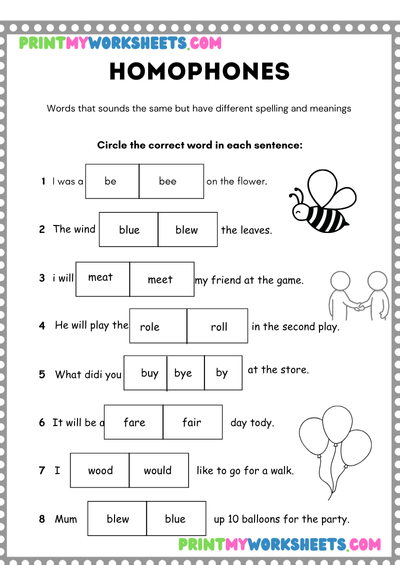
3rd Grade Homophones & Homonyms Worksheet
Understanding words that sound alike or share spellings but have different meanings is an important milestone in upper elementary language development. This 3rd Grade Homophones & Homonyms Worksheet is designed to help students in the United States strengthen their vocabulary, spelling awareness, and reading comprehension through clear, structured practice. Created for parents, teachers, and homeschool families, this printable resource focuses on helping third graders recognize and correctly use commonly confused words in context.
At this grade level, students are reading longer texts, writing more detailed sentences, and encountering new vocabulary across subjects. Confusion between similar-sounding or similar-looking words can impact both comprehension and written expression. These worksheets provide guided practice that helps students slow down, analyze word meaning, and apply correct usage. With a student-friendly format and age-appropriate activities, this free printable PDF supports consistent learning at home or in the classroom while reinforcing essential English language skills.
What Students Will Learn?
These worksheets focus on helping students clearly understand the differences between homophones and homonyms and how they function in everyday reading and writing. Students learn to identify words that sound the same but have different meanings and spellings, as well as words that share spelling but differ in meaning depending on context.
Activities are designed to strengthen word recognition and meaning through sentence-based practice. Students may match words to definitions, choose the correct word to complete a sentence, or analyze short passages where meaning depends on proper word choice. These exercises encourage careful reading and thoughtful decision-making.
The worksheets support structured learning by progressing from simple word identification to more applied usage. This gradual approach aligns well with third-grade expectations, where students are expected to demonstrate growing independence with vocabulary skills. Clear instructions and consistent layouts help students focus on the task rather than the format. By practicing regularly, learners build stronger language awareness and become more confident in distinguishing between commonly confused words in both reading and writing tasks.
Educational Value & Skill Development
Strong vocabulary skills are closely connected to reading comprehension, writing clarity, and overall academic success. The 3rd Grade Homophones & Homonyms Worksheet supports these areas by encouraging students to think critically about word meaning and usage. Rather than relying on sound alone, students learn to use context clues and sentence structure to determine the correct word.
This type of practice supports cognitive development by strengthening attention to detail, memory, and reasoning skills. Students must compare meanings, recall definitions, and apply knowledge accurately. Over time, this repeated exposure helps reduce common errors in spelling and word choice.
The worksheets also build confidence and independence. As students successfully complete activities on their own, they gain trust in their language skills. This confidence often transfers to classroom discussions, written assignments, and standardized assessments.
Skill progression is another key benefit. Mastery of homophones and homonyms in third grade prepares students for more advanced vocabulary work in later grades, including figurative language, nuanced word meanings, and complex reading passages. These worksheets provide a solid foundation for that continued growth.
Why Focus on Homophones & Homonyms?
Homophones and homonyms can be challenging for students because they require careful attention to meaning rather than just pronunciation or spelling. In third grade, students are expected to move beyond basic decoding and begin reading for deeper understanding. Confusion between similar words can interrupt comprehension and weaken writing quality.
Focusing on this skill helps students become more precise readers and writers. When learners understand how word meaning changes based on spelling or context, they are better equipped to interpret sentences accurately. This skill is especially important as reading materials become more complex in later grades.
Repetition and guided practice are essential for mastering these concepts. Worksheets provide a safe space for students to make mistakes, receive feedback, and improve through consistent exposure. These activities align with early language standards used across the United States, which emphasize vocabulary development, word relationships, and language conventions. Building these skills now supports smoother transitions into upper elementary and middle school language arts expectations.
How to Use These Worksheets?
These printable worksheets are flexible and can be used in many learning environments. In homeschool settings, they work well as part of a weekly language arts routine or as focused practice when a child struggles with word confusion. Parents can review answers together with students to encourage discussion about word meaning.
In classrooms, teachers can use the worksheets during whole-group instruction, small-group rotations, or independent practice time. They are also suitable for homework assignments or quick review activities before quizzes.
The 3rd Grade Homophones & Homonyms Worksheet is provided as a free printable PDF, making it easy to download and reuse throughout the school year. Pages can be printed as needed or used with sheet protectors for repeated practice. This reusability allows educators and families to adapt the worksheets to individual learning needs while maintaining consistency.
Related Worksheets / Extensions:
To continue building language skills, you may also explore related grammar and vocabulary worksheets. Activities focused on synonyms, antonyms, prefixes, and suffixes help expand word knowledge and reinforce meaning. Reading comprehension passages that include challenging vocabulary can also support real-world application.
The 3rd Grade Homophones & Homonyms Worksheet pairs well with writing exercises where students create their own sentences using similar-sounding words correctly. You may also consider exploring the same topic for second grade as review or fourth grade as an extension, allowing students to strengthen skills across multiple levels.
Frequently Asked Questions
Q1. Is this worksheet free to download?Yes, this worksheet is 100% free to download and print. No account, subscription, or payment is required. Click the Download Now button to get your free PDF instantly.Q2. What format is this worksheet available in?This worksheet is available as a printable PDF file. It is black-and-white, printer-friendly, and works on any standard home or classroom printer using A4 or US Letter paper.Q3. Can I use this worksheet for both classroom and home learning?Yes, these worksheets are designed for use by classroom teachers, homeschool parents, and tutors. They can be used as morning work, homework, revision practice, or learning centre activities.Q4. Is this worksheet aligned with Common Core ELA standards?Yes, this English worksheet is aligned with U.S. Common Core English Language Arts standards and supports foundational literacy development.Q5. Is this worksheet suitable for ESL or ELL students?This worksheet can be used as a supplemental resource for ESL and ELL students, particularly for vocabulary building and language pattern practice.3rd Grade Homophones and Homonyms Worksheets — Free Printable PDF
3rd Grade Homophones & Homonyms Worksheet
Understanding words that sound alike or share spellings but have different meanings is an important milestone in upper elementary language development. This 3rd Grade Homophones & Homonyms Worksheet is designed to help students in the United States strengthen their vocabulary, spelling awareness, and reading comprehension through clear, structured practice. Created for parents, teachers, and homeschool families, this printable resource focuses on helping third graders recognize and correctly use commonly confused words in context.
At this grade level, students are reading longer texts, writing more detailed sentences, and encountering new vocabulary across subjects. Confusion between similar-sounding or similar-looking words can impact both comprehension and written expression. These worksheets provide guided practice that helps students slow down, analyze word meaning, and apply correct usage. With a student-friendly format and age-appropriate activities, this free printable PDF supports consistent learning at home or in the classroom while reinforcing essential English language skills.
What Students Will Learn?
These worksheets focus on helping students clearly understand the differences between homophones and homonyms and how they function in everyday reading and writing. Students learn to identify words that sound the same but have different meanings and spellings, as well as words that share spelling but differ in meaning depending on context.
Activities are designed to strengthen word recognition and meaning through sentence-based practice. Students may match words to definitions, choose the correct word to complete a sentence, or analyze short passages where meaning depends on proper word choice. These exercises encourage careful reading and thoughtful decision-making.
The worksheets support structured learning by progressing from simple word identification to more applied usage. This gradual approach aligns well with third-grade expectations, where students are expected to demonstrate growing independence with vocabulary skills. Clear instructions and consistent layouts help students focus on the task rather than the format. By practicing regularly, learners build stronger language awareness and become more confident in distinguishing between commonly confused words in both reading and writing tasks.
Educational Value & Skill Development
Strong vocabulary skills are closely connected to reading comprehension, writing clarity, and overall academic success. The 3rd Grade Homophones & Homonyms Worksheet supports these areas by encouraging students to think critically about word meaning and usage. Rather than relying on sound alone, students learn to use context clues and sentence structure to determine the correct word.
This type of practice supports cognitive development by strengthening attention to detail, memory, and reasoning skills. Students must compare meanings, recall definitions, and apply knowledge accurately. Over time, this repeated exposure helps reduce common errors in spelling and word choice.
The worksheets also build confidence and independence. As students successfully complete activities on their own, they gain trust in their language skills. This confidence often transfers to classroom discussions, written assignments, and standardized assessments.
Skill progression is another key benefit. Mastery of homophones and homonyms in third grade prepares students for more advanced vocabulary work in later grades, including figurative language, nuanced word meanings, and complex reading passages. These worksheets provide a solid foundation for that continued growth.
Why Focus on Homophones & Homonyms?
Homophones and homonyms can be challenging for students because they require careful attention to meaning rather than just pronunciation or spelling. In third grade, students are expected to move beyond basic decoding and begin reading for deeper understanding. Confusion between similar words can interrupt comprehension and weaken writing quality.
Focusing on this skill helps students become more precise readers and writers. When learners understand how word meaning changes based on spelling or context, they are better equipped to interpret sentences accurately. This skill is especially important as reading materials become more complex in later grades.
Repetition and guided practice are essential for mastering these concepts. Worksheets provide a safe space for students to make mistakes, receive feedback, and improve through consistent exposure. These activities align with early language standards used across the United States, which emphasize vocabulary development, word relationships, and language conventions. Building these skills now supports smoother transitions into upper elementary and middle school language arts expectations.
How to Use These Worksheets?
These printable worksheets are flexible and can be used in many learning environments. In homeschool settings, they work well as part of a weekly language arts routine or as focused practice when a child struggles with word confusion. Parents can review answers together with students to encourage discussion about word meaning.
In classrooms, teachers can use the worksheets during whole-group instruction, small-group rotations, or independent practice time. They are also suitable for homework assignments or quick review activities before quizzes.
The 3rd Grade Homophones & Homonyms Worksheet is provided as a free printable PDF, making it easy to download and reuse throughout the school year. Pages can be printed as needed or used with sheet protectors for repeated practice. This reusability allows educators and families to adapt the worksheets to individual learning needs while maintaining consistency.
Related Worksheets / Extensions:
To continue building language skills, you may also explore related grammar and vocabulary worksheets. Activities focused on synonyms, antonyms, prefixes, and suffixes help expand word knowledge and reinforce meaning. Reading comprehension passages that include challenging vocabulary can also support real-world application.
The 3rd Grade Homophones & Homonyms Worksheet pairs well with writing exercises where students create their own sentences using similar-sounding words correctly. You may also consider exploring the same topic for second grade as review or fourth grade as an extension, allowing students to strengthen skills across multiple levels.