
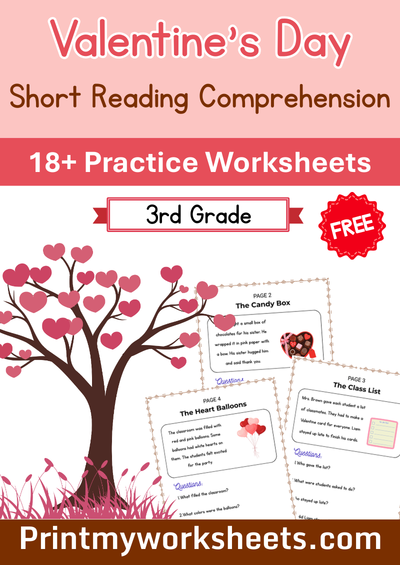
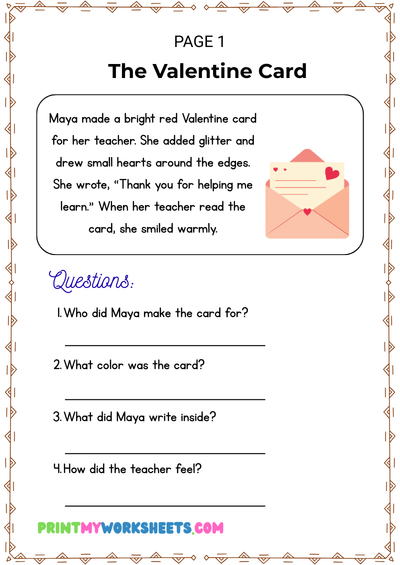
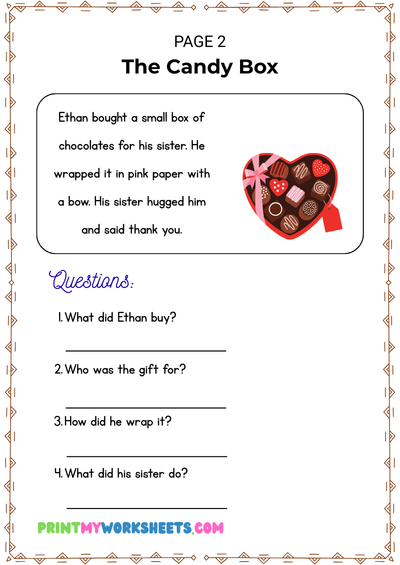
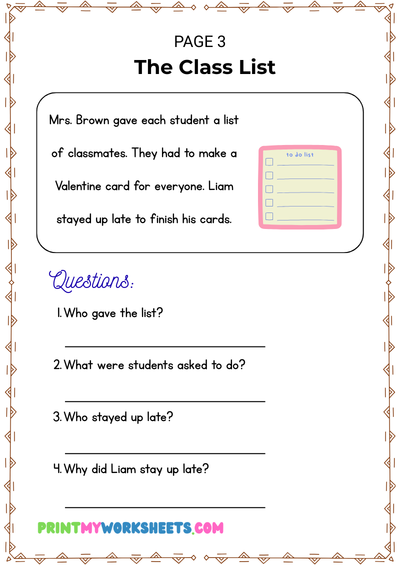
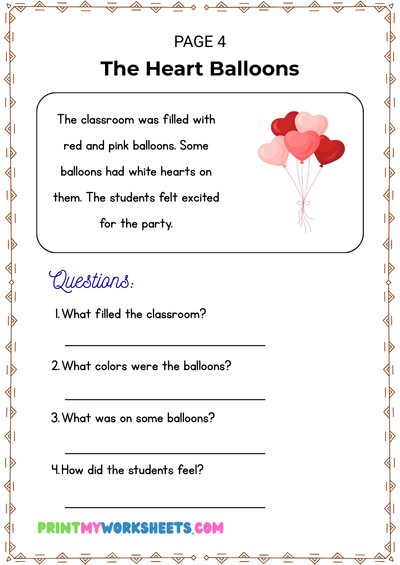
3rd Grade Valentines Reading Comprehension PDF – February Passages with Questions and ELA Skill Practice
Continue Learning
Explore more worksheets to build your child’s English skills.

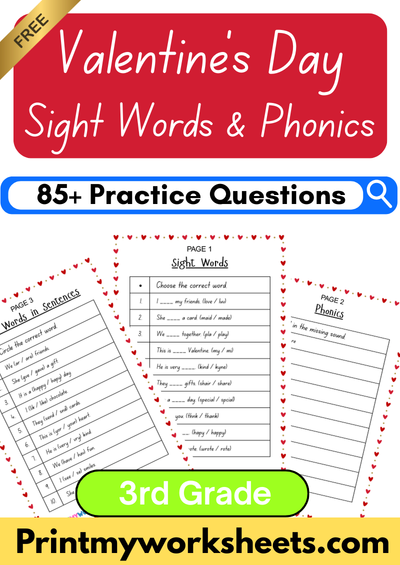
3rd Grade Valentines Reading Comprehension PDF
The 3rd Grade Valentines Reading Comprehension PDF is a thoughtfully designed printable resource that helps students strengthen reading skills through engaging, seasonal content. Created for U.S. parents, classroom teachers, and homeschool families, this worksheet set combines meaningful reading passages with standards-aligned comprehension questions tailored specifically for third graders.
At the third-grade level, students are expected to move beyond basic decoding and begin analyzing text more deeply. They learn to identify main ideas, describe characters, understand vocabulary in context, and draw conclusions from what they read. Valentine-themed reading activities make this practice both relatable and enjoyable while maintaining academic focus. With structured passages and purposeful questions, this printable PDF supports literacy growth in a way that feels motivating and developmentally appropriate for eight- and nine-year-old learners.
What Students Will Learn?
These worksheets help students practice essential third-grade reading comprehension skills in a structured and engaging format. Each passage is written at an appropriate reading level and focuses on clear story structure, descriptive details, and meaningful themes related to friendship, kindness, and seasonal traditions.
Students will work on identifying the main idea and supporting details within short stories or informational texts. They will practice answering multiple-choice and short-response questions that require them to refer back to the text for evidence. Additional activities may include sequencing events, determining the meaning of unfamiliar words using context clues, and identifying character traits.
The reading tasks are carefully organized to build confidence step by step. Questions begin with literal comprehension and gradually move toward inferential thinking. This progression supports age-appropriate expectations and aligns with U.S. third-grade literacy standards. By practicing regularly, students strengthen both reading fluency and comprehension accuracy while building stronger analytical skills.
Educational Value & Skill Development
The 3rd Grade Valentines Reading Comprehension PDF provides strong academic and developmental value for growing readers. Academically, it reinforces essential literacy skills such as summarizing, identifying themes, and explaining answers using textual evidence. These skills are foundational for upper elementary reading success.
Cognitively, comprehension practice improves focus, memory retention, and critical thinking. Students must read carefully, process information, and respond thoughtfully to questions. This helps develop analytical habits that extend beyond reading into other academic subjects.
Working with structured reading passages also promotes independence. As students gain confidence in answering comprehension questions on their own, they develop stronger self-monitoring skills. They learn to reread when necessary, check their answers, and correct misunderstandings.
Additionally, themed reading materials can increase engagement. Seasonal topics like Valentine’s Day provide a familiar and positive context for practicing literacy skills. When students enjoy what they are reading, they are more likely to stay motivated and complete assignments carefully.
Why Focus on Valentines Reading Comprehension?
Reading comprehension is one of the most important academic skills developed in third grade. At this stage, students transition from “learning to read” to “reading to learn.” Practicing comprehension with themed passages helps maintain interest while strengthening core literacy abilities.
Seasonal reading activities encourage repeated exposure to structured texts without feeling repetitive. Students encounter new vocabulary, varied sentence structures, and different text formats while staying engaged with a consistent theme. This repetition builds fluency and understanding over time.
Comprehension skills practiced in third grade directly support future academic success. Students who can analyze passages, draw conclusions, and cite evidence are better prepared for more advanced reading tasks in later grades. Guided and independent practice with structured worksheets ensures students meet grade-level expectations while developing long-term reading confidence.
How to Use These Worksheets?
The 3rd Grade Valentines Reading Comprehension PDF is flexible and easy to use in multiple learning settings. In classrooms, teachers can incorporate the worksheets into literacy centers, small-group reading sessions, or independent practice time. They also work well as seasonal assignments during February.
For homeschool families, this free printable PDF can be added to a daily reading routine. Parents may choose to read passages aloud together first and then guide children through the comprehension questions. Alternatively, students can complete the worksheets independently and review answers afterward.
Because the resource is available as a free printable PDF, it can be downloaded quickly and printed as needed. Teachers and parents may organize pages into a literacy binder or use them for review before reading assessments. The worksheets are designed to be reusable and adaptable, making them a practical addition to any third-grade reading plan.
Related Worksheets / Extensions:
You may also like:
3rd grade reading comprehension passages for other seasons
Character analysis worksheets
Main idea and supporting details practice pages
Vocabulary and context clues activities
The 3rd Grade Valentines Reading Comprehension PDF can be paired with additional reading resources to create a balanced literacy plan. Combining themed comprehension practice with vocabulary, writing prompts, and fluency exercises helps students strengthen multiple skills at once. Regular exposure to diverse reading materials ensures steady progress and prepares students for more advanced text analysis in future grades.
You may also like:

Frequently Asked Questions
Q1. What format is this worksheet available in?
This worksheet is available as a printable PDF file. It is black-and-white, printer-friendly, and works on any standard home or classroom printer using A4 or US Letter paper.
Q2. Is this worksheet free to download?
Yes, this worksheet is 100% free to download and print. No account, subscription, or payment is required. Click the Download Now button to get your free PDF instantly.
Q3. Can I use this worksheet for both classroom and home learning?
Yes, these worksheets are designed for use by classroom teachers, homeschool parents, and tutors. They can be used as morning work, homework, revision practice, or learning centre activities.
Q4. Is this worksheet aligned with Common Core ELA standards?
Yes, this English worksheet is aligned with U.S. Common Core English Language Arts standards and supports foundational literacy development.
Q5. Can this worksheet be used for phonics instruction?
Yes, this worksheet supports phonics-based reading instruction and is suitable for early readers building letter-sound recognition skills.
You may also like…
3rd Grade Multiplication Tables 1–3 Worksheet | Free PDF Download for Kids
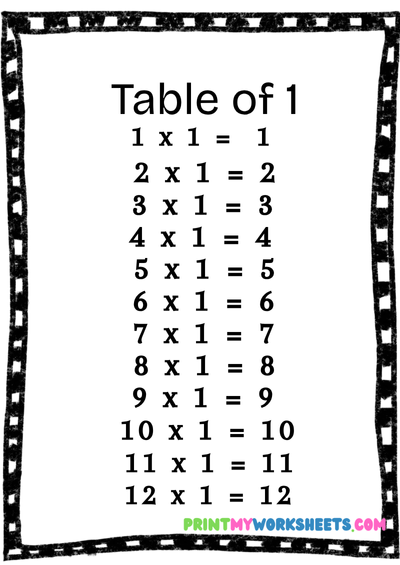
3rd Grade Multiplication Tables 1–3 Worksheet
The 3rd Grade Multiplication Tables 1–3 Worksheet is designed to help students build a strong foundation in early multiplication skills. This free printable PDF is ideal for U.S. parents, teachers, and homeschool families who want structured, grade-level practice that aligns with elementary math standards.
In 3rd grade, students transition from repeated addition to understanding multiplication as equal groups and arrays. Mastering multiplication tables 1 through 3 is a key milestone that supports more advanced multiplication facts later in the year. This worksheet provides focused practice that helps children develop speed, accuracy, and confidence with basic multiplication facts. Through clear instructions and engaging exercises, students strengthen their understanding of number patterns and relationships while reinforcing essential math skills that are critical for long-term success.
What Students Will Learn?
With this multiplication resource, students focus on mastering the 1, 2, and 3 times tables through structured and progressive activities. They practice recognizing multiplication patterns, solving basic fact problems, and understanding multiplication as repeated addition.
Activities may include fill-in-the-blank equations, matching problems, number line multiplication, and simple word problems involving equal groups. Students also practice writing multiplication sentences based on visual models such as arrays or groups of objects. These exercises help connect conceptual understanding with memorization of facts.
The worksheet supports structured learning by starting with straightforward multiplication problems and gradually increasing difficulty. Students move from guided examples to independent practice, reinforcing both conceptual and procedural knowledge. This approach aligns with 3rd grade math expectations in the United States, where fluency with basic multiplication facts is a core objective.
By focusing on smaller sets of multiplication tables, students can build accuracy and confidence before progressing to higher-number facts.
Educational Value & Skill Development
The 3rd Grade Multiplication Tables 1–3 Worksheet provides meaningful academic benefits beyond simple fact memorization. Understanding early multiplication tables strengthens number sense and prepares students for more complex mathematical operations such as multi-digit multiplication and division.
Academically, students develop fluency with foundational multiplication facts. Fluency means they can solve problems accurately and efficiently without relying solely on counting strategies. This skill becomes increasingly important as math problems grow more complex in later grades.
Cognitively, practicing multiplication facts improves memory, concentration, and pattern recognition. Students begin to notice relationships between numbers, such as skip counting and repeated addition patterns. These observations strengthen logical reasoning skills.
As students gain confidence in solving multiplication problems independently, they become more comfortable tackling new mathematical challenges. Regular practice supports long-term retention and reduces frustration when students encounter more advanced multiplication and division concepts in upper elementary grades.
Why Focus on Multiplication Tables 1–3?
Early mastery of basic multiplication tables sets the stage for success in elementary mathematics. The 1, 2, and 3 times tables are often the first multiplication facts introduced in 3rd grade, making them essential building blocks for future learning.
When students fully understand these foundational facts, they are better prepared to learn higher multiplication tables with confidence. Strong fluency also supports division skills, as division is directly connected to multiplication. Without a solid understanding of these early facts, students may struggle with multi-step word problems, fractions, and later algebraic reasoning.
Repetition and guided practice are critical at this stage. Children benefit from repeated exposure to multiplication patterns through structured exercises. Consistent practice helps move knowledge from short-term memory to long-term understanding.
Building confidence with early multiplication tables helps students approach math with a positive attitude and readiness for more advanced topics.
How to Use These Worksheets?
The 3rd Grade Multiplication Tables 1–3 Worksheet can be used in a variety of instructional settings. In classrooms, teachers may assign it as guided practice after introducing multiplication concepts. It works well for small group instruction, math centers, homework assignments, or review sessions.
Homeschool families can incorporate the worksheet into daily or weekly math lessons. Parents may review skip counting and repeated addition before allowing students to complete the practice problems independently. Afterward, reviewing answers together reinforces understanding and corrects misconceptions.
Because this resource is provided as a free printable PDF, it is easy to download and print as needed. Teachers can provide additional copies for reinforcement or assessment preparation. The reusable format makes it convenient for ongoing practice throughout the school year.
The clear layout and focused content make it suitable for both structured lessons and independent practice time.
Related Worksheets / Extensions:
You may also like:
3rd grade multiplication tables 4–6 worksheets
Multiplication and division fact families practice
Array and equal groups visual models worksheets
Multi-digit multiplication introduction worksheets
The 3rd Grade Multiplication Tables 1–3 Worksheet pairs well with additional fact fluency resources and word problem practice. Expanding practice to higher multiplication tables and related division concepts helps students develop a complete understanding of multiplication relationships. By building on these foundational skills, learners strengthen their overall math fluency and prepare for more advanced problem-solving in upper elementary grades.
Frequently Asked Questions
Q1. Is this worksheet free to download?Yes, this worksheet is 100% free to download and print. No account, subscription, or payment is required. Click the Download Now button to get your free PDF instantly.Q2. What format is this worksheet available in?This worksheet is available as a printable PDF file. It is black-and-white, printer-friendly, and works on any standard home or classroom printer using A4 or US Letter paper.Q3. Can I use this worksheet for both classroom and home learning?Yes, these worksheets are designed for use by classroom teachers, homeschool parents, and tutors. They can be used as morning work, homework, revision practice, or learning centre activities.Q4. Is this worksheet suitable for extra practice or exam preparation?Yes, this worksheet is ideal for supplemental practice, homework reinforcement, test preparation, and homeschool math lessons.Q5. Does this math worksheet include an answer key?Yes, an answer key is included in the PDF so parents and teachers can quickly check student responses without manual calculation.3rd Grade Multiplication Tables 1–3 Worksheet | Free PDF Download for Kids
3rd Grade Multiplication Tables 1–3 Worksheet
The 3rd Grade Multiplication Tables 1–3 Worksheet is designed to help students build a strong foundation in early multiplication skills. This free printable PDF is ideal for U.S. parents, teachers, and homeschool families who want structured, grade-level practice that aligns with elementary math standards.
In 3rd grade, students transition from repeated addition to understanding multiplication as equal groups and arrays. Mastering multiplication tables 1 through 3 is a key milestone that supports more advanced multiplication facts later in the year. This worksheet provides focused practice that helps children develop speed, accuracy, and confidence with basic multiplication facts. Through clear instructions and engaging exercises, students strengthen their understanding of number patterns and relationships while reinforcing essential math skills that are critical for long-term success.
What Students Will Learn?
With this multiplication resource, students focus on mastering the 1, 2, and 3 times tables through structured and progressive activities. They practice recognizing multiplication patterns, solving basic fact problems, and understanding multiplication as repeated addition.
Activities may include fill-in-the-blank equations, matching problems, number line multiplication, and simple word problems involving equal groups. Students also practice writing multiplication sentences based on visual models such as arrays or groups of objects. These exercises help connect conceptual understanding with memorization of facts.
The worksheet supports structured learning by starting with straightforward multiplication problems and gradually increasing difficulty. Students move from guided examples to independent practice, reinforcing both conceptual and procedural knowledge. This approach aligns with 3rd grade math expectations in the United States, where fluency with basic multiplication facts is a core objective.
By focusing on smaller sets of multiplication tables, students can build accuracy and confidence before progressing to higher-number facts.
Educational Value & Skill Development
The 3rd Grade Multiplication Tables 1–3 Worksheet provides meaningful academic benefits beyond simple fact memorization. Understanding early multiplication tables strengthens number sense and prepares students for more complex mathematical operations such as multi-digit multiplication and division.
Academically, students develop fluency with foundational multiplication facts. Fluency means they can solve problems accurately and efficiently without relying solely on counting strategies. This skill becomes increasingly important as math problems grow more complex in later grades.
Cognitively, practicing multiplication facts improves memory, concentration, and pattern recognition. Students begin to notice relationships between numbers, such as skip counting and repeated addition patterns. These observations strengthen logical reasoning skills.
As students gain confidence in solving multiplication problems independently, they become more comfortable tackling new mathematical challenges. Regular practice supports long-term retention and reduces frustration when students encounter more advanced multiplication and division concepts in upper elementary grades.
Why Focus on Multiplication Tables 1–3?
Early mastery of basic multiplication tables sets the stage for success in elementary mathematics. The 1, 2, and 3 times tables are often the first multiplication facts introduced in 3rd grade, making them essential building blocks for future learning.
When students fully understand these foundational facts, they are better prepared to learn higher multiplication tables with confidence. Strong fluency also supports division skills, as division is directly connected to multiplication. Without a solid understanding of these early facts, students may struggle with multi-step word problems, fractions, and later algebraic reasoning.
Repetition and guided practice are critical at this stage. Children benefit from repeated exposure to multiplication patterns through structured exercises. Consistent practice helps move knowledge from short-term memory to long-term understanding.
Building confidence with early multiplication tables helps students approach math with a positive attitude and readiness for more advanced topics.
How to Use These Worksheets?
The 3rd Grade Multiplication Tables 1–3 Worksheet can be used in a variety of instructional settings. In classrooms, teachers may assign it as guided practice after introducing multiplication concepts. It works well for small group instruction, math centers, homework assignments, or review sessions.
Homeschool families can incorporate the worksheet into daily or weekly math lessons. Parents may review skip counting and repeated addition before allowing students to complete the practice problems independently. Afterward, reviewing answers together reinforces understanding and corrects misconceptions.
Because this resource is provided as a free printable PDF, it is easy to download and print as needed. Teachers can provide additional copies for reinforcement or assessment preparation. The reusable format makes it convenient for ongoing practice throughout the school year.
The clear layout and focused content make it suitable for both structured lessons and independent practice time.
Related Worksheets / Extensions:
You may also like:
3rd grade multiplication tables 4–6 worksheets
Multiplication and division fact families practice
Array and equal groups visual models worksheets
Multi-digit multiplication introduction worksheets
The 3rd Grade Multiplication Tables 1–3 Worksheet pairs well with additional fact fluency resources and word problem practice. Expanding practice to higher multiplication tables and related division concepts helps students develop a complete understanding of multiplication relationships. By building on these foundational skills, learners strengthen their overall math fluency and prepare for more advanced problem-solving in upper elementary grades.
Frequently Asked Questions
Q1. Is this worksheet free to download?Yes, this worksheet is 100% free to download and print. No account, subscription, or payment is required. Click the Download Now button to get your free PDF instantly.Q2. What format is this worksheet available in?This worksheet is available as a printable PDF file. It is black-and-white, printer-friendly, and works on any standard home or classroom printer using A4 or US Letter paper.Q3. Can I use this worksheet for both classroom and home learning?Yes, these worksheets are designed for use by classroom teachers, homeschool parents, and tutors. They can be used as morning work, homework, revision practice, or learning centre activities.Q4. Is this worksheet suitable for extra practice or exam preparation?Yes, this worksheet is ideal for supplemental practice, homework reinforcement, test preparation, and homeschool math lessons.Q5. Does this math worksheet include an answer key?Yes, an answer key is included in the PDF so parents and teachers can quickly check student responses without manual calculation.
3rd Grade Long and Short Vowel Sounds Worksheet | Free Spelling & Phonics PDF Downloadable
3rd Grade Long and Short Vowel Sounds Worksheet
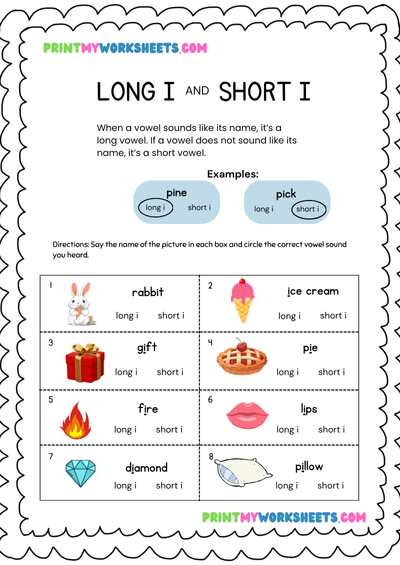
The 3rd Grade Long and Short Vowel Sounds Worksheet is designed to help students strengthen their understanding of vowel patterns and pronunciation through focused, skill-based practice. This free printable PDF is ideal for U.S. parents, classroom teachers, and homeschool families who want structured phonics reinforcement at the third grade level.
By third grade, students are expected to read with greater fluency and accuracy. Mastering long and short vowel sounds plays a key role in improving decoding skills, spelling patterns, and overall reading comprehension. When students can confidently distinguish between vowel sounds, they are better prepared to tackle multisyllabic words and more complex texts. This worksheet supports foundational phonics skills while encouraging independent learning and meaningful literacy growth in both classroom and home settings.
What Students Will Learn?
This vowel-focused worksheet helps students clearly identify, compare, and apply long and short vowel sounds in different word contexts. Learners practice distinguishing between similar spellings that produce different sounds, such as short “a” in cat and long “a” in cake.
Activities may include sorting words by vowel sound, circling correct spellings, completing sentences with the appropriate word choice, and identifying vowel patterns such as silent “e,” vowel teams, and open syllables. Students also practice reading short passages and highlighting specific vowel sounds to reinforce recognition in connected text.
The structured format allows students to move from simple word identification to more applied tasks, such as writing their own examples or correcting incorrect vowel usage. These exercises align with U.S. third grade language arts standards, which emphasize decoding multisyllabic words and understanding common spelling-sound correspondences.
Through guided practice and repetition, students strengthen both their reading fluency and spelling accuracy while building confidence in phonics skills.
Educational Value & Skill Development
The 3rd Grade Long and Short Vowel Sounds Worksheet provides meaningful phonics practice that supports reading development in multiple ways. Academically, understanding vowel patterns improves word recognition and reading speed. When students can quickly identify vowel sounds, they spend less time decoding and more time focusing on comprehension.
This type of phonics work also strengthens spelling skills. Recognizing patterns such as silent “e” or vowel digraphs helps students make logical spelling choices rather than guessing. Over time, consistent practice leads to greater independence in both reading and writing tasks.
Cognitively, identifying vowel sounds requires attention to detail and pattern recognition. Students learn to analyze word structures, compare similar spellings, and apply rules in new situations. These skills support critical thinking and language processing.
Confidence plays a significant role in literacy development. As students successfully complete phonics exercises and notice improvement in their reading, they become more willing to tackle challenging texts. This worksheet offers structured repetition that encourages steady progress while maintaining engagement appropriate for third graders.
Why Focus on Long and Short Vowel Sounds?
Vowel sounds form the foundation of English word pronunciation. Even small differences in vowel sounds can completely change the meaning of a word. For example, confusing short and long vowels may lead to reading errors that affect comprehension.
In third grade, students move beyond basic phonics into more complex spelling patterns and longer words. A strong grasp of vowel distinctions helps them decode unfamiliar words with greater accuracy. It also supports fluency, as students no longer need to pause frequently to determine pronunciation.
Repetition and guided practice are essential for mastering vowel patterns. Regular review ensures that students retain the difference between common patterns such as CVC (consonant-vowel-consonant) words and silent “e” words. Continued exposure builds automaticity and prepares learners for advanced vocabulary and reading materials in later grades.
How to Use These Worksheets?
The 3rd Grade Long and Short Vowel Sounds Worksheet can be used in a variety of educational settings. In the classroom, teachers may incorporate the worksheet into literacy centers, small group instruction, or independent practice time. It works well as a review tool before spelling assessments or reading fluency checks.
For homeschool families, the worksheet can be part of a daily phonics routine. Parents can begin by reviewing vowel rules aloud, then allow the student to complete the page independently. Afterward, discussing answers together helps reinforce learning and clarify misunderstandings.
Because this resource is provided as a free printable PDF, it is easy to download and print as needed. Educators and parents can reuse the worksheet throughout the year for reinforcement. The clear, black-and-white layout keeps students focused on the task and minimizes distractions, making it suitable for both guided instruction and independent review.
Related Worksheets / Extensions:
You may also like:
Short vowel review worksheets for earlier grades
Long vowel teams and diphthongs practice
Multisyllabic word decoding worksheets
3rd grade spelling pattern activities
Reading comprehension worksheets with phonics integration
The 3rd Grade Long and Short Vowel Sounds Worksheet pairs well with broader phonics and spelling units to create a complete literacy practice plan. Rotating vowel-focused activities throughout the school year ensures steady improvement in reading accuracy and fluency. Continued reinforcement of vowel distinctions helps students approach more advanced texts with confidence and clarity as they progress through elementary school.
You may also like :
[gallery ids="5961,5939,5570"]Frequently Asked Questions
Q1. Is this worksheet free to download?Yes, this worksheet is 100% free to download and print. No account, subscription, or payment is required. Click the Download Now button to get your free PDF instantly.Q2. What format is this worksheet available in?This worksheet is available as a printable PDF file. It is black-and-white, printer-friendly, and works on any standard home or classroom printer using A4 or US Letter paper.Q3. Do I need to create an account to download this worksheet?No account or sign-up is required. All worksheets on Print My Worksheets are freely accessible to teachers, parents, and homeschool families without any registration.Q4. Are these worksheets aligned with curriculum standards?Yes, all worksheets on Print My Worksheets are aligned with U.S. Common Core and ELA standards, making them suitable for classroom use, homeschooling, and supplemental learning from Pre-KG through Grade 8.Q5. Can I use this worksheet for both classroom and home learning?Yes, these worksheets are designed for use by classroom teachers, homeschool parents, and tutors. They can be used as morning work, homework, revision practice, or learning centre activities.Q6. Is this worksheet aligned with Common Core ELA standards?Yes, this English worksheet is aligned with U.S. Common Core English Language Arts standards and supports foundational literacy development.Q7. Can this worksheet be used for phonics instruction?Yes, this worksheet supports phonics-based reading instruction and is suitable for early readers building letter-sound recognition skills.Q8. Is this worksheet suitable for ESL or ELL students?This worksheet can be used as a supplemental resource for ESL and ELL students, particularly for vocabulary building and language pattern practice.3rd Grade Long and Short Vowel Sounds Worksheet | Free Spelling & Phonics PDF Downloadable
3rd Grade Long and Short Vowel Sounds Worksheet
The 3rd Grade Long and Short Vowel Sounds Worksheet is designed to help students strengthen their understanding of vowel patterns and pronunciation through focused, skill-based practice. This free printable PDF is ideal for U.S. parents, classroom teachers, and homeschool families who want structured phonics reinforcement at the third grade level.
By third grade, students are expected to read with greater fluency and accuracy. Mastering long and short vowel sounds plays a key role in improving decoding skills, spelling patterns, and overall reading comprehension. When students can confidently distinguish between vowel sounds, they are better prepared to tackle multisyllabic words and more complex texts. This worksheet supports foundational phonics skills while encouraging independent learning and meaningful literacy growth in both classroom and home settings.
What Students Will Learn?
This vowel-focused worksheet helps students clearly identify, compare, and apply long and short vowel sounds in different word contexts. Learners practice distinguishing between similar spellings that produce different sounds, such as short “a” in cat and long “a” in cake.
Activities may include sorting words by vowel sound, circling correct spellings, completing sentences with the appropriate word choice, and identifying vowel patterns such as silent “e,” vowel teams, and open syllables. Students also practice reading short passages and highlighting specific vowel sounds to reinforce recognition in connected text.
The structured format allows students to move from simple word identification to more applied tasks, such as writing their own examples or correcting incorrect vowel usage. These exercises align with U.S. third grade language arts standards, which emphasize decoding multisyllabic words and understanding common spelling-sound correspondences.
Through guided practice and repetition, students strengthen both their reading fluency and spelling accuracy while building confidence in phonics skills.
Educational Value & Skill Development
The 3rd Grade Long and Short Vowel Sounds Worksheet provides meaningful phonics practice that supports reading development in multiple ways. Academically, understanding vowel patterns improves word recognition and reading speed. When students can quickly identify vowel sounds, they spend less time decoding and more time focusing on comprehension.
This type of phonics work also strengthens spelling skills. Recognizing patterns such as silent “e” or vowel digraphs helps students make logical spelling choices rather than guessing. Over time, consistent practice leads to greater independence in both reading and writing tasks.
Cognitively, identifying vowel sounds requires attention to detail and pattern recognition. Students learn to analyze word structures, compare similar spellings, and apply rules in new situations. These skills support critical thinking and language processing.
Confidence plays a significant role in literacy development. As students successfully complete phonics exercises and notice improvement in their reading, they become more willing to tackle challenging texts. This worksheet offers structured repetition that encourages steady progress while maintaining engagement appropriate for third graders.
Why Focus on Long and Short Vowel Sounds?
Vowel sounds form the foundation of English word pronunciation. Even small differences in vowel sounds can completely change the meaning of a word. For example, confusing short and long vowels may lead to reading errors that affect comprehension.
In third grade, students move beyond basic phonics into more complex spelling patterns and longer words. A strong grasp of vowel distinctions helps them decode unfamiliar words with greater accuracy. It also supports fluency, as students no longer need to pause frequently to determine pronunciation.
Repetition and guided practice are essential for mastering vowel patterns. Regular review ensures that students retain the difference between common patterns such as CVC (consonant-vowel-consonant) words and silent “e” words. Continued exposure builds automaticity and prepares learners for advanced vocabulary and reading materials in later grades.
How to Use These Worksheets?
The 3rd Grade Long and Short Vowel Sounds Worksheet can be used in a variety of educational settings. In the classroom, teachers may incorporate the worksheet into literacy centers, small group instruction, or independent practice time. It works well as a review tool before spelling assessments or reading fluency checks.
For homeschool families, the worksheet can be part of a daily phonics routine. Parents can begin by reviewing vowel rules aloud, then allow the student to complete the page independently. Afterward, discussing answers together helps reinforce learning and clarify misunderstandings.
Because this resource is provided as a free printable PDF, it is easy to download and print as needed. Educators and parents can reuse the worksheet throughout the year for reinforcement. The clear, black-and-white layout keeps students focused on the task and minimizes distractions, making it suitable for both guided instruction and independent review.
Related Worksheets / Extensions:
You may also like:
Short vowel review worksheets for earlier grades
Long vowel teams and diphthongs practice
Multisyllabic word decoding worksheets
3rd grade spelling pattern activities
Reading comprehension worksheets with phonics integration
The 3rd Grade Long and Short Vowel Sounds Worksheet pairs well with broader phonics and spelling units to create a complete literacy practice plan. Rotating vowel-focused activities throughout the school year ensures steady improvement in reading accuracy and fluency. Continued reinforcement of vowel distinctions helps students approach more advanced texts with confidence and clarity as they progress through elementary school.
You may also like :
[gallery ids="5961,5939,5570"]Frequently Asked Questions
Q1. Is this worksheet free to download?Yes, this worksheet is 100% free to download and print. No account, subscription, or payment is required. Click the Download Now button to get your free PDF instantly.Q2. What format is this worksheet available in?This worksheet is available as a printable PDF file. It is black-and-white, printer-friendly, and works on any standard home or classroom printer using A4 or US Letter paper.Q3. Do I need to create an account to download this worksheet?No account or sign-up is required. All worksheets on Print My Worksheets are freely accessible to teachers, parents, and homeschool families without any registration.Q4. Are these worksheets aligned with curriculum standards?Yes, all worksheets on Print My Worksheets are aligned with U.S. Common Core and ELA standards, making them suitable for classroom use, homeschooling, and supplemental learning from Pre-KG through Grade 8.Q5. Can I use this worksheet for both classroom and home learning?Yes, these worksheets are designed for use by classroom teachers, homeschool parents, and tutors. They can be used as morning work, homework, revision practice, or learning centre activities.Q6. Is this worksheet aligned with Common Core ELA standards?Yes, this English worksheet is aligned with U.S. Common Core English Language Arts standards and supports foundational literacy development.Q7. Can this worksheet be used for phonics instruction?Yes, this worksheet supports phonics-based reading instruction and is suitable for early readers building letter-sound recognition skills.Q8. Is this worksheet suitable for ESL or ELL students?This worksheet can be used as a supplemental resource for ESL and ELL students, particularly for vocabulary building and language pattern practice.
2nd Grade Place Value Worksheets PDF – Printable Math Practice with Answer Key
2nd Grade Place Value Worksheets PDF
Understanding how numbers are built is a key step in developing strong math skills, and place value plays a central role in that process. The 2nd Grade Place Value Worksheets PDF is designed to help students explore numbers in a structured and meaningful way. These free printable worksheets are ideal for U.S. parents, teachers, and homeschool families who want to support foundational math learning.
In second grade, students begin working with larger numbers and are expected to understand hundreds, tens, and ones. This knowledge helps them read, write, compare, and solve problems with confidence. Place value is not just a math concept—it is the basis for addition, subtraction, and future operations.
The 2nd Grade Place Value Worksheets PDF provides engaging activities that guide students through these concepts step by step. With regular practice, learners gain a deeper understanding of numbers and build the confidence needed to succeed in math.
What Students Will Learn?
Place value worksheets for second grade focus on helping students understand how numbers are structured. These activities are designed to match grade-level expectations and provide clear, step-by-step learning.
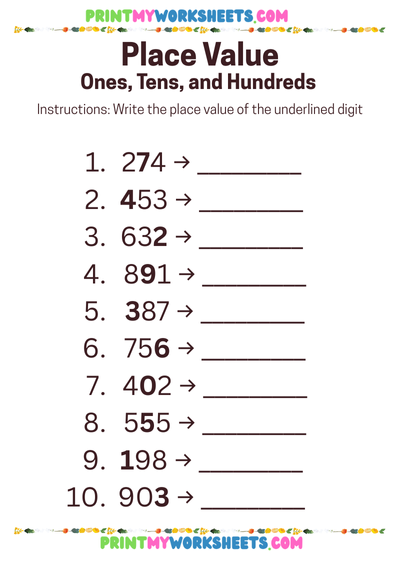
Students begin by identifying the value of digits in two-digit and three-digit numbers. They learn how each position in a number represents a different value, such as ones, tens, and hundreds.
Many worksheets include activities where students break numbers into expanded form. For example, they learn to write 345 as 300 + 40 + 5. This helps them understand how numbers are composed.
Students also practice comparing numbers using greater than, less than, and equal to symbols. This builds number sense and helps them understand relationships between values.
Some worksheets include number-building activities, where students create numbers using base-ten blocks or place value charts. These visual tools support conceptual understanding.
Word problems may also be included to help students apply place value knowledge in real-life situations.
Through these activities, students develop a strong understanding of how numbers work, which is essential for future math learning.
Educational Value & Skill Development
The 2nd Grade Place Value Worksheets PDF supports essential math skills that go beyond simple number recognition.
One of the main benefits is developing number sense. Students learn how numbers are organized and how each digit contributes to the overall value.
The 2nd Grade Place Value Worksheets PDF also strengthens problem-solving skills. Students analyze numbers, compare values, and break numbers apart, which requires logical thinking.
These worksheets support computational skills as well. A strong understanding of place value makes it easier for students to perform addition and subtraction, especially with larger numbers.
Another important benefit is increased confidence. When students understand how numbers work, they feel more comfortable solving math problems.
These activities also support visual learning. Using charts, blocks, and models helps students see how numbers are structured, making abstract concepts easier to understand.
Additionally, the worksheets encourage independent practice. Students can complete many of the activities on their own, building responsibility and focus.
By combining conceptual understanding with practice, these worksheets provide a strong foundation for math success.
Why Focus on Place Value Worksheets PDF?
Place value is one of the most important concepts in early math education. It helps students understand the structure of numbers and how digits relate to each other.
In second grade, students expand their knowledge from simple numbers to larger values. This makes place value essential for understanding more advanced math concepts.
Without a strong grasp of place value, students may struggle with addition, subtraction, and other operations. Understanding how numbers are built makes these processes easier and more logical.
Place value also supports estimation and mental math. Students can quickly determine the size of a number and make reasonable calculations.
In classrooms across the United States, place value is a key part of math instruction. Teachers use a variety of methods, including visual models and hands-on activities, to help students understand this concept.
Repetition and practice are important for mastering place value. Worksheets provide a structured way for students to reinforce their learning and build confidence.
By focusing on place value, students develop a deeper understanding of numbers and a strong foundation for future math learning.
How to Use These Worksheets?
The 2nd Grade Place Value Worksheets PDF can be used in classrooms, homeschool environments, and independent study settings.
Teachers can include these worksheets as part of daily math lessons. Students may complete activities during class, in small groups, or as homework assignments.
In classroom settings, teachers can introduce place value concepts using visual tools before assigning worksheets for practice. This helps students understand the concept before applying it.
Parents who homeschool can use these worksheets as part of a structured math routine. Children can practice place value regularly to build consistency and confidence.
Because the worksheets are available as a free printable PDF, they can be easily downloaded and printed for repeated use. This makes them convenient for both teaching and review.
These worksheets are also useful for small group instruction. Students can work together to solve problems and discuss their reasoning.
The printable format provides flexibility, making it easy to use the worksheets in different learning environments.
Related Worksheets / Extensions:
You may also like:
• 2nd grade addition worksheets
• 2nd grade subtraction worksheets
• number sense worksheets for elementary students
• math word problem worksheets for grade 2
• base-ten and number building activities
The 2nd Grade Place Value Worksheets PDF works well alongside other math resources that focus on operations and number sense. Combining these worksheets helps students develop a complete understanding of foundational math skills.
Teachers and parents can extend learning by encouraging students to create their own numbers or explain how digits represent different values.
With consistent practice, second grade students build strong place value skills, improved confidence, and a deeper understanding of numbers.