

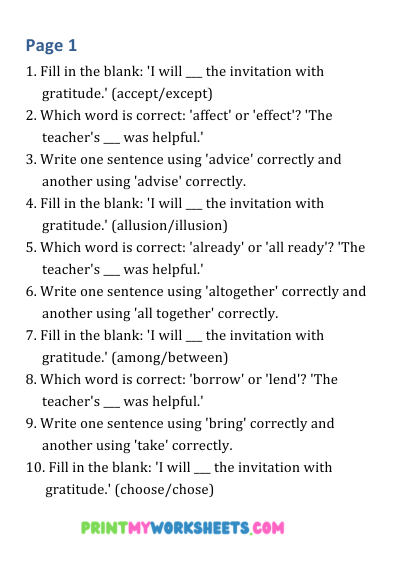


3rd Grade Back to School Reading Worksheets | Free Downloadable PDF
₹0.00
These 3rd Grade Back to School Reading Worksheets help students improve reading fluency, vocabulary, comprehension, and critical thinking. Perfect for homeschool families, teachers, and parents, the printable activities build literacy confidence, encourage independent reading, and prepare learners for a successful and engaging school year. This is completely aligned with U.S Curriculum.
Click below to access the free 3rd Grade Back to School Reading Worksheets
Continue Learning
Explore more worksheets to build your child’s English skills.

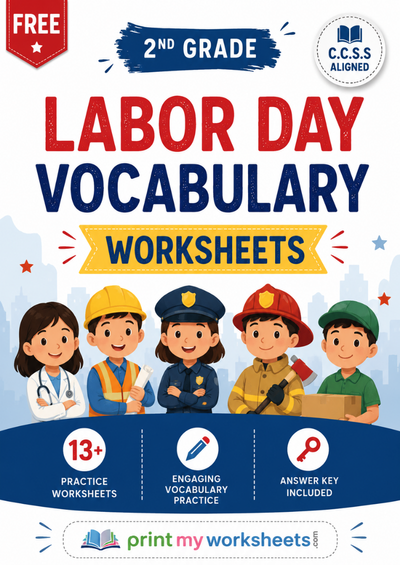
Make the new school year exciting with these engaging 3rd Grade Back to School Reading Worksheets ! This downloadable PDF workbook is designed to help students strengthen reading comprehension while exploring fun, school-themed passages and activities. Children will read engaging stories about classroom experiences, friendships, teachers, school routines, and first-day adventures while developing essential literacy skills.
Perfect for homeschool parents, classroom teachers, tutors, literacy centers, and independent learners, these printable worksheets include fiction and nonfiction reading passages, comprehension questions, vocabulary practice, sequencing activities, context clues, main idea and supporting details, inference exercises, and critical thinking tasks. Each worksheet aligns with Grade 3 English Language Arts standards and encourages confident, independent reading.
Back-to-school reading comprehension activities help students transition smoothly into the new academic year while improving reading fluency, vocabulary, comprehension, and analytical thinking. Regular practice strengthens the ability to identify key details, draw conclusions, make predictions, and summarize texts. These foundational literacy skills support success across all subjects while encouraging a lifelong love of reading. The engaging school-themed content also builds confidence, reduces first-week anxiety, and helps students reconnect with learning after school breaks.
Easy to download and print, these worksheets are ideal for classroom lessons, homeschool education, morning work, literacy stations, homework, independent practice, substitute plans, and back-to-school activities. Help your third grader start the school year with stronger reading skills and greater confidence using this comprehensive Back to School Reading Comprehension Worksheet Pack.
Frequently Asked Questions
Q1. Is this worksheet free to download?
Yes, this worksheet is 100% free to download and print. No account, subscription, or payment is required. Click the Download Now button to get your free PDF instantly.
Q2. What format is this worksheet available in?
This worksheet is available as a printable PDF file. It is black-and-white, printer-friendly, and works on any standard home or classroom printer using A4 or US Letter paper.
Q3. Can I use this worksheet for both classroom and home learning?
Yes, these worksheets are designed for use by classroom teachers, homeschool parents, and tutors. They can be used as morning work, homework, revision practice, or learning centre activities.
Q4. Is this worksheet aligned with Common Core ELA standards?
Yes, this English worksheet is aligned with U.S. Common Core English Language Arts standards and supports foundational literacy development.
Q5. Can this worksheet be used for phonics instruction?
Yes, this worksheet supports phonics-based reading instruction and is suitable for early readers building letter-sound recognition skills.
Purchase now to read the book online.
Download NowYou may also like…
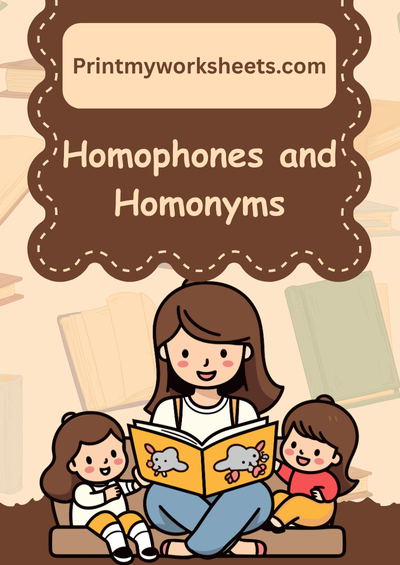
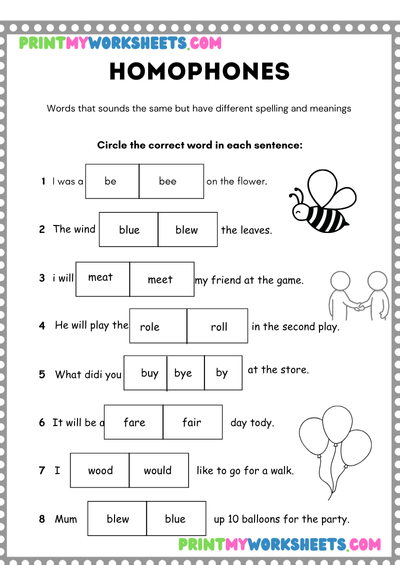
3rd Grade Homophones and Homonyms Worksheets — Free Printable PDF
3rd Grade Homophones & Homonyms Worksheet
Understanding words that sound alike or share spellings but have different meanings is an important milestone in upper elementary language development. This 3rd Grade Homophones & Homonyms Worksheet is designed to help students in the United States strengthen their vocabulary, spelling awareness, and reading comprehension through clear, structured practice. Created for parents, teachers, and homeschool families, this printable resource focuses on helping third graders recognize and correctly use commonly confused words in context.
At this grade level, students are reading longer texts, writing more detailed sentences, and encountering new vocabulary across subjects. Confusion between similar-sounding or similar-looking words can impact both comprehension and written expression. These worksheets provide guided practice that helps students slow down, analyze word meaning, and apply correct usage. With a student-friendly format and age-appropriate activities, this free printable PDF supports consistent learning at home or in the classroom while reinforcing essential English language skills.
What Students Will Learn?
These worksheets focus on helping students clearly understand the differences between homophones and homonyms and how they function in everyday reading and writing. Students learn to identify words that sound the same but have different meanings and spellings, as well as words that share spelling but differ in meaning depending on context.
Activities are designed to strengthen word recognition and meaning through sentence-based practice. Students may match words to definitions, choose the correct word to complete a sentence, or analyze short passages where meaning depends on proper word choice. These exercises encourage careful reading and thoughtful decision-making.
The worksheets support structured learning by progressing from simple word identification to more applied usage. This gradual approach aligns well with third-grade expectations, where students are expected to demonstrate growing independence with vocabulary skills. Clear instructions and consistent layouts help students focus on the task rather than the format. By practicing regularly, learners build stronger language awareness and become more confident in distinguishing between commonly confused words in both reading and writing tasks.
Educational Value & Skill Development
Strong vocabulary skills are closely connected to reading comprehension, writing clarity, and overall academic success. The 3rd Grade Homophones & Homonyms Worksheet supports these areas by encouraging students to think critically about word meaning and usage. Rather than relying on sound alone, students learn to use context clues and sentence structure to determine the correct word.
This type of practice supports cognitive development by strengthening attention to detail, memory, and reasoning skills. Students must compare meanings, recall definitions, and apply knowledge accurately. Over time, this repeated exposure helps reduce common errors in spelling and word choice.
The worksheets also build confidence and independence. As students successfully complete activities on their own, they gain trust in their language skills. This confidence often transfers to classroom discussions, written assignments, and standardized assessments.
Skill progression is another key benefit. Mastery of homophones and homonyms in third grade prepares students for more advanced vocabulary work in later grades, including figurative language, nuanced word meanings, and complex reading passages. These worksheets provide a solid foundation for that continued growth.
Why Focus on Homophones & Homonyms?
Homophones and homonyms can be challenging for students because they require careful attention to meaning rather than just pronunciation or spelling. In third grade, students are expected to move beyond basic decoding and begin reading for deeper understanding. Confusion between similar words can interrupt comprehension and weaken writing quality.
Focusing on this skill helps students become more precise readers and writers. When learners understand how word meaning changes based on spelling or context, they are better equipped to interpret sentences accurately. This skill is especially important as reading materials become more complex in later grades.
Repetition and guided practice are essential for mastering these concepts. Worksheets provide a safe space for students to make mistakes, receive feedback, and improve through consistent exposure. These activities align with early language standards used across the United States, which emphasize vocabulary development, word relationships, and language conventions. Building these skills now supports smoother transitions into upper elementary and middle school language arts expectations.
How to Use These Worksheets?
These printable worksheets are flexible and can be used in many learning environments. In homeschool settings, they work well as part of a weekly language arts routine or as focused practice when a child struggles with word confusion. Parents can review answers together with students to encourage discussion about word meaning.
In classrooms, teachers can use the worksheets during whole-group instruction, small-group rotations, or independent practice time. They are also suitable for homework assignments or quick review activities before quizzes.
The 3rd Grade Homophones & Homonyms Worksheet is provided as a free printable PDF, making it easy to download and reuse throughout the school year. Pages can be printed as needed or used with sheet protectors for repeated practice. This reusability allows educators and families to adapt the worksheets to individual learning needs while maintaining consistency.
Related Worksheets / Extensions:
To continue building language skills, you may also explore related grammar and vocabulary worksheets. Activities focused on synonyms, antonyms, prefixes, and suffixes help expand word knowledge and reinforce meaning. Reading comprehension passages that include challenging vocabulary can also support real-world application.
The 3rd Grade Homophones & Homonyms Worksheet pairs well with writing exercises where students create their own sentences using similar-sounding words correctly. You may also consider exploring the same topic for second grade as review or fourth grade as an extension, allowing students to strengthen skills across multiple levels.
Frequently Asked Questions
Q1. Is this worksheet free to download?Yes, this worksheet is 100% free to download and print. No account, subscription, or payment is required. Click the Download Now button to get your free PDF instantly.Q2. What format is this worksheet available in?This worksheet is available as a printable PDF file. It is black-and-white, printer-friendly, and works on any standard home or classroom printer using A4 or US Letter paper.Q3. Can I use this worksheet for both classroom and home learning?Yes, these worksheets are designed for use by classroom teachers, homeschool parents, and tutors. They can be used as morning work, homework, revision practice, or learning centre activities.Q4. Is this worksheet aligned with Common Core ELA standards?Yes, this English worksheet is aligned with U.S. Common Core English Language Arts standards and supports foundational literacy development.Q5. Is this worksheet suitable for ESL or ELL students?This worksheet can be used as a supplemental resource for ESL and ELL students, particularly for vocabulary building and language pattern practice.3rd Grade Homophones and Homonyms Worksheets — Free Printable PDF
3rd Grade Homophones & Homonyms Worksheet
Understanding words that sound alike or share spellings but have different meanings is an important milestone in upper elementary language development. This 3rd Grade Homophones & Homonyms Worksheet is designed to help students in the United States strengthen their vocabulary, spelling awareness, and reading comprehension through clear, structured practice. Created for parents, teachers, and homeschool families, this printable resource focuses on helping third graders recognize and correctly use commonly confused words in context.
At this grade level, students are reading longer texts, writing more detailed sentences, and encountering new vocabulary across subjects. Confusion between similar-sounding or similar-looking words can impact both comprehension and written expression. These worksheets provide guided practice that helps students slow down, analyze word meaning, and apply correct usage. With a student-friendly format and age-appropriate activities, this free printable PDF supports consistent learning at home or in the classroom while reinforcing essential English language skills.
What Students Will Learn?
These worksheets focus on helping students clearly understand the differences between homophones and homonyms and how they function in everyday reading and writing. Students learn to identify words that sound the same but have different meanings and spellings, as well as words that share spelling but differ in meaning depending on context.
Activities are designed to strengthen word recognition and meaning through sentence-based practice. Students may match words to definitions, choose the correct word to complete a sentence, or analyze short passages where meaning depends on proper word choice. These exercises encourage careful reading and thoughtful decision-making.
The worksheets support structured learning by progressing from simple word identification to more applied usage. This gradual approach aligns well with third-grade expectations, where students are expected to demonstrate growing independence with vocabulary skills. Clear instructions and consistent layouts help students focus on the task rather than the format. By practicing regularly, learners build stronger language awareness and become more confident in distinguishing between commonly confused words in both reading and writing tasks.
Educational Value & Skill Development
Strong vocabulary skills are closely connected to reading comprehension, writing clarity, and overall academic success. The 3rd Grade Homophones & Homonyms Worksheet supports these areas by encouraging students to think critically about word meaning and usage. Rather than relying on sound alone, students learn to use context clues and sentence structure to determine the correct word.
This type of practice supports cognitive development by strengthening attention to detail, memory, and reasoning skills. Students must compare meanings, recall definitions, and apply knowledge accurately. Over time, this repeated exposure helps reduce common errors in spelling and word choice.
The worksheets also build confidence and independence. As students successfully complete activities on their own, they gain trust in their language skills. This confidence often transfers to classroom discussions, written assignments, and standardized assessments.
Skill progression is another key benefit. Mastery of homophones and homonyms in third grade prepares students for more advanced vocabulary work in later grades, including figurative language, nuanced word meanings, and complex reading passages. These worksheets provide a solid foundation for that continued growth.
Why Focus on Homophones & Homonyms?
Homophones and homonyms can be challenging for students because they require careful attention to meaning rather than just pronunciation or spelling. In third grade, students are expected to move beyond basic decoding and begin reading for deeper understanding. Confusion between similar words can interrupt comprehension and weaken writing quality.
Focusing on this skill helps students become more precise readers and writers. When learners understand how word meaning changes based on spelling or context, they are better equipped to interpret sentences accurately. This skill is especially important as reading materials become more complex in later grades.
Repetition and guided practice are essential for mastering these concepts. Worksheets provide a safe space for students to make mistakes, receive feedback, and improve through consistent exposure. These activities align with early language standards used across the United States, which emphasize vocabulary development, word relationships, and language conventions. Building these skills now supports smoother transitions into upper elementary and middle school language arts expectations.
How to Use These Worksheets?
These printable worksheets are flexible and can be used in many learning environments. In homeschool settings, they work well as part of a weekly language arts routine or as focused practice when a child struggles with word confusion. Parents can review answers together with students to encourage discussion about word meaning.
In classrooms, teachers can use the worksheets during whole-group instruction, small-group rotations, or independent practice time. They are also suitable for homework assignments or quick review activities before quizzes.
The 3rd Grade Homophones & Homonyms Worksheet is provided as a free printable PDF, making it easy to download and reuse throughout the school year. Pages can be printed as needed or used with sheet protectors for repeated practice. This reusability allows educators and families to adapt the worksheets to individual learning needs while maintaining consistency.
Related Worksheets / Extensions:
To continue building language skills, you may also explore related grammar and vocabulary worksheets. Activities focused on synonyms, antonyms, prefixes, and suffixes help expand word knowledge and reinforce meaning. Reading comprehension passages that include challenging vocabulary can also support real-world application.
The 3rd Grade Homophones & Homonyms Worksheet pairs well with writing exercises where students create their own sentences using similar-sounding words correctly. You may also consider exploring the same topic for second grade as review or fourth grade as an extension, allowing students to strengthen skills across multiple levels.
Frequently Asked Questions
Q1. Is this worksheet free to download?Yes, this worksheet is 100% free to download and print. No account, subscription, or payment is required. Click the Download Now button to get your free PDF instantly.Q2. What format is this worksheet available in?This worksheet is available as a printable PDF file. It is black-and-white, printer-friendly, and works on any standard home or classroom printer using A4 or US Letter paper.Q3. Can I use this worksheet for both classroom and home learning?Yes, these worksheets are designed for use by classroom teachers, homeschool parents, and tutors. They can be used as morning work, homework, revision practice, or learning centre activities.Q4. Is this worksheet aligned with Common Core ELA standards?Yes, this English worksheet is aligned with U.S. Common Core English Language Arts standards and supports foundational literacy development.Q5. Is this worksheet suitable for ESL or ELL students?This worksheet can be used as a supplemental resource for ESL and ELL students, particularly for vocabulary building and language pattern practice.
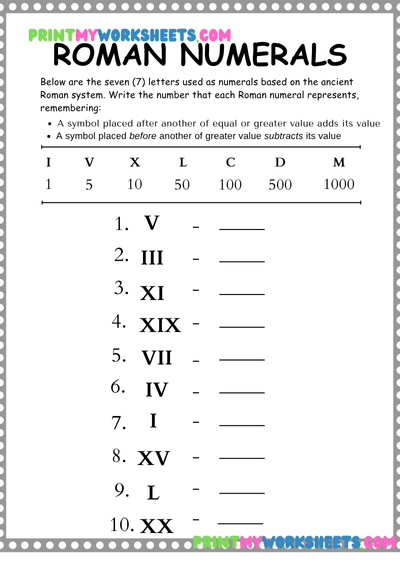
3rd Grade Roman Numerals 1-30 Worksheet | Free Printable PDF
3rd Grade Roman Numerals 1-30 Worksheet
Learning Roman numerals helps students understand how numbers have been represented across history while strengthening number sense and pattern recognition. The 3rd Grade Roman Numerals 1-30 Worksheet is designed to give students clear, structured practice with reading, writing, and identifying Roman numerals from 1 to 30. This printable resource is ideal for U.S. parents, classroom teachers, and homeschool families looking for an easy-to-use math activity that supports foundational number skills.
At the third-grade level, students are expected to expand their understanding of numbers beyond standard forms. Roman numerals are commonly introduced in elementary math standards, clocks, book chapters, timelines, and everyday contexts. These worksheets provide guided exposure that helps students become comfortable recognizing symbols such as I, V, X, and combinations that represent values up to 30. With age-appropriate exercises and a simple layout, this free printable PDF supports independent practice, small-group instruction, and review, helping students build confidence with an important math concept.
What Students Will Learn?
These worksheets focus on helping students understand how Roman numerals work and how they connect to standard numbers. Students learn to identify Roman numeral symbols and recognize how different combinations represent values from 1 through 30. Early activities emphasize recognition and matching, allowing learners to become familiar with the symbols before moving into more applied tasks.
As students progress, they practice converting standard numbers into Roman numerals and Roman numerals into standard numbers. This two-way practice strengthens understanding and helps prevent memorization without meaning. Some activities may include filling in missing numerals, selecting correct answers, or writing numerals independently.
The worksheets are designed to support structured learning with a gradual increase in difficulty. Clear instructions and consistent formatting help students focus on the math rather than the layout. The activities align well with third-grade expectations, supporting number sense, logical thinking, and attention to detail. By practicing Roman numerals within a limited and manageable range, students build a strong foundation that prepares them for more advanced math concepts later on.
Educational Value & Skill Development
Understanding Roman numerals supports more than just math knowledge; it also strengthens reasoning and pattern recognition skills. The 3rd Grade Roman Numerals 1-30 Worksheet helps students analyze how symbols combine to form values, encouraging them to think critically rather than rely on rote memorization. This analytical approach supports deeper learning and long-term retention.
Academically, these worksheets reinforce number awareness and strengthen connections between different number systems. Students learn that numbers can be represented in multiple ways, which supports flexibility in thinking and problem-solving. This understanding is helpful not only in math but also in reading, history, and real-world contexts where Roman numerals appear.
Cognitively, the activities encourage focus, sequencing, and comparison. Students must pay close attention to symbol order and value, which helps build concentration and accuracy. Completing worksheets independently also supports confidence and responsibility.
As students gain mastery within the 1–30 range, they are better prepared to recognize Roman numerals in higher numbers later on. This progression supports smooth skill development and readiness for future grade-level math expectations.
Why Focus on Roman Numerals 1–30?
Roman numerals are a key part of elementary math standards and are often introduced in the upper elementary grades. Focusing on numerals from 1 to 30 allows students to learn the system without becoming overwhelmed. This limited range helps learners understand how symbols repeat and combine to represent different values.
Developing this skill supports future learning in both math and other subjects. Roman numerals commonly appear on clocks, outlines, book chapters, and historical dates. When students recognize these numerals confidently, they are better equipped to interpret information across academic areas.
Repetition and guided practice are essential when learning a new number system. Worksheets provide a structured way for students to practice consistently, receive feedback, and correct mistakes. These activities align with early math learning standards used across the United States, which emphasize number representation, pattern recognition, and reasoning. By mastering Roman numerals early, students build a strong foundation that supports continued success in mathematics.
How to Use These Worksheets?
These printable worksheets are flexible and easy to integrate into different learning environments. In homeschool settings, they can be used as part of a math lesson or as focused practice when introducing Roman numerals. Parents can work alongside students, reviewing answers and discussing patterns together.
In classrooms, teachers may use the worksheets for whole-class instruction, math centers, small-group practice, or independent work. They are also helpful for review sessions or quick assessments to check understanding.
The 3rd Grade Roman Numerals 1-30 Worksheet is provided as a free printable PDF, making it simple to download and reuse throughout the school year. Pages can be printed multiple times or placed in sheet protectors for repeated practice with dry-erase markers. This reusability allows educators and families to adapt the worksheets to different learning needs while maintaining consistent instruction.
Related Worksheets / Extensions:
Frequently Asked Questions
Q1. Is this worksheet free to download?Yes, this worksheet is 100% free to download and print. No account, subscription, or payment is required. Click the Download Now button to get your free PDF instantly.Q2. What format is this worksheet available in?This worksheet is available as a printable PDF file. It is black-and-white, printer-friendly, and works on any standard home or classroom printer using A4 or US Letter paper.Q3. Can I use this worksheet for both classroom and home learning?Yes, these worksheets are designed for use by classroom teachers, homeschool parents, and tutors. They can be used as morning work, homework, revision practice, or learning centre activities.Q4. Is this worksheet suitable for extra practice or exam preparation?Yes, this worksheet is ideal for supplemental practice, homework reinforcement, test preparation, and homeschool math lessons.Q5. Does this math worksheet include an answer key?Yes, an answer key is included in the PDF so parents and teachers can quickly check student responses without manual calculation.3rd Grade Roman Numerals 1-30 Worksheet | Free Printable PDF
3rd Grade Roman Numerals 1-30 Worksheet
Learning Roman numerals helps students understand how numbers have been represented across history while strengthening number sense and pattern recognition. The 3rd Grade Roman Numerals 1-30 Worksheet is designed to give students clear, structured practice with reading, writing, and identifying Roman numerals from 1 to 30. This printable resource is ideal for U.S. parents, classroom teachers, and homeschool families looking for an easy-to-use math activity that supports foundational number skills.
At the third-grade level, students are expected to expand their understanding of numbers beyond standard forms. Roman numerals are commonly introduced in elementary math standards, clocks, book chapters, timelines, and everyday contexts. These worksheets provide guided exposure that helps students become comfortable recognizing symbols such as I, V, X, and combinations that represent values up to 30. With age-appropriate exercises and a simple layout, this free printable PDF supports independent practice, small-group instruction, and review, helping students build confidence with an important math concept.
What Students Will Learn?
These worksheets focus on helping students understand how Roman numerals work and how they connect to standard numbers. Students learn to identify Roman numeral symbols and recognize how different combinations represent values from 1 through 30. Early activities emphasize recognition and matching, allowing learners to become familiar with the symbols before moving into more applied tasks.
As students progress, they practice converting standard numbers into Roman numerals and Roman numerals into standard numbers. This two-way practice strengthens understanding and helps prevent memorization without meaning. Some activities may include filling in missing numerals, selecting correct answers, or writing numerals independently.
The worksheets are designed to support structured learning with a gradual increase in difficulty. Clear instructions and consistent formatting help students focus on the math rather than the layout. The activities align well with third-grade expectations, supporting number sense, logical thinking, and attention to detail. By practicing Roman numerals within a limited and manageable range, students build a strong foundation that prepares them for more advanced math concepts later on.
Educational Value & Skill Development
Understanding Roman numerals supports more than just math knowledge; it also strengthens reasoning and pattern recognition skills. The 3rd Grade Roman Numerals 1-30 Worksheet helps students analyze how symbols combine to form values, encouraging them to think critically rather than rely on rote memorization. This analytical approach supports deeper learning and long-term retention.
Academically, these worksheets reinforce number awareness and strengthen connections between different number systems. Students learn that numbers can be represented in multiple ways, which supports flexibility in thinking and problem-solving. This understanding is helpful not only in math but also in reading, history, and real-world contexts where Roman numerals appear.
Cognitively, the activities encourage focus, sequencing, and comparison. Students must pay close attention to symbol order and value, which helps build concentration and accuracy. Completing worksheets independently also supports confidence and responsibility.
As students gain mastery within the 1–30 range, they are better prepared to recognize Roman numerals in higher numbers later on. This progression supports smooth skill development and readiness for future grade-level math expectations.
Why Focus on Roman Numerals 1–30?
Roman numerals are a key part of elementary math standards and are often introduced in the upper elementary grades. Focusing on numerals from 1 to 30 allows students to learn the system without becoming overwhelmed. This limited range helps learners understand how symbols repeat and combine to represent different values.
Developing this skill supports future learning in both math and other subjects. Roman numerals commonly appear on clocks, outlines, book chapters, and historical dates. When students recognize these numerals confidently, they are better equipped to interpret information across academic areas.
Repetition and guided practice are essential when learning a new number system. Worksheets provide a structured way for students to practice consistently, receive feedback, and correct mistakes. These activities align with early math learning standards used across the United States, which emphasize number representation, pattern recognition, and reasoning. By mastering Roman numerals early, students build a strong foundation that supports continued success in mathematics.
How to Use These Worksheets?
These printable worksheets are flexible and easy to integrate into different learning environments. In homeschool settings, they can be used as part of a math lesson or as focused practice when introducing Roman numerals. Parents can work alongside students, reviewing answers and discussing patterns together.
In classrooms, teachers may use the worksheets for whole-class instruction, math centers, small-group practice, or independent work. They are also helpful for review sessions or quick assessments to check understanding.
The 3rd Grade Roman Numerals 1-30 Worksheet is provided as a free printable PDF, making it simple to download and reuse throughout the school year. Pages can be printed multiple times or placed in sheet protectors for repeated practice with dry-erase markers. This reusability allows educators and families to adapt the worksheets to different learning needs while maintaining consistent instruction.
Related Worksheets / Extensions:
Frequently Asked Questions
Q1. Is this worksheet free to download?Yes, this worksheet is 100% free to download and print. No account, subscription, or payment is required. Click the Download Now button to get your free PDF instantly.Q2. What format is this worksheet available in?This worksheet is available as a printable PDF file. It is black-and-white, printer-friendly, and works on any standard home or classroom printer using A4 or US Letter paper.Q3. Can I use this worksheet for both classroom and home learning?Yes, these worksheets are designed for use by classroom teachers, homeschool parents, and tutors. They can be used as morning work, homework, revision practice, or learning centre activities.Q4. Is this worksheet suitable for extra practice or exam preparation?Yes, this worksheet is ideal for supplemental practice, homework reinforcement, test preparation, and homeschool math lessons.Q5. Does this math worksheet include an answer key?Yes, an answer key is included in the PDF so parents and teachers can quickly check student responses without manual calculation.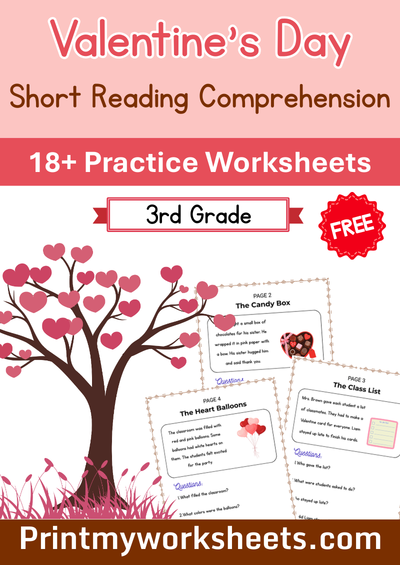
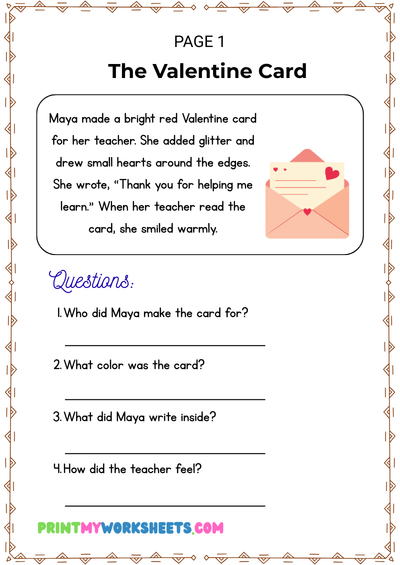
3rd Grade Valentines Reading Comprehension PDF – February Passages with Questions and ELA Skill Practice
3rd Grade Valentines Reading Comprehension PDF
The 3rd Grade Valentines Reading Comprehension PDF is a thoughtfully designed printable resource that helps students strengthen reading skills through engaging, seasonal content. Created for U.S. parents, classroom teachers, and homeschool families, this worksheet set combines meaningful reading passages with standards-aligned comprehension questions tailored specifically for third graders.
At the third-grade level, students are expected to move beyond basic decoding and begin analyzing text more deeply. They learn to identify main ideas, describe characters, understand vocabulary in context, and draw conclusions from what they read. Valentine-themed reading activities make this practice both relatable and enjoyable while maintaining academic focus. With structured passages and purposeful questions, this printable PDF supports literacy growth in a way that feels motivating and developmentally appropriate for eight- and nine-year-old learners.
What Students Will Learn?
These worksheets help students practice essential third-grade reading comprehension skills in a structured and engaging format. Each passage is written at an appropriate reading level and focuses on clear story structure, descriptive details, and meaningful themes related to friendship, kindness, and seasonal traditions.
Students will work on identifying the main idea and supporting details within short stories or informational texts. They will practice answering multiple-choice and short-response questions that require them to refer back to the text for evidence. Additional activities may include sequencing events, determining the meaning of unfamiliar words using context clues, and identifying character traits.
The reading tasks are carefully organized to build confidence step by step. Questions begin with literal comprehension and gradually move toward inferential thinking. This progression supports age-appropriate expectations and aligns with U.S. third-grade literacy standards. By practicing regularly, students strengthen both reading fluency and comprehension accuracy while building stronger analytical skills.
Educational Value & Skill Development
The 3rd Grade Valentines Reading Comprehension PDF provides strong academic and developmental value for growing readers. Academically, it reinforces essential literacy skills such as summarizing, identifying themes, and explaining answers using textual evidence. These skills are foundational for upper elementary reading success.
Cognitively, comprehension practice improves focus, memory retention, and critical thinking. Students must read carefully, process information, and respond thoughtfully to questions. This helps develop analytical habits that extend beyond reading into other academic subjects.
Working with structured reading passages also promotes independence. As students gain confidence in answering comprehension questions on their own, they develop stronger self-monitoring skills. They learn to reread when necessary, check their answers, and correct misunderstandings.
Additionally, themed reading materials can increase engagement. Seasonal topics like Valentine’s Day provide a familiar and positive context for practicing literacy skills. When students enjoy what they are reading, they are more likely to stay motivated and complete assignments carefully.
Why Focus on Valentines Reading Comprehension?
Reading comprehension is one of the most important academic skills developed in third grade. At this stage, students transition from “learning to read” to “reading to learn.” Practicing comprehension with themed passages helps maintain interest while strengthening core literacy abilities.
Seasonal reading activities encourage repeated exposure to structured texts without feeling repetitive. Students encounter new vocabulary, varied sentence structures, and different text formats while staying engaged with a consistent theme. This repetition builds fluency and understanding over time.
Comprehension skills practiced in third grade directly support future academic success. Students who can analyze passages, draw conclusions, and cite evidence are better prepared for more advanced reading tasks in later grades. Guided and independent practice with structured worksheets ensures students meet grade-level expectations while developing long-term reading confidence.
How to Use These Worksheets?
The 3rd Grade Valentines Reading Comprehension PDF is flexible and easy to use in multiple learning settings. In classrooms, teachers can incorporate the worksheets into literacy centers, small-group reading sessions, or independent practice time. They also work well as seasonal assignments during February.
For homeschool families, this free printable PDF can be added to a daily reading routine. Parents may choose to read passages aloud together first and then guide children through the comprehension questions. Alternatively, students can complete the worksheets independently and review answers afterward.
Because the resource is available as a free printable PDF, it can be downloaded quickly and printed as needed. Teachers and parents may organize pages into a literacy binder or use them for review before reading assessments. The worksheets are designed to be reusable and adaptable, making them a practical addition to any third-grade reading plan.
Related Worksheets / Extensions:
You may also like:
3rd grade reading comprehension passages for other seasons
Character analysis worksheets
Main idea and supporting details practice pages
Vocabulary and context clues activities
The 3rd Grade Valentines Reading Comprehension PDF can be paired with additional reading resources to create a balanced literacy plan. Combining themed comprehension practice with vocabulary, writing prompts, and fluency exercises helps students strengthen multiple skills at once. Regular exposure to diverse reading materials ensures steady progress and prepares students for more advanced text analysis in future grades.
You may also like:
[gallery ids="7080,6750,5987"]Frequently Asked Questions
Q1. What format is this worksheet available in?This worksheet is available as a printable PDF file. It is black-and-white, printer-friendly, and works on any standard home or classroom printer using A4 or US Letter paper.Q2. Is this worksheet free to download?Yes, this worksheet is 100% free to download and print. No account, subscription, or payment is required. Click the Download Now button to get your free PDF instantly.Q3. Can I use this worksheet for both classroom and home learning?Yes, these worksheets are designed for use by classroom teachers, homeschool parents, and tutors. They can be used as morning work, homework, revision practice, or learning centre activities.Q4. Is this worksheet aligned with Common Core ELA standards?Yes, this English worksheet is aligned with U.S. Common Core English Language Arts standards and supports foundational literacy development.Q5. Can this worksheet be used for phonics instruction?Yes, this worksheet supports phonics-based reading instruction and is suitable for early readers building letter-sound recognition skills.3rd Grade Valentines Reading Comprehension PDF – February Passages with Questions and ELA Skill Practice
3rd Grade Valentines Reading Comprehension PDF
The 3rd Grade Valentines Reading Comprehension PDF is a thoughtfully designed printable resource that helps students strengthen reading skills through engaging, seasonal content. Created for U.S. parents, classroom teachers, and homeschool families, this worksheet set combines meaningful reading passages with standards-aligned comprehension questions tailored specifically for third graders.
At the third-grade level, students are expected to move beyond basic decoding and begin analyzing text more deeply. They learn to identify main ideas, describe characters, understand vocabulary in context, and draw conclusions from what they read. Valentine-themed reading activities make this practice both relatable and enjoyable while maintaining academic focus. With structured passages and purposeful questions, this printable PDF supports literacy growth in a way that feels motivating and developmentally appropriate for eight- and nine-year-old learners.
What Students Will Learn?
These worksheets help students practice essential third-grade reading comprehension skills in a structured and engaging format. Each passage is written at an appropriate reading level and focuses on clear story structure, descriptive details, and meaningful themes related to friendship, kindness, and seasonal traditions.
Students will work on identifying the main idea and supporting details within short stories or informational texts. They will practice answering multiple-choice and short-response questions that require them to refer back to the text for evidence. Additional activities may include sequencing events, determining the meaning of unfamiliar words using context clues, and identifying character traits.
The reading tasks are carefully organized to build confidence step by step. Questions begin with literal comprehension and gradually move toward inferential thinking. This progression supports age-appropriate expectations and aligns with U.S. third-grade literacy standards. By practicing regularly, students strengthen both reading fluency and comprehension accuracy while building stronger analytical skills.
Educational Value & Skill Development
The 3rd Grade Valentines Reading Comprehension PDF provides strong academic and developmental value for growing readers. Academically, it reinforces essential literacy skills such as summarizing, identifying themes, and explaining answers using textual evidence. These skills are foundational for upper elementary reading success.
Cognitively, comprehension practice improves focus, memory retention, and critical thinking. Students must read carefully, process information, and respond thoughtfully to questions. This helps develop analytical habits that extend beyond reading into other academic subjects.
Working with structured reading passages also promotes independence. As students gain confidence in answering comprehension questions on their own, they develop stronger self-monitoring skills. They learn to reread when necessary, check their answers, and correct misunderstandings.
Additionally, themed reading materials can increase engagement. Seasonal topics like Valentine’s Day provide a familiar and positive context for practicing literacy skills. When students enjoy what they are reading, they are more likely to stay motivated and complete assignments carefully.
Why Focus on Valentines Reading Comprehension?
Reading comprehension is one of the most important academic skills developed in third grade. At this stage, students transition from “learning to read” to “reading to learn.” Practicing comprehension with themed passages helps maintain interest while strengthening core literacy abilities.
Seasonal reading activities encourage repeated exposure to structured texts without feeling repetitive. Students encounter new vocabulary, varied sentence structures, and different text formats while staying engaged with a consistent theme. This repetition builds fluency and understanding over time.
Comprehension skills practiced in third grade directly support future academic success. Students who can analyze passages, draw conclusions, and cite evidence are better prepared for more advanced reading tasks in later grades. Guided and independent practice with structured worksheets ensures students meet grade-level expectations while developing long-term reading confidence.
How to Use These Worksheets?
The 3rd Grade Valentines Reading Comprehension PDF is flexible and easy to use in multiple learning settings. In classrooms, teachers can incorporate the worksheets into literacy centers, small-group reading sessions, or independent practice time. They also work well as seasonal assignments during February.
For homeschool families, this free printable PDF can be added to a daily reading routine. Parents may choose to read passages aloud together first and then guide children through the comprehension questions. Alternatively, students can complete the worksheets independently and review answers afterward.
Because the resource is available as a free printable PDF, it can be downloaded quickly and printed as needed. Teachers and parents may organize pages into a literacy binder or use them for review before reading assessments. The worksheets are designed to be reusable and adaptable, making them a practical addition to any third-grade reading plan.
Related Worksheets / Extensions:
You may also like:
3rd grade reading comprehension passages for other seasons
Character analysis worksheets
Main idea and supporting details practice pages
Vocabulary and context clues activities
The 3rd Grade Valentines Reading Comprehension PDF can be paired with additional reading resources to create a balanced literacy plan. Combining themed comprehension practice with vocabulary, writing prompts, and fluency exercises helps students strengthen multiple skills at once. Regular exposure to diverse reading materials ensures steady progress and prepares students for more advanced text analysis in future grades.