
5th Grade Reading Comprehension Non-Fiction Worksheets PDF – Informational Text Practice with Answer Key
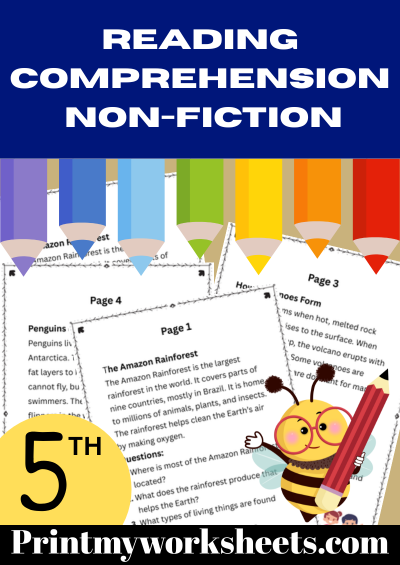
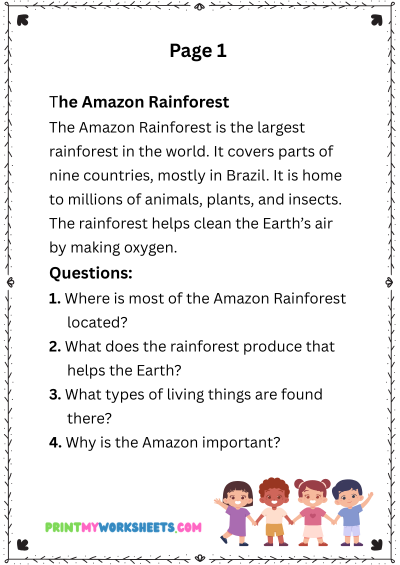
5th Grade Reading Comprehension Non-Fiction Worksheets PDF
These worksheets are designed for US homeschool parents, teachers, and classrooms. These engaging worksheets help students develop essential reading, reasoning, and analytical skills while exploring factual, informative, and inspiring non-fiction passages.
Each worksheet includes interesting non-fiction texts about history, science, geography, and nature — followed by comprehension questions, vocabulary tasks, and inference challenges. Students will practice identifying main ideas, supporting details, cause-and-effect relationships, and author’s purpose, improving their ability to understand and interpret informational texts effectively.
Why learn through non-fiction comprehension?
Non-fiction reading builds real-world knowledge, academic vocabulary, and critical thinking, essential for higher-level learning. It helps students connect classroom lessons to everyday life while strengthening research and study skills. These worksheets encourage curiosity and confidence in analyzing factual material with accuracy and clarity.
Perfect for classroom learning, homeschool reading practice, or after-school enrichment, this free printable PDF makes non-fiction reading fun, interactive, and skill-building.
Download your Reading Comprehension Non-Fiction Worksheets today and help your 5th grader become a confident reader ready to explore the real world through the power of words and knowledge!
You may also like :
[gallery ids="6373,6336,5662"]Frequently Asked Questions
Q1. What format is this worksheet available in?This worksheet is available as a printable PDF file. It is black-and-white, printer-friendly, and works on any standard home or classroom printer using A4 or US Letter paper.Q2. Is this worksheet free to download?Yes, this worksheet is 100% free to download and print. No account, subscription, or payment is required. Click the Download Now button to get your free PDF instantly.Q3. Can I use this worksheet for both classroom and home learning?Yes, these worksheets are designed for use by classroom teachers, homeschool parents, and tutors. They can be used as morning work, homework, revision practice, or learning centre activities.Q4. Is this worksheet aligned with Common Core ELA standards?Yes, this English worksheet is aligned with U.S. Common Core English Language Arts standards and supports foundational literacy development.Q5. Can this worksheet be used for phonics instruction?Yes, this worksheet supports phonics-based reading instruction and is suitable for early readers building letter-sound recognition skills.5th Grade Reading Comprehension Non-Fiction Worksheets PDF – Informational Text Practice with Answer Key
5th Grade Reading Comprehension Non-Fiction Worksheets PDF
These worksheets are designed for US homeschool parents, teachers, and classrooms. These engaging worksheets help students develop essential reading, reasoning, and analytical skills while exploring factual, informative, and inspiring non-fiction passages.
Each worksheet includes interesting non-fiction texts about history, science, geography, and nature — followed by comprehension questions, vocabulary tasks, and inference challenges. Students will practice identifying main ideas, supporting details, cause-and-effect relationships, and author’s purpose, improving their ability to understand and interpret informational texts effectively.
Why learn through non-fiction comprehension?
Non-fiction reading builds real-world knowledge, academic vocabulary, and critical thinking, essential for higher-level learning. It helps students connect classroom lessons to everyday life while strengthening research and study skills. These worksheets encourage curiosity and confidence in analyzing factual material with accuracy and clarity.
Perfect for classroom learning, homeschool reading practice, or after-school enrichment, this free printable PDF makes non-fiction reading fun, interactive, and skill-building.
Download your Reading Comprehension Non-Fiction Worksheets today and help your 5th grader become a confident reader ready to explore the real world through the power of words and knowledge!
You may also like :
[gallery ids="6373,6336,5662"]Frequently Asked Questions
Q1. What format is this worksheet available in?This worksheet is available as a printable PDF file. It is black-and-white, printer-friendly, and works on any standard home or classroom printer using A4 or US Letter paper.Q2. Is this worksheet free to download?Yes, this worksheet is 100% free to download and print. No account, subscription, or payment is required. Click the Download Now button to get your free PDF instantly.Q3. Can I use this worksheet for both classroom and home learning?Yes, these worksheets are designed for use by classroom teachers, homeschool parents, and tutors. They can be used as morning work, homework, revision practice, or learning centre activities.Q4. Is this worksheet aligned with Common Core ELA standards?Yes, this English worksheet is aligned with U.S. Common Core English Language Arts standards and supports foundational literacy development.Q5. Can this worksheet be used for phonics instruction?Yes, this worksheet supports phonics-based reading instruction and is suitable for early readers building letter-sound recognition skills.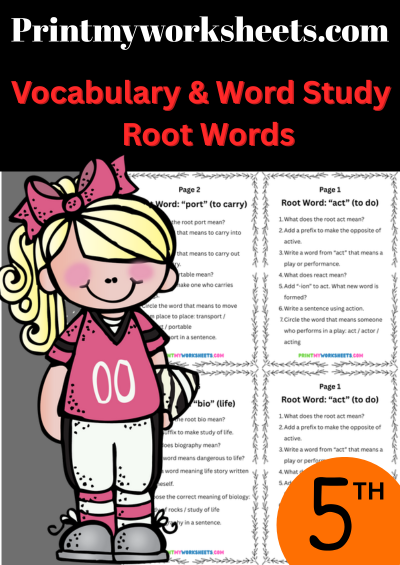
5th Grade Root Words Worksheets PDF – Easy Home Vocabulary Review Pack
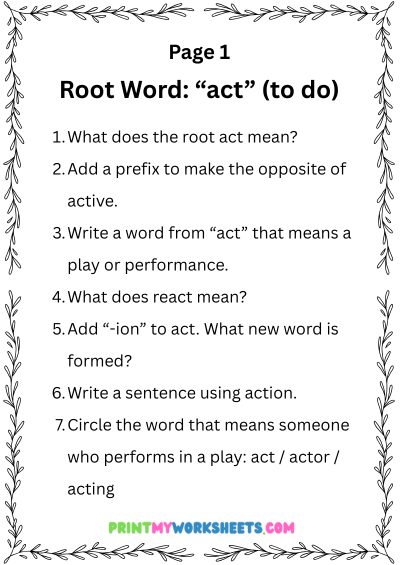
5th Grade Root Words Worksheets PDF
These worksheets are designed for US homeschool parents, teachers, and classrooms! These worksheets help kids understand how root words form the basis of English vocabulary, improving both comprehension and spelling skills.
Each worksheet includes fun word-building exercises, matching activities, and vocabulary challenges that teach students how prefixes, suffixes, and root words combine to create meaning. Words like telegraph, biology, and audible come to life as students explore how root meanings connect across different words.
Why learn root words? Understanding root words strengthens reading fluency, word decoding, and vocabulary expansion. It helps children identify unfamiliar words by breaking them down into understandable parts — a vital skill for reading, writing, and standardized tests. These worksheets make complex word study engaging through real-world examples, puzzles, and creative writing tasks.
Perfect for classroom lessons, homeschool enrichment, or self-paced study, this free printable PDF makes vocabulary learning interactive, effective, and fun.
Download your Vocabulary & Word Study – Root Words Worksheets today and watch your 5th grader grow into a confident, curious, and word-smart learner!
Frequently Asked Questions
Q1. What format is this worksheet available in?This worksheet is available as a printable PDF file. It is black-and-white, printer-friendly, and works on any standard home or classroom printer using A4 or US Letter paper.Q2. Is this worksheet free to download?Yes, this worksheet is 100% free to download and print. No account, subscription, or payment is required. Click the Download Now button to get your free PDF instantly.Q3. Can I use this worksheet for both classroom and home learning?Yes, these worksheets are designed for use by classroom teachers, homeschool parents, and tutors. They can be used as morning work, homework, revision practice, or learning centre activities.Q4. Is this worksheet aligned with Common Core ELA standards?Yes, this English worksheet is aligned with U.S. Common Core English Language Arts standards and supports foundational literacy development.Q5. Can this worksheet be used for phonics instruction?Yes, this worksheet supports phonics-based reading instruction and is suitable for early readers building letter-sound recognition skills.5th Grade Root Words Worksheets PDF – Easy Home Vocabulary Review Pack
5th Grade Root Words Worksheets PDF
These worksheets are designed for US homeschool parents, teachers, and classrooms! These worksheets help kids understand how root words form the basis of English vocabulary, improving both comprehension and spelling skills.
Each worksheet includes fun word-building exercises, matching activities, and vocabulary challenges that teach students how prefixes, suffixes, and root words combine to create meaning. Words like telegraph, biology, and audible come to life as students explore how root meanings connect across different words.
Why learn root words? Understanding root words strengthens reading fluency, word decoding, and vocabulary expansion. It helps children identify unfamiliar words by breaking them down into understandable parts — a vital skill for reading, writing, and standardized tests. These worksheets make complex word study engaging through real-world examples, puzzles, and creative writing tasks.
Perfect for classroom lessons, homeschool enrichment, or self-paced study, this free printable PDF makes vocabulary learning interactive, effective, and fun.
Download your Vocabulary & Word Study – Root Words Worksheets today and watch your 5th grader grow into a confident, curious, and word-smart learner!
Frequently Asked Questions
Q1. What format is this worksheet available in?This worksheet is available as a printable PDF file. It is black-and-white, printer-friendly, and works on any standard home or classroom printer using A4 or US Letter paper.Q2. Is this worksheet free to download?Yes, this worksheet is 100% free to download and print. No account, subscription, or payment is required. Click the Download Now button to get your free PDF instantly.Q3. Can I use this worksheet for both classroom and home learning?Yes, these worksheets are designed for use by classroom teachers, homeschool parents, and tutors. They can be used as morning work, homework, revision practice, or learning centre activities.Q4. Is this worksheet aligned with Common Core ELA standards?Yes, this English worksheet is aligned with U.S. Common Core English Language Arts standards and supports foundational literacy development.Q5. Can this worksheet be used for phonics instruction?Yes, this worksheet supports phonics-based reading instruction and is suitable for early readers building letter-sound recognition skills.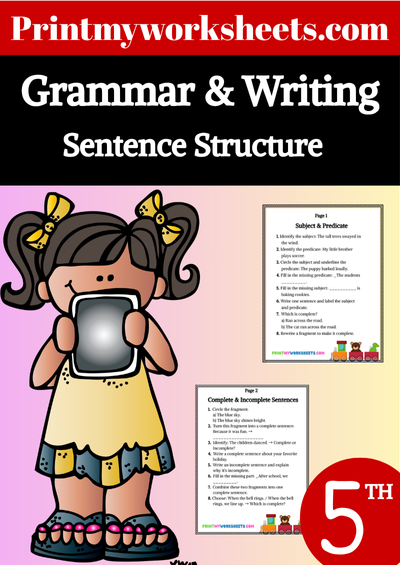
5th Grade Sentence Structure Worksheets PDF – Grammar and Writing Practice with Answer Key
5th Grade Sentence Structure Worksheets PDF
Clear and effective writing depends on strong sentence structure, especially as students move into upper elementary grades. The 5th Grade Sentence Structure Worksheets PDF is designed to help students develop the skills they need to write complete, well-organized sentences with confidence. This printable worksheet resource is created for U.S. parents, classroom teachers, and homeschool families who want structured, reliable practice that supports grade-level language arts expectations.
By fifth grade, students are expected to write longer responses, multi-paragraph compositions, and subject-specific explanations. Sentence structure plays a key role in helping students communicate ideas clearly and logically. These worksheets focus on guiding learners through essential sentence-building skills, including clarity, variety, and correctness. With a clean layout and step-by-step activities, this free printable PDF supports both independent learning and guided instruction, helping students strengthen their writing foundation before transitioning to middle school.
What Students Will Learn?
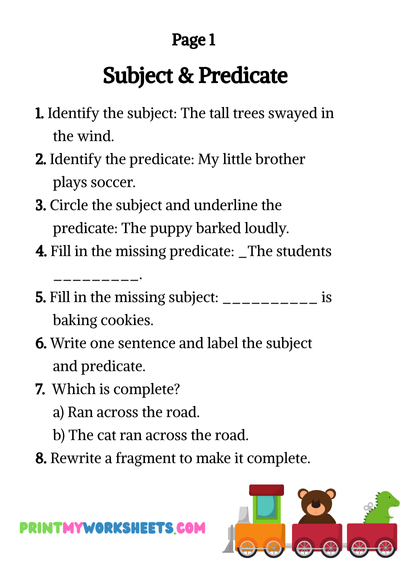
These worksheets help students understand how sentences are built and how structure affects meaning and clarity. Learners practice identifying subjects and predicates, recognizing complete sentences, and correcting common errors such as fragments and run-on sentences. These foundational skills are essential for producing clear and readable writing.
Students also explore different sentence types, including simple, compound, and complex sentences. Activities may include combining shorter sentences, rearranging sentence parts for better flow, or choosing appropriate conjunctions and punctuation. These exercises encourage students to think critically about how ideas connect within a sentence.
The worksheets support structured learning by following consistent formats and clear instructions. This helps students focus on the skill rather than navigating the activity. Tasks are aligned with fifth-grade expectations, where students are developing stronger writing stamina and organization. Through repeated practice, learners improve sentence fluency and begin applying these skills naturally in essays, reports, and creative writing assignments.
Educational Value & Skill Development
Strong sentence structure supports success across all areas of language arts. The 5th Grade Sentence Structure Worksheets PDF helps students improve writing clarity, reading comprehension, and overall communication. When students understand how sentences are constructed, they can better interpret complex texts and express ideas with precision.
These worksheets also promote cognitive development by encouraging logical thinking and organization. Students analyze how words, phrases, and clauses work together, strengthening reasoning and attention to detail. Editing and revising sentences builds problem-solving skills as students consider multiple ways to express the same idea effectively.
Confidence and independence grow as students gain control over sentence construction. Familiar patterns and guided practice reduce frustration and help learners self-correct their writing. Over time, students begin to apply sentence structure rules automatically, improving both speed and accuracy.
Skill progression is a key benefit at this grade level. Mastery of sentence structure in fifth grade prepares students for middle school writing demands, including analytical essays, research projects, and extended responses across subjects.
Why Focus on Sentence Structure?
Sentence structure is the foundation of clear written communication. In fifth grade, students are expected to move beyond basic sentences and write more detailed, organized text. Without strong sentence structure, writing can become confusing or repetitive.
Focusing on sentence structure helps students understand how ideas are organized and how meaning changes with word order, punctuation, and sentence variety. This skill directly supports reading comprehension, as students learn to break down longer and more complex sentences in texts.
Repetition and guided practice are essential for mastering sentence construction. Worksheets provide structured opportunities for students to identify errors, revise sentences, and experiment with different sentence forms. These activities align with U.S. language arts standards, which emphasize grammar, clarity, and sentence variety in upper elementary grades. Strengthening this skill now helps students approach advanced writing tasks with confidence and control.
How to Use These Worksheets?
These printable sentence structure worksheets are flexible and easy to use in many learning environments. In homeschool settings, they can be included as part of a daily language arts routine or used for targeted writing practice. Parents can review completed work with students and discuss how sentence changes improve clarity.
In classrooms, teachers may use the worksheets during whole-group instruction, small-group writing workshops, or independent practice time. They also work well as warm-up activities before writing assignments or as review before assessments.
The 5th Grade Sentence Structure Worksheets PDF is provided as a free printable PDF, making it simple to download and reuse throughout the school year. Pages can be printed multiple times or placed in sheet protectors for repeated editing practice. This reusability allows educators to reinforce skills consistently while adapting instruction to individual learning needs.
Related Worksheets / Extensions:
Frequently Asked Questions
Q1. What format is this worksheet available in?This worksheet is available as a printable PDF file. It is black-and-white, printer-friendly, and works on any standard home or classroom printer using A4 or US Letter paper.Q2. Is this worksheet free to download?Yes, this worksheet is 100% free to download and print. No account, subscription, or payment is required. Click the Download Now button to get your free PDF instantly.Q3. Can I use this worksheet for both classroom and home learning?Yes, these worksheets are designed for use by classroom teachers, homeschool parents, and tutors. They can be used as morning work, homework, revision practice, or learning centre activities.Q4. Is this worksheet aligned with Common Core ELA standards?Yes, this English worksheet is aligned with U.S. Common Core English Language Arts standards and supports foundational literacy development.Q5. Can this worksheet be used for phonics instruction?Yes, this worksheet supports phonics-based reading instruction and is suitable for early readers building letter-sound recognition skills.5th Grade Sentence Structure Worksheets PDF – Grammar and Writing Practice with Answer Key
5th Grade Sentence Structure Worksheets PDF
Clear and effective writing depends on strong sentence structure, especially as students move into upper elementary grades. The 5th Grade Sentence Structure Worksheets PDF is designed to help students develop the skills they need to write complete, well-organized sentences with confidence. This printable worksheet resource is created for U.S. parents, classroom teachers, and homeschool families who want structured, reliable practice that supports grade-level language arts expectations.
By fifth grade, students are expected to write longer responses, multi-paragraph compositions, and subject-specific explanations. Sentence structure plays a key role in helping students communicate ideas clearly and logically. These worksheets focus on guiding learners through essential sentence-building skills, including clarity, variety, and correctness. With a clean layout and step-by-step activities, this free printable PDF supports both independent learning and guided instruction, helping students strengthen their writing foundation before transitioning to middle school.
What Students Will Learn?
These worksheets help students understand how sentences are built and how structure affects meaning and clarity. Learners practice identifying subjects and predicates, recognizing complete sentences, and correcting common errors such as fragments and run-on sentences. These foundational skills are essential for producing clear and readable writing.
Students also explore different sentence types, including simple, compound, and complex sentences. Activities may include combining shorter sentences, rearranging sentence parts for better flow, or choosing appropriate conjunctions and punctuation. These exercises encourage students to think critically about how ideas connect within a sentence.
The worksheets support structured learning by following consistent formats and clear instructions. This helps students focus on the skill rather than navigating the activity. Tasks are aligned with fifth-grade expectations, where students are developing stronger writing stamina and organization. Through repeated practice, learners improve sentence fluency and begin applying these skills naturally in essays, reports, and creative writing assignments.
Educational Value & Skill Development
Strong sentence structure supports success across all areas of language arts. The 5th Grade Sentence Structure Worksheets PDF helps students improve writing clarity, reading comprehension, and overall communication. When students understand how sentences are constructed, they can better interpret complex texts and express ideas with precision.
These worksheets also promote cognitive development by encouraging logical thinking and organization. Students analyze how words, phrases, and clauses work together, strengthening reasoning and attention to detail. Editing and revising sentences builds problem-solving skills as students consider multiple ways to express the same idea effectively.
Confidence and independence grow as students gain control over sentence construction. Familiar patterns and guided practice reduce frustration and help learners self-correct their writing. Over time, students begin to apply sentence structure rules automatically, improving both speed and accuracy.
Skill progression is a key benefit at this grade level. Mastery of sentence structure in fifth grade prepares students for middle school writing demands, including analytical essays, research projects, and extended responses across subjects.
Why Focus on Sentence Structure?
Sentence structure is the foundation of clear written communication. In fifth grade, students are expected to move beyond basic sentences and write more detailed, organized text. Without strong sentence structure, writing can become confusing or repetitive.
Focusing on sentence structure helps students understand how ideas are organized and how meaning changes with word order, punctuation, and sentence variety. This skill directly supports reading comprehension, as students learn to break down longer and more complex sentences in texts.
Repetition and guided practice are essential for mastering sentence construction. Worksheets provide structured opportunities for students to identify errors, revise sentences, and experiment with different sentence forms. These activities align with U.S. language arts standards, which emphasize grammar, clarity, and sentence variety in upper elementary grades. Strengthening this skill now helps students approach advanced writing tasks with confidence and control.
How to Use These Worksheets?
These printable sentence structure worksheets are flexible and easy to use in many learning environments. In homeschool settings, they can be included as part of a daily language arts routine or used for targeted writing practice. Parents can review completed work with students and discuss how sentence changes improve clarity.
In classrooms, teachers may use the worksheets during whole-group instruction, small-group writing workshops, or independent practice time. They also work well as warm-up activities before writing assignments or as review before assessments.
The 5th Grade Sentence Structure Worksheets PDF is provided as a free printable PDF, making it simple to download and reuse throughout the school year. Pages can be printed multiple times or placed in sheet protectors for repeated editing practice. This reusability allows educators to reinforce skills consistently while adapting instruction to individual learning needs.
Related Worksheets / Extensions:
Frequently Asked Questions
Q1. What format is this worksheet available in?This worksheet is available as a printable PDF file. It is black-and-white, printer-friendly, and works on any standard home or classroom printer using A4 or US Letter paper.Q2. Is this worksheet free to download?Yes, this worksheet is 100% free to download and print. No account, subscription, or payment is required. Click the Download Now button to get your free PDF instantly.Q3. Can I use this worksheet for both classroom and home learning?Yes, these worksheets are designed for use by classroom teachers, homeschool parents, and tutors. They can be used as morning work, homework, revision practice, or learning centre activities.Q4. Is this worksheet aligned with Common Core ELA standards?Yes, this English worksheet is aligned with U.S. Common Core English Language Arts standards and supports foundational literacy development.Q5. Can this worksheet be used for phonics instruction?Yes, this worksheet supports phonics-based reading instruction and is suitable for early readers building letter-sound recognition skills.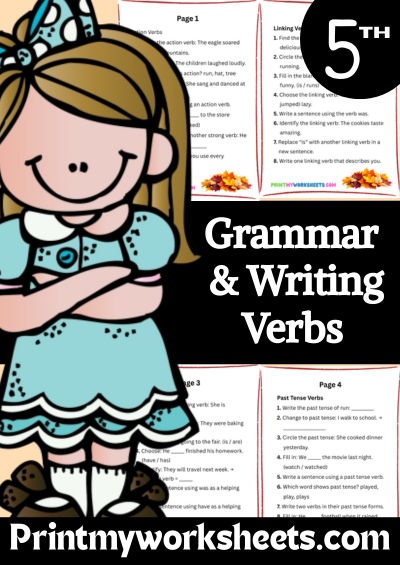
5th Grade Verbs Worksheets PDF – Easy Home Grammar Review Pack
5th Grade Verbs Worksheets PDF
These worksheets are created for US homeschool parents, teachers, and classrooms. These engaging worksheets help students master verbs — the action words that bring sentences to life! ✍️📘
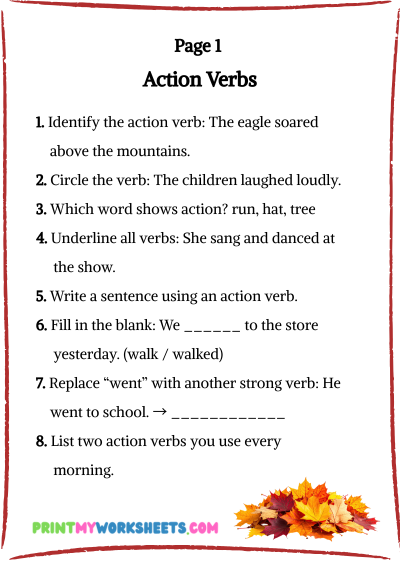
Each worksheet includes fun exercises, sentence-building activities, and grammar challenges that teach kids how to identify, use, and conjugate verbs correctly. Students will practice regular and irregular verbs, tenses, and subject-verb agreement, improving both their grammar and overall writing fluency.
Why learn verbs?
Understanding verbs is essential to writing strong, clear sentences. These worksheets help children enhance sentence structure, express ideas effectively, and build confidence in written communication. They also prepare students for higher-level grammar, creative writing, and standardized English assessments.
Perfect for classroom lessons, homeschool practice, or after-school review, this free printable PDF makes learning verbs interactive and enjoyable.
Download your Grammar & Writing – Verbs Worksheets today and give your 5th grader the tools to write with clarity, confidence, and creativity while mastering the building blocks of English grammar!
You may also like :
[gallery ids="6373,6297,6322"]Frequently Asked Questions
Q1. What format is this worksheet available in?This worksheet is available as a printable PDF file. It is black-and-white, printer-friendly, and works on any standard home or classroom printer using A4 or US Letter paper.Q2. Is this worksheet free to download?Yes, this worksheet is 100% free to download and print. No account, subscription, or payment is required. Click the Download Now button to get your free PDF instantly.Q3. Can I use this worksheet for both classroom and home learning?Yes, these worksheets are designed for use by classroom teachers, homeschool parents, and tutors. They can be used as morning work, homework, revision practice, or learning centre activities.Q4. Is this worksheet aligned with Common Core ELA standards?Yes, this English worksheet is aligned with U.S. Common Core English Language Arts standards and supports foundational literacy development.Q5. Can this worksheet be used for phonics instruction?Yes, this worksheet supports phonics-based reading instruction and is suitable for early readers building letter-sound recognition skills.5th Grade Verbs Worksheets PDF – Easy Home Grammar Review Pack
5th Grade Verbs Worksheets PDF
These worksheets are created for US homeschool parents, teachers, and classrooms. These engaging worksheets help students master verbs — the action words that bring sentences to life! ✍️📘
Each worksheet includes fun exercises, sentence-building activities, and grammar challenges that teach kids how to identify, use, and conjugate verbs correctly. Students will practice regular and irregular verbs, tenses, and subject-verb agreement, improving both their grammar and overall writing fluency.
Why learn verbs?
Understanding verbs is essential to writing strong, clear sentences. These worksheets help children enhance sentence structure, express ideas effectively, and build confidence in written communication. They also prepare students for higher-level grammar, creative writing, and standardized English assessments.
Perfect for classroom lessons, homeschool practice, or after-school review, this free printable PDF makes learning verbs interactive and enjoyable.
Download your Grammar & Writing – Verbs Worksheets today and give your 5th grader the tools to write with clarity, confidence, and creativity while mastering the building blocks of English grammar!
You may also like :
[gallery ids="6373,6297,6322"]Frequently Asked Questions
Q1. What format is this worksheet available in?This worksheet is available as a printable PDF file. It is black-and-white, printer-friendly, and works on any standard home or classroom printer using A4 or US Letter paper.Q2. Is this worksheet free to download?Yes, this worksheet is 100% free to download and print. No account, subscription, or payment is required. Click the Download Now button to get your free PDF instantly.Q3. Can I use this worksheet for both classroom and home learning?Yes, these worksheets are designed for use by classroom teachers, homeschool parents, and tutors. They can be used as morning work, homework, revision practice, or learning centre activities.Q4. Is this worksheet aligned with Common Core ELA standards?Yes, this English worksheet is aligned with U.S. Common Core English Language Arts standards and supports foundational literacy development.Q5. Can this worksheet be used for phonics instruction?Yes, this worksheet supports phonics-based reading instruction and is suitable for early readers building letter-sound recognition skills.
5th Grade Vocabulary Puzzles Worksheets PDF – Word Meaning Practice with Answer Key
Make vocabulary learning exciting with our 5th Grade Vocabulary Puzzles Worksheets | Free Downloadable PDF, created to align with the US curriculum and ideal for homeschool parents, teachers, and tutors.
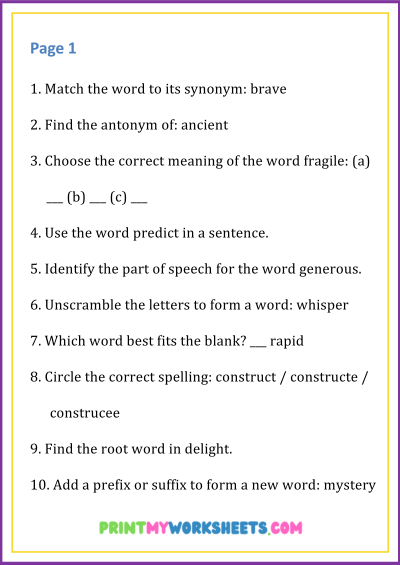
These worksheets combine word study with puzzles, offering activities like crosswords, word searches, scrambled words, and matching games. Each puzzle challenges students to apply their vocabulary knowledge in fun, interactive ways that strengthen spelling, word recognition, and comprehension. The engaging format keeps learners motivated while building confidence in language skills.
Why are vocabulary puzzles important in 5th grade? At this level, children are expanding their vocabulary for more advanced reading and writing tasks. Vocabulary puzzles encourage critical thinking, problem-solving, and pattern recognition, while also reinforcing context clues and word meanings. This makes them an excellent tool for improving communication, reading comprehension, and writing fluency.
Perfect for classroom learning, homeschooling, or after-school enrichment, this free printable PDF is easy to download, print, and use anytime. With varied puzzles and answer keys included, students can practice independently or in groups, making learning both collaborative and enjoyable.
Download and print today to give your little learners the head start they deserve!
Frequently Asked Questions
Q1. Is this worksheet free to download?Yes, this worksheet is 100% free to download and print. No account, subscription, or payment is required. Click the Download Now button to get your free PDF instantly.Q2. What format is this worksheet available in?This worksheet is available as a printable PDF file. It is black-and-white, printer-friendly, and works on any standard home or classroom printer using A4 or US Letter paper.Q3. Can I use this worksheet for both classroom and home learning?Yes, these worksheets are designed for use by classroom teachers, homeschool parents, and tutors. They can be used as morning work, homework, revision practice, or learning centre activities.Q4. Is this worksheet aligned with Common Core ELA standards?Yes, this English worksheet is aligned with U.S. Common Core English Language Arts standards and supports foundational literacy development.Q5. Can this worksheet be used for phonics instruction?Yes, this worksheet supports phonics-based reading instruction and is suitable for early readers building letter-sound recognition skills.5th Grade Vocabulary Puzzles Worksheets PDF – Word Meaning Practice with Answer Key
Make vocabulary learning exciting with our 5th Grade Vocabulary Puzzles Worksheets | Free Downloadable PDF, created to align with the US curriculum and ideal for homeschool parents, teachers, and tutors.
These worksheets combine word study with puzzles, offering activities like crosswords, word searches, scrambled words, and matching games. Each puzzle challenges students to apply their vocabulary knowledge in fun, interactive ways that strengthen spelling, word recognition, and comprehension. The engaging format keeps learners motivated while building confidence in language skills.
Why are vocabulary puzzles important in 5th grade? At this level, children are expanding their vocabulary for more advanced reading and writing tasks. Vocabulary puzzles encourage critical thinking, problem-solving, and pattern recognition, while also reinforcing context clues and word meanings. This makes them an excellent tool for improving communication, reading comprehension, and writing fluency.
Perfect for classroom learning, homeschooling, or after-school enrichment, this free printable PDF is easy to download, print, and use anytime. With varied puzzles and answer keys included, students can practice independently or in groups, making learning both collaborative and enjoyable.
Download and print today to give your little learners the head start they deserve!
Frequently Asked Questions
Q1. Is this worksheet free to download?Yes, this worksheet is 100% free to download and print. No account, subscription, or payment is required. Click the Download Now button to get your free PDF instantly.Q2. What format is this worksheet available in?This worksheet is available as a printable PDF file. It is black-and-white, printer-friendly, and works on any standard home or classroom printer using A4 or US Letter paper.Q3. Can I use this worksheet for both classroom and home learning?Yes, these worksheets are designed for use by classroom teachers, homeschool parents, and tutors. They can be used as morning work, homework, revision practice, or learning centre activities.Q4. Is this worksheet aligned with Common Core ELA standards?Yes, this English worksheet is aligned with U.S. Common Core English Language Arts standards and supports foundational literacy development.Q5. Can this worksheet be used for phonics instruction?Yes, this worksheet supports phonics-based reading instruction and is suitable for early readers building letter-sound recognition skills.
6th Grade Active and Passive Voice Worksheets PDF | Free English Downloadable
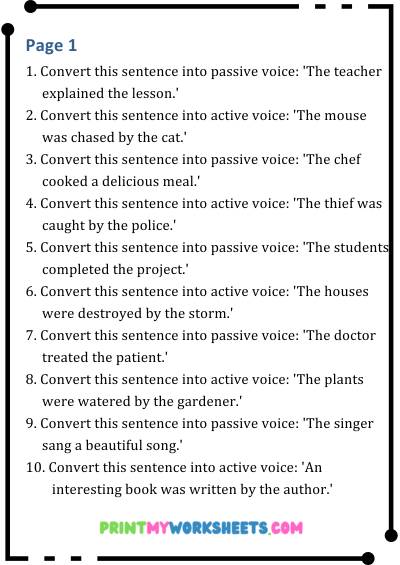
Master the rules of English grammar with our 6th Grade Active and Passive Voice Worksheets PDF, designed for US homeschool parents, teachers, and classrooms. These worksheets help students understand how to transform sentences between active and passive voice while improving their overall writing and grammar skills.
Each worksheet includes examples, conversion exercises, fill-in-the-blank activities, and sentence correction tasks that make learning easy and engaging. Students will learn to identify the subject, verb, and object in a sentence and understand how voice affects tone, clarity, and meaning in writing.
Why is learning active and passive voice important? Understanding sentence structure and verb usage strengthens writing fluency, clarity, and grammatical accuracy. Mastery of voice allows students to express ideas effectively, vary their writing style, and enhance both creative and academic compositions.
Perfect for classroom instruction, homeschool study, or at-home grammar review, this free printable PDF is easy to download, print, and use anytime.
Download and print today to give your little learners the head start they deserve!
You may also like:
[caption id="attachment_6077" align="alignnone" width="212"] Free 6th Grade Adverbs Worksheets PDF | English Grammar Practice for Kids[/caption][caption id="attachment_6113" align="alignnone" width="212"]
 6th Grade Future Perfect Tense Worksheets PDF[/caption][caption id="attachment_6120" align="alignnone" width="212"]
 6th Grade Synonyms and Antonyms Worksheets PDF[/caption]
Frequently Asked Questions
Q1. Is this worksheet free to download?Yes, this worksheet is 100% free to download and print. No account, subscription, or payment is required. Click the Download Now button to get your free PDF instantly.Q2. What format is this worksheet available in?This worksheet is available as a printable PDF file. It is black-and-white, printer-friendly, and works on any standard home or classroom printer using A4 or US Letter paper.Q3. Can I use this worksheet for both classroom and home learning?Yes, these worksheets are designed for use by classroom teachers, homeschool parents, and tutors. They can be used as morning work, homework, revision practice, or learning centre activities.Q4. Is this worksheet aligned with Common Core ELA standards?Yes, this English worksheet is aligned with U.S. Common Core English Language Arts standards and supports foundational literacy development.Q5. Can this worksheet be used for phonics instruction?Yes, this worksheet supports phonics-based reading instruction and is suitable for early readers building letter-sound recognition skills.6th Grade Active and Passive Voice Worksheets PDF | Free English Downloadable
Master the rules of English grammar with our 6th Grade Active and Passive Voice Worksheets PDF, designed for US homeschool parents, teachers, and classrooms. These worksheets help students understand how to transform sentences between active and passive voice while improving their overall writing and grammar skills.
Each worksheet includes examples, conversion exercises, fill-in-the-blank activities, and sentence correction tasks that make learning easy and engaging. Students will learn to identify the subject, verb, and object in a sentence and understand how voice affects tone, clarity, and meaning in writing.
Why is learning active and passive voice important? Understanding sentence structure and verb usage strengthens writing fluency, clarity, and grammatical accuracy. Mastery of voice allows students to express ideas effectively, vary their writing style, and enhance both creative and academic compositions.
Perfect for classroom instruction, homeschool study, or at-home grammar review, this free printable PDF is easy to download, print, and use anytime.
Download and print today to give your little learners the head start they deserve!
You may also like:
[caption id="attachment_6077" align="alignnone" width="212"] Free 6th Grade Adverbs Worksheets PDF | English Grammar Practice for Kids[/caption][caption id="attachment_6113" align="alignnone" width="212"] 6th Grade Future Perfect Tense Worksheets PDF[/caption][caption id="attachment_6120" align="alignnone" width="212"] 6th Grade Synonyms and Antonyms Worksheets PDF[/caption]Frequently Asked Questions
Q1. Is this worksheet free to download?Yes, this worksheet is 100% free to download and print. No account, subscription, or payment is required. Click the Download Now button to get your free PDF instantly.Q2. What format is this worksheet available in?This worksheet is available as a printable PDF file. It is black-and-white, printer-friendly, and works on any standard home or classroom printer using A4 or US Letter paper.Q3. Can I use this worksheet for both classroom and home learning?Yes, these worksheets are designed for use by classroom teachers, homeschool parents, and tutors. They can be used as morning work, homework, revision practice, or learning centre activities.Q4. Is this worksheet aligned with Common Core ELA standards?Yes, this English worksheet is aligned with U.S. Common Core English Language Arts standards and supports foundational literacy development.Q5. Can this worksheet be used for phonics instruction?Yes, this worksheet supports phonics-based reading instruction and is suitable for early readers building letter-sound recognition skills.

6th Grade Adverbs Worksheets PDF | Free English Grammar Practice for Kids
Boost your child’s grammar and writing skills with our 6th Grade Adverbs Worksheets | Free Downloadable PDF, created specifically for US homeschool parents, teachers, and classrooms. These engaging worksheets help students understand how adverbs modify verbs, adjectives, and other adverbs to make sentences more detailed and expressive.
Each worksheet includes fill-in-the-blank exercises, sentence rewriting, identifying adverbs, and creative writing prompts to reinforce understanding through practical application. Children learn how adverbs answer questions like how, when, where, and to what extent, improving sentence structure and overall communication.
Why are adverbs important in grammar? Learning adverbs helps students enhance sentence variety, improve writing clarity, and express ideas with precision. Understanding adverb placement and function allows young writers to describe actions effectively, making their writing more engaging and vivid.
Perfect for classroom grammar lessons, homeschool study, or at-home practice, this free printable PDF is easy to download and use. Designed to meet 6th-grade English standards, it encourages mastery through fun and interactive learning.
Download and print today to give your little learners the head start they deserve!
Frequently Asked Questions
Q1. Is this worksheet free to download?Yes, this worksheet is 100% free to download and print. No account, subscription, or payment is required. Click the Download Now button to get your free PDF instantly.Q2. What format is this worksheet available in?This worksheet is available as a printable PDF file. It is black-and-white, printer-friendly, and works on any standard home or classroom printer using A4 or US Letter paper.Q3. Can I use this worksheet for both classroom and home learning?Yes, these worksheets are designed for use by classroom teachers, homeschool parents, and tutors. They can be used as morning work, homework, revision practice, or learning centre activities.Q4. Is this worksheet aligned with Common Core ELA standards?Yes, this English worksheet is aligned with U.S. Common Core English Language Arts standards and supports foundational literacy development.Q5. Can this worksheet be used for phonics instruction?Yes, this worksheet supports phonics-based reading instruction and is suitable for early readers building letter-sound recognition skills.6th Grade Adverbs Worksheets PDF | Free English Grammar Practice for Kids
Boost your child’s grammar and writing skills with our 6th Grade Adverbs Worksheets | Free Downloadable PDF, created specifically for US homeschool parents, teachers, and classrooms. These engaging worksheets help students understand how adverbs modify verbs, adjectives, and other adverbs to make sentences more detailed and expressive.
Each worksheet includes fill-in-the-blank exercises, sentence rewriting, identifying adverbs, and creative writing prompts to reinforce understanding through practical application. Children learn how adverbs answer questions like how, when, where, and to what extent, improving sentence structure and overall communication.
Why are adverbs important in grammar? Learning adverbs helps students enhance sentence variety, improve writing clarity, and express ideas with precision. Understanding adverb placement and function allows young writers to describe actions effectively, making their writing more engaging and vivid.
Perfect for classroom grammar lessons, homeschool study, or at-home practice, this free printable PDF is easy to download and use. Designed to meet 6th-grade English standards, it encourages mastery through fun and interactive learning.
Download and print today to give your little learners the head start they deserve!
Frequently Asked Questions
Q1. Is this worksheet free to download?Yes, this worksheet is 100% free to download and print. No account, subscription, or payment is required. Click the Download Now button to get your free PDF instantly.Q2. What format is this worksheet available in?This worksheet is available as a printable PDF file. It is black-and-white, printer-friendly, and works on any standard home or classroom printer using A4 or US Letter paper.Q3. Can I use this worksheet for both classroom and home learning?Yes, these worksheets are designed for use by classroom teachers, homeschool parents, and tutors. They can be used as morning work, homework, revision practice, or learning centre activities.Q4. Is this worksheet aligned with Common Core ELA standards?Yes, this English worksheet is aligned with U.S. Common Core English Language Arts standards and supports foundational literacy development.Q5. Can this worksheet be used for phonics instruction?Yes, this worksheet supports phonics-based reading instruction and is suitable for early readers building letter-sound recognition skills.
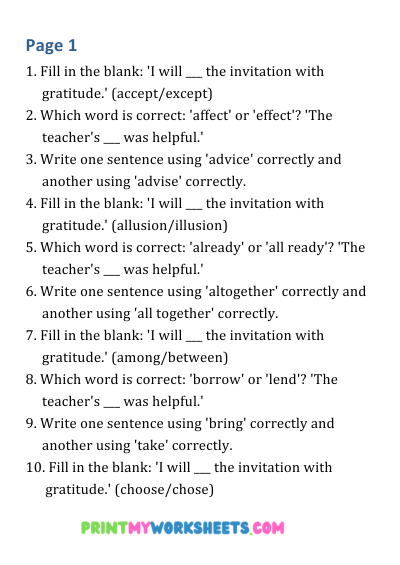
6th Grade Commonly Confused Words Worksheets PDF | Free Downloadable PDF
Frequently Asked Questions
Q1. Is this worksheet free to download?Yes, this worksheet is 100% free to download and print. No account, subscription, or payment is required. Click the Download Now button to get your free PDF instantly.Q2. What format is this worksheet available in?This worksheet is available as a printable PDF file. It is black-and-white, printer-friendly, and works on any standard home or classroom printer using A4 or US Letter paper.Q3. Can I use this worksheet for both classroom and home learning?Yes, these worksheets are designed for use by classroom teachers, homeschool parents, and tutors. They can be used as morning work, homework, revision practice, or learning centre activities.Q4. Is this worksheet aligned with Common Core ELA standards?Yes, this English worksheet is aligned with U.S. Common Core English Language Arts standards and supports foundational literacy development.Q5. Can this worksheet be used for phonics instruction?Yes, this worksheet supports phonics-based reading instruction and is suitable for early readers building letter-sound recognition skills.6th Grade Commonly Confused Words Worksheets PDF | Free Downloadable PDF
Frequently Asked Questions
Q1. Is this worksheet free to download?Yes, this worksheet is 100% free to download and print. No account, subscription, or payment is required. Click the Download Now button to get your free PDF instantly.Q2. What format is this worksheet available in?This worksheet is available as a printable PDF file. It is black-and-white, printer-friendly, and works on any standard home or classroom printer using A4 or US Letter paper.Q3. Can I use this worksheet for both classroom and home learning?Yes, these worksheets are designed for use by classroom teachers, homeschool parents, and tutors. They can be used as morning work, homework, revision practice, or learning centre activities.Q4. Is this worksheet aligned with Common Core ELA standards?Yes, this English worksheet is aligned with U.S. Common Core English Language Arts standards and supports foundational literacy development.Q5. Can this worksheet be used for phonics instruction?Yes, this worksheet supports phonics-based reading instruction and is suitable for early readers building letter-sound recognition skills.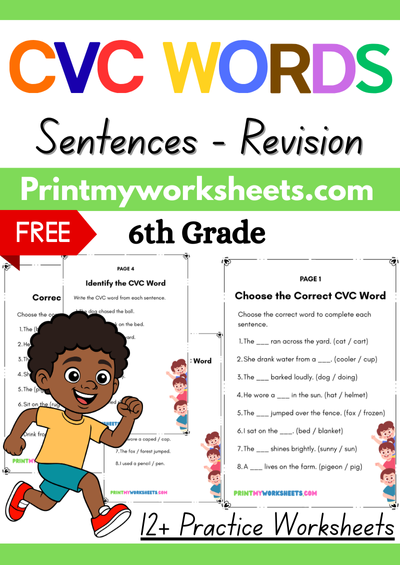
6th Grade CVC Words in Sentences Worksheets PDF – Phonics Practice with Reading Fluency Activities
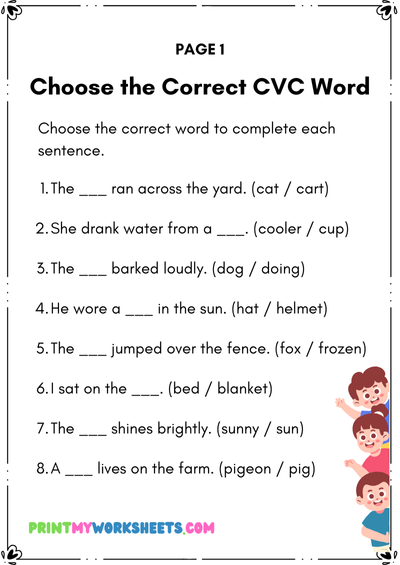
6th Grade CVC Words in Sentences Worksheets PDF
These worksheets are designed to strengthen foundational phonics skills through contextual sentence practice. These free downloadable PDF worksheets are ideal for US homeschool parents, teachers, intervention specialists, and students who benefit from revisiting core decoding and spelling concepts.
CVC (Consonant–Vowel–Consonant) words are essential building blocks of reading. While typically introduced in early grades, revising CVC words in sentence form at the 6th grade level is especially helpful for remediation, literacy intervention, ESL learners, or students who need extra phonics reinforcement. These worksheets move beyond isolated words and focus on using CVC words correctly within complete sentences.
Learning CVC words in sentences improves decoding accuracy, reading fluency, spelling, and comprehension. When students practice phonics skills in context, they better understand meaning, sentence structure, and word usage. This helps reduce reading hesitation and increases confidence across all subjects that require reading and writing.
Each worksheet includes targeted activities such as identifying CVC words in sentences, completing sentences with correct words, correcting errors, and reading for meaning. The printable PDF format makes them easy to use for classroom intervention, homeschooling routines, tutoring sessions, or independent practice.
Whether closing learning gaps or reinforcing essential literacy foundations, these worksheets provide an effective, supportive, and completely free resource aligned with US reading goals.
You may also like:
[gallery ids="6127,6099,6070"]Frequently Asked Questions
Q1. What format is this worksheet available in?This worksheet is available as a printable PDF file. It is black-and-white, printer-friendly, and works on any standard home or classroom printer using A4 or US Letter paper.Q2. Is this worksheet free to download?Yes, this worksheet is 100% free to download and print. No account, subscription, or payment is required. Click the Download Now button to get your free PDF instantly.Q3. Can I use this worksheet for both classroom and home learning?Yes, these worksheets are designed for use by classroom teachers, homeschool parents, and tutors. They can be used as morning work, homework, revision practice, or learning centre activities.Q4. Is this worksheet aligned with Common Core ELA standards?Yes, this English worksheet is aligned with U.S. Common Core English Language Arts standards and supports foundational literacy development.Q5. Can this worksheet be used for phonics instruction?Yes, this worksheet supports phonics-based reading instruction and is suitable for early readers building letter-sound recognition skills.6th Grade CVC Words in Sentences Worksheets PDF – Phonics Practice with Reading Fluency Activities
6th Grade CVC Words in Sentences Worksheets PDF
These worksheets are designed to strengthen foundational phonics skills through contextual sentence practice. These free downloadable PDF worksheets are ideal for US homeschool parents, teachers, intervention specialists, and students who benefit from revisiting core decoding and spelling concepts.
CVC (Consonant–Vowel–Consonant) words are essential building blocks of reading. While typically introduced in early grades, revising CVC words in sentence form at the 6th grade level is especially helpful for remediation, literacy intervention, ESL learners, or students who need extra phonics reinforcement. These worksheets move beyond isolated words and focus on using CVC words correctly within complete sentences.
Learning CVC words in sentences improves decoding accuracy, reading fluency, spelling, and comprehension. When students practice phonics skills in context, they better understand meaning, sentence structure, and word usage. This helps reduce reading hesitation and increases confidence across all subjects that require reading and writing.
Each worksheet includes targeted activities such as identifying CVC words in sentences, completing sentences with correct words, correcting errors, and reading for meaning. The printable PDF format makes them easy to use for classroom intervention, homeschooling routines, tutoring sessions, or independent practice.
Whether closing learning gaps or reinforcing essential literacy foundations, these worksheets provide an effective, supportive, and completely free resource aligned with US reading goals.
You may also like:
[gallery ids="6127,6099,6070"]Frequently Asked Questions
Q1. What format is this worksheet available in?This worksheet is available as a printable PDF file. It is black-and-white, printer-friendly, and works on any standard home or classroom printer using A4 or US Letter paper.Q2. Is this worksheet free to download?Yes, this worksheet is 100% free to download and print. No account, subscription, or payment is required. Click the Download Now button to get your free PDF instantly.Q3. Can I use this worksheet for both classroom and home learning?Yes, these worksheets are designed for use by classroom teachers, homeschool parents, and tutors. They can be used as morning work, homework, revision practice, or learning centre activities.Q4. Is this worksheet aligned with Common Core ELA standards?Yes, this English worksheet is aligned with U.S. Common Core English Language Arts standards and supports foundational literacy development.Q5. Can this worksheet be used for phonics instruction?Yes, this worksheet supports phonics-based reading instruction and is suitable for early readers building letter-sound recognition skills.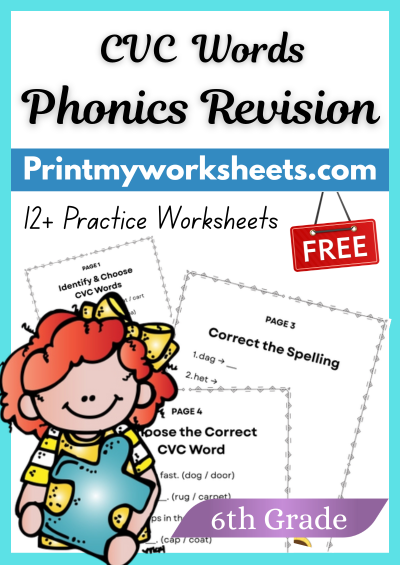
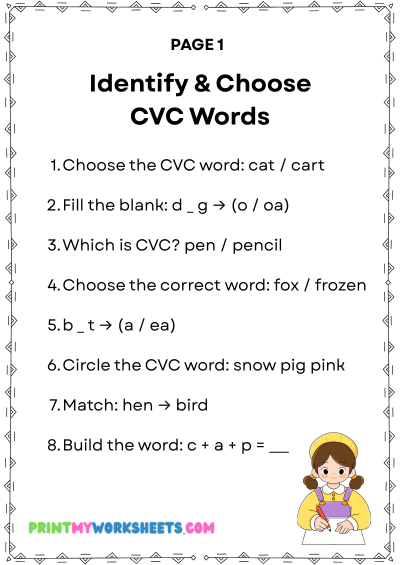
6th Grade CVC Words Phonics Revision Worksheets PDF – Targeted Reading Review with Answer Key
6th Grade CVC Words Phonics Revision Worksheets PDF
These worksheets are designed to reinforce foundational decoding and spelling skills for learners who need targeted phonics review. These free downloadable PDF worksheets are ideal for US homeschool parents, teachers, and students who benefit from revisiting core phonics concepts to strengthen reading accuracy and confidence.
CVC (Consonant–Vowel–Consonant) words form the building blocks of phonics. While commonly introduced in earlier grades, revisiting CVC patterns in 6th grade can be especially helpful for intervention, remediation, ESL learners, or students needing additional literacy support. These worksheets focus on reinforcing sound–letter relationships, decoding strategies, and spelling patterns in a clear, structured way.
Learning CVC phonics through revision improves word recognition, reading fluency, and spelling accuracy. When students master basic phonics patterns, they read more smoothly and focus better on comprehension rather than decoding. This foundational strength supports success across all subjects that require reading and written responses.
Each worksheet includes engaging activities such as identifying CVC patterns, completing words, sorting sounds, and applying phonics skills in short contexts. The printable PDF format makes them easy to use for classroom intervention, homeschooling routines, tutoring sessions, or independent practice.
Whether closing learning gaps or reinforcing essential skills, these worksheets provide an effective, supportive, and completely free phonics resource aligned with US literacy goals.
You may also like:
[gallery ids="6113,6070,6127"]Frequently Asked Questions
Q1. Is this worksheet free to download?Yes, this worksheet is 100% free to download and print. No account, subscription, or payment is required. Click the Download Now button to get your free PDF instantly.Q2. What format is this worksheet available in?This worksheet is available as a printable PDF file. It is black-and-white, printer-friendly, and works on any standard home or classroom printer using A4 or US Letter paper.Q3. Can I use this worksheet for both classroom and home learning?Yes, these worksheets are designed for use by classroom teachers, homeschool parents, and tutors. They can be used as morning work, homework, revision practice, or learning centre activities.6th Grade CVC Words Phonics Revision Worksheets PDF – Targeted Reading Review with Answer Key
6th Grade CVC Words Phonics Revision Worksheets PDF
These worksheets are designed to reinforce foundational decoding and spelling skills for learners who need targeted phonics review. These free downloadable PDF worksheets are ideal for US homeschool parents, teachers, and students who benefit from revisiting core phonics concepts to strengthen reading accuracy and confidence.
CVC (Consonant–Vowel–Consonant) words form the building blocks of phonics. While commonly introduced in earlier grades, revisiting CVC patterns in 6th grade can be especially helpful for intervention, remediation, ESL learners, or students needing additional literacy support. These worksheets focus on reinforcing sound–letter relationships, decoding strategies, and spelling patterns in a clear, structured way.
Learning CVC phonics through revision improves word recognition, reading fluency, and spelling accuracy. When students master basic phonics patterns, they read more smoothly and focus better on comprehension rather than decoding. This foundational strength supports success across all subjects that require reading and written responses.
Each worksheet includes engaging activities such as identifying CVC patterns, completing words, sorting sounds, and applying phonics skills in short contexts. The printable PDF format makes them easy to use for classroom intervention, homeschooling routines, tutoring sessions, or independent practice.
Whether closing learning gaps or reinforcing essential skills, these worksheets provide an effective, supportive, and completely free phonics resource aligned with US literacy goals.
You may also like:
[gallery ids="6113,6070,6127"]Frequently Asked Questions
Q1. Is this worksheet free to download?Yes, this worksheet is 100% free to download and print. No account, subscription, or payment is required. Click the Download Now button to get your free PDF instantly.Q2. What format is this worksheet available in?This worksheet is available as a printable PDF file. It is black-and-white, printer-friendly, and works on any standard home or classroom printer using A4 or US Letter paper.Q3. Can I use this worksheet for both classroom and home learning?Yes, these worksheets are designed for use by classroom teachers, homeschool parents, and tutors. They can be used as morning work, homework, revision practice, or learning centre activities.

6th Grade Future Perfect Tense Worksheets PDF – Free
Build advanced grammar skills with our 6th Grade Future Perfect Tense Worksheets PDF, designed for US homeschool parents, teachers, and students. These interactive worksheets help children understand how to describe actions that will be completed before a specific time in the future — using the “will have + past participle” structure.
Each worksheet includes fill-in-the-blank exercises, sentence rewriting tasks, and short writing prompts to strengthen understanding through practical examples. Students will learn how to correctly form and use the future perfect tense in sentences, helping them improve clarity, precision, and fluency in their writing.
Why learn the future perfect tense? Mastering this tense enables students to express future actions with accuracy, improving both written and spoken communication. It also helps build a deeper understanding of verb tenses, timelines, and logical sequencing, which are essential for storytelling, essays, and advanced grammar mastery.
Perfect for classroom lessons, homeschool learning, or independent practice, this free printable PDF makes grammar study simple and engaging.
Download and print today to give your little learners the head start they deserve!
Frequently Asked Questions
Q1. Is this worksheet free to download?Yes, this worksheet is 100% free to download and print. No account, subscription, or payment is required. Click the Download Now button to get your free PDF instantly.Q2. What format is this worksheet available in?This worksheet is available as a printable PDF file. It is black-and-white, printer-friendly, and works on any standard home or classroom printer using A4 or US Letter paper.Q3. Do I need to create an account to download this worksheet?No account or sign-up is required. All worksheets on Print My Worksheets are freely accessible to teachers, parents, and homeschool families without any registration.Q4. Is this worksheet aligned with Common Core ELA standards?Yes, this English worksheet is aligned with U.S. Common Core English Language Arts standards and supports foundational literacy development.Q5. Can this worksheet be used for phonics instruction?Yes, this worksheet supports phonics-based reading instruction and is suitable for early readers building letter-sound recognition skills.6th Grade Future Perfect Tense Worksheets PDF – Free
Build advanced grammar skills with our 6th Grade Future Perfect Tense Worksheets PDF, designed for US homeschool parents, teachers, and students. These interactive worksheets help children understand how to describe actions that will be completed before a specific time in the future — using the “will have + past participle” structure.
Each worksheet includes fill-in-the-blank exercises, sentence rewriting tasks, and short writing prompts to strengthen understanding through practical examples. Students will learn how to correctly form and use the future perfect tense in sentences, helping them improve clarity, precision, and fluency in their writing.
Why learn the future perfect tense? Mastering this tense enables students to express future actions with accuracy, improving both written and spoken communication. It also helps build a deeper understanding of verb tenses, timelines, and logical sequencing, which are essential for storytelling, essays, and advanced grammar mastery.
Perfect for classroom lessons, homeschool learning, or independent practice, this free printable PDF makes grammar study simple and engaging.
Download and print today to give your little learners the head start they deserve!
Frequently Asked Questions
Q1. Is this worksheet free to download?Yes, this worksheet is 100% free to download and print. No account, subscription, or payment is required. Click the Download Now button to get your free PDF instantly.Q2. What format is this worksheet available in?This worksheet is available as a printable PDF file. It is black-and-white, printer-friendly, and works on any standard home or classroom printer using A4 or US Letter paper.Q3. Do I need to create an account to download this worksheet?No account or sign-up is required. All worksheets on Print My Worksheets are freely accessible to teachers, parents, and homeschool families without any registration.Q4. Is this worksheet aligned with Common Core ELA standards?Yes, this English worksheet is aligned with U.S. Common Core English Language Arts standards and supports foundational literacy development.Q5. Can this worksheet be used for phonics instruction?Yes, this worksheet supports phonics-based reading instruction and is suitable for early readers building letter-sound recognition skills.

6th Grade Grammar Mechanics Worksheets PDF – Free
Master the rules of writing with our 6th Grade Grammar Mechanics Worksheets PDF, designed for US homeschool parents, teachers, and classrooms. These worksheets help students build strong grammar foundations by focusing on essential writing mechanics such as punctuation, capitalization, sentence structure, and proper word usage.
Each worksheet includes fun, interactive exercises that challenge students to identify and correct grammatical errors, rewrite sentences, and apply rules in context. By practicing grammar mechanics, children enhance their writing fluency, clarity, and communication skills, preparing them for advanced academic writing.
Why are grammar mechanics important? Understanding the mechanics of language helps students communicate effectively and write with confidence. It encourages precision in expression, improves reading comprehension, and strengthens vocabulary. These skills are crucial not only for school success but also for lifelong literacy and effective communication.
Perfect for classroom lessons, homeschool assignments, or self-paced learning, this free printable PDF makes English grammar practice easy and engaging.
Download and print today to give your little learners the head start they deserve!
Frequently Asked Questions
Q1. Is this worksheet free to download?Yes, this worksheet is 100% free to download and print. No account, subscription, or payment is required. Click the Download Now button to get your free PDF instantly.Q2. What format is this worksheet available in?This worksheet is available as a printable PDF file. It is black-and-white, printer-friendly, and works on any standard home or classroom printer using A4 or US Letter paper.Q3. Can I use this worksheet for both classroom and home learning?Yes, these worksheets are designed for use by classroom teachers, homeschool parents, and tutors. They can be used as morning work, homework, revision practice, or learning centre activities.Q4. Is this worksheet aligned with Common Core ELA standards?Yes, this English worksheet is aligned with U.S. Common Core English Language Arts standards and supports foundational literacy development.Q5. Can this worksheet be used for phonics instruction?Yes, this worksheet supports phonics-based reading instruction and is suitable for early readers building letter-sound recognition skills.6th Grade Grammar Mechanics Worksheets PDF – Free
Master the rules of writing with our 6th Grade Grammar Mechanics Worksheets PDF, designed for US homeschool parents, teachers, and classrooms. These worksheets help students build strong grammar foundations by focusing on essential writing mechanics such as punctuation, capitalization, sentence structure, and proper word usage.
Each worksheet includes fun, interactive exercises that challenge students to identify and correct grammatical errors, rewrite sentences, and apply rules in context. By practicing grammar mechanics, children enhance their writing fluency, clarity, and communication skills, preparing them for advanced academic writing.
Why are grammar mechanics important? Understanding the mechanics of language helps students communicate effectively and write with confidence. It encourages precision in expression, improves reading comprehension, and strengthens vocabulary. These skills are crucial not only for school success but also for lifelong literacy and effective communication.
Perfect for classroom lessons, homeschool assignments, or self-paced learning, this free printable PDF makes English grammar practice easy and engaging.
Download and print today to give your little learners the head start they deserve!
Frequently Asked Questions
Q1. Is this worksheet free to download?Yes, this worksheet is 100% free to download and print. No account, subscription, or payment is required. Click the Download Now button to get your free PDF instantly.Q2. What format is this worksheet available in?This worksheet is available as a printable PDF file. It is black-and-white, printer-friendly, and works on any standard home or classroom printer using A4 or US Letter paper.Q3. Can I use this worksheet for both classroom and home learning?Yes, these worksheets are designed for use by classroom teachers, homeschool parents, and tutors. They can be used as morning work, homework, revision practice, or learning centre activities.Q4. Is this worksheet aligned with Common Core ELA standards?Yes, this English worksheet is aligned with U.S. Common Core English Language Arts standards and supports foundational literacy development.Q5. Can this worksheet be used for phonics instruction?Yes, this worksheet supports phonics-based reading instruction and is suitable for early readers building letter-sound recognition skills.

6th Grade Homophones and Homonyms Worksheets PDF – Vocabulary and Grammar Practice
6th Grade Homophones and Homonyms Worksheets PDF
As students move into middle school, precise word choice and vocabulary awareness become increasingly important for reading comprehension and clear writing. The 6th Grade Homophones and Homonyms Worksheets PDF is designed to help students understand and correctly use words that sound alike or share spellings but have different meanings. Created for U.S. parents, classroom teachers, and homeschool families, this free printable resource provides structured, grade-appropriate practice that supports language growth.
In sixth grade, students encounter more complex texts across subjects, making it essential to recognize how word meaning changes based on context. Confusing homophones and homonyms can affect both comprehension and written expression. These worksheets guide learners through focused activities that strengthen word awareness, context clues, and critical thinking. With clear directions and engaging exercises, this printable PDF fits seamlessly into classroom instruction, homework routines, and independent study, helping students build confidence and accuracy in their everyday language use.
What Students Will Learn?
These worksheets focus on helping students clearly distinguish between homophones and homonyms and understand how context determines meaning. Learners review common word pairs and groups that often cause confusion, such as words that sound the same but have different spellings, as well as words that share spelling but differ in definition.
Activities include matching words to meanings, choosing the correct word to complete a sentence, and identifying context clues that signal which word is appropriate. Some exercises ask students to explain differences in meaning, encouraging deeper understanding rather than memorization. Others focus on editing sentences to correct word usage errors.
The worksheets support structured learning by progressing from recognition to application. Tasks are aligned with sixth-grade language expectations, helping students strengthen vocabulary skills while improving reading and writing accuracy. This approach ensures students can apply what they learn to real academic tasks across subjects.
Educational Value & Skill Development
The 6th Grade Homophones and Homonyms Worksheets PDF provides strong educational value by reinforcing essential language arts skills. Academically, these worksheets help students improve reading comprehension by teaching them to interpret word meaning based on context. This skill is critical as texts become more detailed and vocabulary more nuanced in middle school.
Cognitively, working with similar-sounding or similar-looking words strengthens analytical thinking and attention to detail. Students learn to slow down, examine sentence structure, and evaluate meaning rather than relying on assumptions. These habits support better reading accuracy and clearer writing.
Confidence and independence grow as students practice and master commonly confused words. Worksheets allow learners to work at their own pace, revisit challenging word sets, and self-check understanding. Over time, students progress from identifying basic word differences to applying correct usage in extended writing. This steady skill development prepares them for advanced grammar, editing, and composition tasks in higher grades.
Why Focus on Homophones and Homonyms?
Understanding homophones and homonyms is essential for effective communication. These words frequently appear in both academic texts and everyday writing, and misuse can lead to misunderstanding or unclear expression. Learning to recognize subtle differences in meaning helps students read more accurately and write with precision.
In sixth grade, students are expected to analyze text more deeply and produce more polished written work. Mastery of commonly confused words supports these goals by reducing errors and strengthening vocabulary awareness. This skill also plays a role in standardized assessments, where precise word choice matters.
Repetition and guided practice are key to mastering these concepts. Worksheets provide consistent exposure to challenging word pairs and meaningful opportunities to apply learning in context. This focus aligns with U.S. language arts standards that emphasize vocabulary development, context clues, and accurate language use across reading and writing tasks.
How to Use These Worksheets?
These worksheets are flexible and easy to integrate into various learning settings. In classrooms, teachers can use them during grammar lessons, literacy centers, or as review activities before quizzes and writing assignments. They also work well for small-group instruction focused on targeted language skills.
For homeschool families, the worksheets offer a clear and organized way to practice vocabulary at home. Parents can review answers with their child, discuss why certain words fit best in context, or assign pages for independent practice. The 6th Grade Homophones and Homonyms Worksheets PDF is especially useful for reinforcing skills learned through reading and writing activities.
Because the worksheets are provided as a free printable PDF, they are easy to download, print, and reuse throughout the year. Pages can be revisited for reinforcement or selected based on specific learning needs, allowing instruction to remain flexible and student-centered.
Related Worksheets / Extensions:
Frequently Asked Questions
Q1. Is this worksheet free to download?Yes, this worksheet is 100% free to download and print. No account, subscription, or payment is required. Click the Download Now button to get your free PDF instantly.Q2. What format is this worksheet available in?This worksheet is available as a printable PDF file. It is black-and-white, printer-friendly, and works on any standard home or classroom printer using A4 or US Letter paper.Q3. Do I need to create an account to download this worksheet?No account or sign-up is required. All worksheets on Print My Worksheets are freely accessible to teachers, parents, and homeschool families without any registration.Q4. Is this worksheet aligned with Common Core ELA standards?Yes, this English worksheet is aligned with U.S. Common Core English Language Arts standards and supports foundational literacy development.Q5. Can this worksheet be used for phonics instruction?Yes, this worksheet supports phonics-based reading instruction and is suitable for early readers building letter-sound recognition skills.6th Grade Homophones and Homonyms Worksheets PDF – Vocabulary and Grammar Practice
6th Grade Homophones and Homonyms Worksheets PDF
As students move into middle school, precise word choice and vocabulary awareness become increasingly important for reading comprehension and clear writing. The 6th Grade Homophones and Homonyms Worksheets PDF is designed to help students understand and correctly use words that sound alike or share spellings but have different meanings. Created for U.S. parents, classroom teachers, and homeschool families, this free printable resource provides structured, grade-appropriate practice that supports language growth.
In sixth grade, students encounter more complex texts across subjects, making it essential to recognize how word meaning changes based on context. Confusing homophones and homonyms can affect both comprehension and written expression. These worksheets guide learners through focused activities that strengthen word awareness, context clues, and critical thinking. With clear directions and engaging exercises, this printable PDF fits seamlessly into classroom instruction, homework routines, and independent study, helping students build confidence and accuracy in their everyday language use.
What Students Will Learn?
These worksheets focus on helping students clearly distinguish between homophones and homonyms and understand how context determines meaning. Learners review common word pairs and groups that often cause confusion, such as words that sound the same but have different spellings, as well as words that share spelling but differ in definition.
Activities include matching words to meanings, choosing the correct word to complete a sentence, and identifying context clues that signal which word is appropriate. Some exercises ask students to explain differences in meaning, encouraging deeper understanding rather than memorization. Others focus on editing sentences to correct word usage errors.
The worksheets support structured learning by progressing from recognition to application. Tasks are aligned with sixth-grade language expectations, helping students strengthen vocabulary skills while improving reading and writing accuracy. This approach ensures students can apply what they learn to real academic tasks across subjects.
Educational Value & Skill Development
The 6th Grade Homophones and Homonyms Worksheets PDF provides strong educational value by reinforcing essential language arts skills. Academically, these worksheets help students improve reading comprehension by teaching them to interpret word meaning based on context. This skill is critical as texts become more detailed and vocabulary more nuanced in middle school.
Cognitively, working with similar-sounding or similar-looking words strengthens analytical thinking and attention to detail. Students learn to slow down, examine sentence structure, and evaluate meaning rather than relying on assumptions. These habits support better reading accuracy and clearer writing.
Confidence and independence grow as students practice and master commonly confused words. Worksheets allow learners to work at their own pace, revisit challenging word sets, and self-check understanding. Over time, students progress from identifying basic word differences to applying correct usage in extended writing. This steady skill development prepares them for advanced grammar, editing, and composition tasks in higher grades.
Why Focus on Homophones and Homonyms?
Understanding homophones and homonyms is essential for effective communication. These words frequently appear in both academic texts and everyday writing, and misuse can lead to misunderstanding or unclear expression. Learning to recognize subtle differences in meaning helps students read more accurately and write with precision.
In sixth grade, students are expected to analyze text more deeply and produce more polished written work. Mastery of commonly confused words supports these goals by reducing errors and strengthening vocabulary awareness. This skill also plays a role in standardized assessments, where precise word choice matters.
Repetition and guided practice are key to mastering these concepts. Worksheets provide consistent exposure to challenging word pairs and meaningful opportunities to apply learning in context. This focus aligns with U.S. language arts standards that emphasize vocabulary development, context clues, and accurate language use across reading and writing tasks.
How to Use These Worksheets?
These worksheets are flexible and easy to integrate into various learning settings. In classrooms, teachers can use them during grammar lessons, literacy centers, or as review activities before quizzes and writing assignments. They also work well for small-group instruction focused on targeted language skills.
For homeschool families, the worksheets offer a clear and organized way to practice vocabulary at home. Parents can review answers with their child, discuss why certain words fit best in context, or assign pages for independent practice. The 6th Grade Homophones and Homonyms Worksheets PDF is especially useful for reinforcing skills learned through reading and writing activities.
Because the worksheets are provided as a free printable PDF, they are easy to download, print, and reuse throughout the year. Pages can be revisited for reinforcement or selected based on specific learning needs, allowing instruction to remain flexible and student-centered.
Related Worksheets / Extensions:
Frequently Asked Questions
Q1. Is this worksheet free to download?Yes, this worksheet is 100% free to download and print. No account, subscription, or payment is required. Click the Download Now button to get your free PDF instantly.Q2. What format is this worksheet available in?This worksheet is available as a printable PDF file. It is black-and-white, printer-friendly, and works on any standard home or classroom printer using A4 or US Letter paper.Q3. Do I need to create an account to download this worksheet?No account or sign-up is required. All worksheets on Print My Worksheets are freely accessible to teachers, parents, and homeschool families without any registration.Q4. Is this worksheet aligned with Common Core ELA standards?Yes, this English worksheet is aligned with U.S. Common Core English Language Arts standards and supports foundational literacy development.Q5. Can this worksheet be used for phonics instruction?Yes, this worksheet supports phonics-based reading instruction and is suitable for early readers building letter-sound recognition skills.

6th Grade Progressive Tense Worksheets PDF – Free
Help your child master verb tenses with our 6th Grade Progressive Tense Worksheets PDF, designed for US homeschool parents, teachers, and classrooms. These engaging worksheets teach students how to use the progressive (continuous) tense — present, past, and future — to describe ongoing actions effectively.
Through interactive exercises, fill-in-the-blank sentences, and short writing prompts, students will learn how to form and identify progressive tenses correctly using am/is/are + verb-ing structures. These worksheets make grammar practice both fun and meaningful while improving students’ sentence fluency and writing accuracy.
Why is learning the progressive tense important? Understanding progressive verbs helps students communicate actions that happen over time, making their writing more dynamic, descriptive, and precise. It also strengthens grammar skills essential for storytelling, essays, and real-life communication.
Perfect for homeschool lessons, classroom use, or after-school study, these free printable PDF worksheets encourage independent learning and self-correction while reinforcing key English grammar skills.
Download and print today to give your little learners the head start they deserve!
Frequently Asked Questions
Q1. Is this worksheet free to download?Yes, this worksheet is 100% free to download and print. No account, subscription, or payment is required. Click the Download Now button to get your free PDF instantly.Q2. What format is this worksheet available in?This worksheet is available as a printable PDF file. It is black-and-white, printer-friendly, and works on any standard home or classroom printer using A4 or US Letter paper.Q3. Do I need to create an account to download this worksheet?No account or sign-up is required. All worksheets on Print My Worksheets are freely accessible to teachers, parents, and homeschool families without any registration.Q4. Is this worksheet aligned with Common Core ELA standards?Yes, this English worksheet is aligned with U.S. Common Core English Language Arts standards and supports foundational literacy development.Q5. Can this worksheet be used for phonics instruction?Yes, this worksheet supports phonics-based reading instruction and is suitable for early readers building letter-sound recognition skills.6th Grade Progressive Tense Worksheets PDF – Free
Help your child master verb tenses with our 6th Grade Progressive Tense Worksheets PDF, designed for US homeschool parents, teachers, and classrooms. These engaging worksheets teach students how to use the progressive (continuous) tense — present, past, and future — to describe ongoing actions effectively.
Through interactive exercises, fill-in-the-blank sentences, and short writing prompts, students will learn how to form and identify progressive tenses correctly using am/is/are + verb-ing structures. These worksheets make grammar practice both fun and meaningful while improving students’ sentence fluency and writing accuracy.
Why is learning the progressive tense important? Understanding progressive verbs helps students communicate actions that happen over time, making their writing more dynamic, descriptive, and precise. It also strengthens grammar skills essential for storytelling, essays, and real-life communication.
Perfect for homeschool lessons, classroom use, or after-school study, these free printable PDF worksheets encourage independent learning and self-correction while reinforcing key English grammar skills.
Download and print today to give your little learners the head start they deserve!
Frequently Asked Questions
Q1. Is this worksheet free to download?Yes, this worksheet is 100% free to download and print. No account, subscription, or payment is required. Click the Download Now button to get your free PDF instantly.Q2. What format is this worksheet available in?This worksheet is available as a printable PDF file. It is black-and-white, printer-friendly, and works on any standard home or classroom printer using A4 or US Letter paper.Q3. Do I need to create an account to download this worksheet?No account or sign-up is required. All worksheets on Print My Worksheets are freely accessible to teachers, parents, and homeschool families without any registration.Q4. Is this worksheet aligned with Common Core ELA standards?Yes, this English worksheet is aligned with U.S. Common Core English Language Arts standards and supports foundational literacy development.Q5. Can this worksheet be used for phonics instruction?Yes, this worksheet supports phonics-based reading instruction and is suitable for early readers building letter-sound recognition skills.
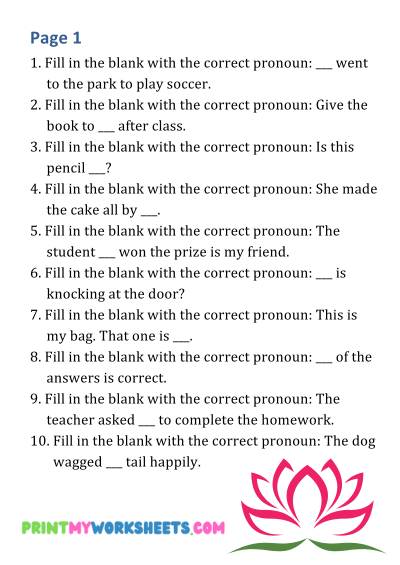
6th Grade Pronouns Worksheets PDF – Free with Answer Key
Master grammar easily with our 6th Grade Pronouns Worksheets PDF, designed especially for kids to strengthen their understanding of pronouns in fun and engaging ways. These worksheets help students identify, use, and differentiate between various types of pronouns — including personal, possessive, reflexive, demonstrative, and relative pronouns.
By practicing through interactive exercises, fill-in-the-blanks, and sentence correction activities, learners build a strong foundation in grammar and sentence structure. Understanding pronouns improves writing clarity, eliminates repetition, and enhances overall communication skills — a crucial part of English language development.
These worksheets are perfect for homeschool parents, teachers, and 6th-grade classrooms in the US who want to make grammar lessons interactive and meaningful. Each printable page encourages independent learning and boosts students’ confidence in constructing grammatically correct sentences.
Give your child the advantage of mastering pronouns through practical learning and real-world examples. Download these Free Pronouns Worksheets PDFs today and make grammar practice an enjoyable experience for your learners!
Download and print today to give your little learners the head start they deserve!
Frequently Asked Questions
Q1. Is this worksheet free to download?Yes, this worksheet is 100% free to download and print. No account, subscription, or payment is required. Click the Download Now button to get your free PDF instantly.Q2. What format is this worksheet available in?This worksheet is available as a printable PDF file. It is black-and-white, printer-friendly, and works on any standard home or classroom printer using A4 or US Letter paper.Q3. Do I need to create an account to download this worksheet?No account or sign-up is required. All worksheets on Print My Worksheets are freely accessible to teachers, parents, and homeschool families without any registration.Q4. Is this worksheet aligned with Common Core ELA standards?Yes, this English worksheet is aligned with U.S. Common Core English Language Arts standards and supports foundational literacy development.Q5. Can this worksheet be used for phonics instruction?Yes, this worksheet supports phonics-based reading instruction and is suitable for early readers building letter-sound recognition skills.6th Grade Pronouns Worksheets PDF – Free with Answer Key
Master grammar easily with our 6th Grade Pronouns Worksheets PDF, designed especially for kids to strengthen their understanding of pronouns in fun and engaging ways. These worksheets help students identify, use, and differentiate between various types of pronouns — including personal, possessive, reflexive, demonstrative, and relative pronouns.
By practicing through interactive exercises, fill-in-the-blanks, and sentence correction activities, learners build a strong foundation in grammar and sentence structure. Understanding pronouns improves writing clarity, eliminates repetition, and enhances overall communication skills — a crucial part of English language development.
These worksheets are perfect for homeschool parents, teachers, and 6th-grade classrooms in the US who want to make grammar lessons interactive and meaningful. Each printable page encourages independent learning and boosts students’ confidence in constructing grammatically correct sentences.
Give your child the advantage of mastering pronouns through practical learning and real-world examples. Download these Free Pronouns Worksheets PDFs today and make grammar practice an enjoyable experience for your learners!
Download and print today to give your little learners the head start they deserve!
Frequently Asked Questions
Q1. Is this worksheet free to download?Yes, this worksheet is 100% free to download and print. No account, subscription, or payment is required. Click the Download Now button to get your free PDF instantly.Q2. What format is this worksheet available in?This worksheet is available as a printable PDF file. It is black-and-white, printer-friendly, and works on any standard home or classroom printer using A4 or US Letter paper.Q3. Do I need to create an account to download this worksheet?No account or sign-up is required. All worksheets on Print My Worksheets are freely accessible to teachers, parents, and homeschool families without any registration.Q4. Is this worksheet aligned with Common Core ELA standards?Yes, this English worksheet is aligned with U.S. Common Core English Language Arts standards and supports foundational literacy development.Q5. Can this worksheet be used for phonics instruction?Yes, this worksheet supports phonics-based reading instruction and is suitable for early readers building letter-sound recognition skills.
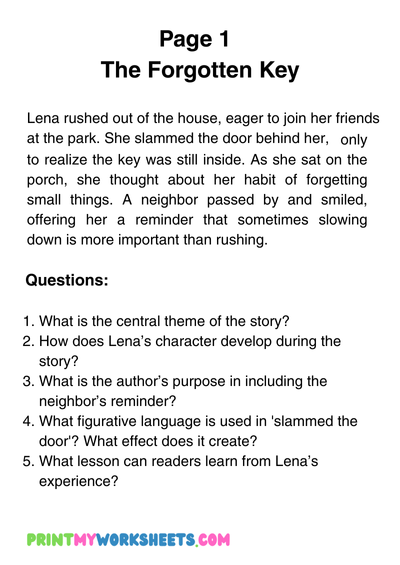
6th Grade Reading Comprehension Fiction Worksheets PDF | Free English Downloadable
Boost your child’s literacy and analytical skills with our 6th Grade Reading Comprehension Fiction Worksheets PDF, created for the US curriculum and designed for homeschool parents, teachers, and tutors.
These worksheets feature carefully selected fiction passages paired with engaging comprehension questions. Students practice identifying story elements such as characters, setting, plot, and theme, while also learning to infer meaning, analyze figurative language, and evaluate the author’s purpose. Activities include multiple-choice questions, short answers, and critical thinking prompts that encourage deeper engagement with texts.
Why focus on fiction comprehension in 6th grade? At this level, students transition from basic reading skills to higher-level analysis. Mastering fiction comprehension strengthens critical thinking, vocabulary development, and writing ability while nurturing creativity and imagination. By exploring stories, students learn empathy, cultural awareness, and how to connect ideas beyond the text.
Our free printable PDF is easy to download, print, and use at home or in classrooms. With answer keys included, children can practice independently or with guidance, making it an excellent tool for literacy centers, homework, or homeschool lessons.
Download and print today to give your little learners the head start they deserve!
You may also like :
[gallery ids="6113,6063,6070"]Frequently Asked Questions
Q1. Is this worksheet free to download?Yes, this worksheet is 100% free to download and print. No account, subscription, or payment is required. Click the Download Now button to get your free PDF instantly.Q2. What format is this worksheet available in?This worksheet is available as a printable PDF file. It is black-and-white, printer-friendly, and works on any standard home or classroom printer using A4 or US Letter paper.Q3. Can I use this worksheet for both classroom and home learning?Yes, these worksheets are designed for use by classroom teachers, homeschool parents, and tutors. They can be used as morning work, homework, revision practice, or learning centre activities.Q4. Is this worksheet aligned with Common Core ELA standards?Yes, this English worksheet is aligned with U.S. Common Core English Language Arts standards and supports foundational literacy development.Q5. Can this worksheet be used for phonics instruction?Yes, this worksheet supports phonics-based reading instruction and is suitable for early readers building letter-sound recognition skills.6th Grade Reading Comprehension Fiction Worksheets PDF | Free English Downloadable
Boost your child’s literacy and analytical skills with our 6th Grade Reading Comprehension Fiction Worksheets PDF, created for the US curriculum and designed for homeschool parents, teachers, and tutors.
These worksheets feature carefully selected fiction passages paired with engaging comprehension questions. Students practice identifying story elements such as characters, setting, plot, and theme, while also learning to infer meaning, analyze figurative language, and evaluate the author’s purpose. Activities include multiple-choice questions, short answers, and critical thinking prompts that encourage deeper engagement with texts.
Why focus on fiction comprehension in 6th grade? At this level, students transition from basic reading skills to higher-level analysis. Mastering fiction comprehension strengthens critical thinking, vocabulary development, and writing ability while nurturing creativity and imagination. By exploring stories, students learn empathy, cultural awareness, and how to connect ideas beyond the text.
Our free printable PDF is easy to download, print, and use at home or in classrooms. With answer keys included, children can practice independently or with guidance, making it an excellent tool for literacy centers, homework, or homeschool lessons.
Download and print today to give your little learners the head start they deserve!
You may also like :
[gallery ids="6113,6063,6070"]Frequently Asked Questions
Q1. Is this worksheet free to download?Yes, this worksheet is 100% free to download and print. No account, subscription, or payment is required. Click the Download Now button to get your free PDF instantly.Q2. What format is this worksheet available in?This worksheet is available as a printable PDF file. It is black-and-white, printer-friendly, and works on any standard home or classroom printer using A4 or US Letter paper.Q3. Can I use this worksheet for both classroom and home learning?Yes, these worksheets are designed for use by classroom teachers, homeschool parents, and tutors. They can be used as morning work, homework, revision practice, or learning centre activities.Q4. Is this worksheet aligned with Common Core ELA standards?Yes, this English worksheet is aligned with U.S. Common Core English Language Arts standards and supports foundational literacy development.Q5. Can this worksheet be used for phonics instruction?Yes, this worksheet supports phonics-based reading instruction and is suitable for early readers building letter-sound recognition skills.

6th Grade Sentence Combining Worksheets PDF | Free English Downloadable
Help your child enhance their writing fluency and creativity with our 6th Grade Sentence Combining Worksheets PDF, designed for US homeschool parents, teachers, and classrooms. These worksheets guide students in constructing more engaging, complex, and well-structured sentences that make writing stronger and more expressive.
Each worksheet includes combining exercises, sentence expansion tasks, and rewriting activities that encourage students to move beyond simple sentences. By learning how to join ideas effectively using conjunctions, transitions, and punctuation, kids improve grammar, clarity, and sentence flow. The result is smoother, more polished writing that keeps readers engaged.
Why are sentence combining and variety exercises important? They teach students how to avoid repetition, strengthen sentence rhythm, and communicate ideas clearly. These skills are essential for academic essays, creative writing, and real-world communication. Sentence variety also helps students express complex ideas with precision and style.
Perfect for classroom writing lessons, homeschool practice, or at-home enrichment, this free printable PDF is easy to download and use.
Download and print today to give your little learners the head start they deserve!
Frequently Asked Questions
Q1. Is this worksheet free to download?Yes, this worksheet is 100% free to download and print. No account, subscription, or payment is required. Click the Download Now button to get your free PDF instantly.Q2. What format is this worksheet available in?This worksheet is available as a printable PDF file. It is black-and-white, printer-friendly, and works on any standard home or classroom printer using A4 or US Letter paper.Q3. Can I use this worksheet for both classroom and home learning?Yes, these worksheets are designed for use by classroom teachers, homeschool parents, and tutors. They can be used as morning work, homework, revision practice, or learning centre activities.Q4. Is this worksheet aligned with Common Core ELA standards?Yes, this English worksheet is aligned with U.S. Common Core English Language Arts standards and supports foundational literacy development.Q5. Can this worksheet be used for phonics instruction?Yes, this worksheet supports phonics-based reading instruction and is suitable for early readers building letter-sound recognition skills.6th Grade Sentence Combining Worksheets PDF | Free English Downloadable
Help your child enhance their writing fluency and creativity with our 6th Grade Sentence Combining Worksheets PDF, designed for US homeschool parents, teachers, and classrooms. These worksheets guide students in constructing more engaging, complex, and well-structured sentences that make writing stronger and more expressive.
Each worksheet includes combining exercises, sentence expansion tasks, and rewriting activities that encourage students to move beyond simple sentences. By learning how to join ideas effectively using conjunctions, transitions, and punctuation, kids improve grammar, clarity, and sentence flow. The result is smoother, more polished writing that keeps readers engaged.
Why are sentence combining and variety exercises important? They teach students how to avoid repetition, strengthen sentence rhythm, and communicate ideas clearly. These skills are essential for academic essays, creative writing, and real-world communication. Sentence variety also helps students express complex ideas with precision and style.
Perfect for classroom writing lessons, homeschool practice, or at-home enrichment, this free printable PDF is easy to download and use.
Download and print today to give your little learners the head start they deserve!
Frequently Asked Questions
Q1. Is this worksheet free to download?Yes, this worksheet is 100% free to download and print. No account, subscription, or payment is required. Click the Download Now button to get your free PDF instantly.Q2. What format is this worksheet available in?This worksheet is available as a printable PDF file. It is black-and-white, printer-friendly, and works on any standard home or classroom printer using A4 or US Letter paper.Q3. Can I use this worksheet for both classroom and home learning?Yes, these worksheets are designed for use by classroom teachers, homeschool parents, and tutors. They can be used as morning work, homework, revision practice, or learning centre activities.Q4. Is this worksheet aligned with Common Core ELA standards?Yes, this English worksheet is aligned with U.S. Common Core English Language Arts standards and supports foundational literacy development.Q5. Can this worksheet be used for phonics instruction?Yes, this worksheet supports phonics-based reading instruction and is suitable for early readers building letter-sound recognition skills.
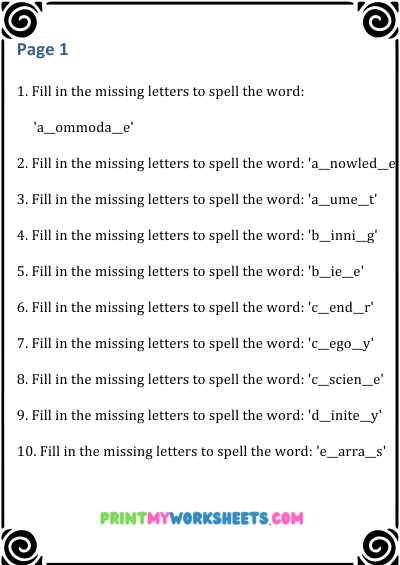
6th Grade Spelling Worksheets PDF – Word Study Practice with Answer Key
Strengthen your child’s vocabulary and writing skills with our 6th Grade Spelling Worksheets PDF, created for US homeschool parents, teachers, and students. These worksheets are designed to make spelling practice engaging and effective through interactive activities that improve both language and comprehension skills.
Each worksheet includes word lists, fill-in-the-blank exercises, crossword puzzles, sentence completion tasks, and spelling challenges to help students master new words and apply them correctly in context. The activities are carefully aligned with grade-level standards to expand vocabulary and reinforce correct spelling patterns.
Why are spelling worksheets important? Good spelling supports strong writing, reading comprehension, and communication. When students spell accurately, they write more confidently and clearly express their ideas. These worksheets also help develop phonetic awareness, memory retention, and word recognition, which are key skills for academic success.
Perfect for classroom lessons, homeschool practice, or at-home enrichment, this free printable PDF is easy to download and use.
Download and print today to give your little learners the head start they deserve!
Frequently Asked Questions
Q1. Is this worksheet free to download?Yes, this worksheet is 100% free to download and print. No account, subscription, or payment is required. Click the Download Now button to get your free PDF instantly.Q2. What format is this worksheet available in?This worksheet is available as a printable PDF file. It is black-and-white, printer-friendly, and works on any standard home or classroom printer using A4 or US Letter paper.Q3. Can I use this worksheet for both classroom and home learning?Yes, these worksheets are designed for use by classroom teachers, homeschool parents, and tutors. They can be used as morning work, homework, revision practice, or learning centre activities.Q4. Is this worksheet aligned with Common Core ELA standards?Yes, this English worksheet is aligned with U.S. Common Core English Language Arts standards and supports foundational literacy development.Q5. Can this worksheet be used for phonics instruction?Yes, this worksheet supports phonics-based reading instruction and is suitable for early readers building letter-sound recognition skills.6th Grade Spelling Worksheets PDF – Word Study Practice with Answer Key
Strengthen your child’s vocabulary and writing skills with our 6th Grade Spelling Worksheets PDF, created for US homeschool parents, teachers, and students. These worksheets are designed to make spelling practice engaging and effective through interactive activities that improve both language and comprehension skills.
Each worksheet includes word lists, fill-in-the-blank exercises, crossword puzzles, sentence completion tasks, and spelling challenges to help students master new words and apply them correctly in context. The activities are carefully aligned with grade-level standards to expand vocabulary and reinforce correct spelling patterns.
Why are spelling worksheets important? Good spelling supports strong writing, reading comprehension, and communication. When students spell accurately, they write more confidently and clearly express their ideas. These worksheets also help develop phonetic awareness, memory retention, and word recognition, which are key skills for academic success.
Perfect for classroom lessons, homeschool practice, or at-home enrichment, this free printable PDF is easy to download and use.
Download and print today to give your little learners the head start they deserve!
Frequently Asked Questions
Q1. Is this worksheet free to download?Yes, this worksheet is 100% free to download and print. No account, subscription, or payment is required. Click the Download Now button to get your free PDF instantly.Q2. What format is this worksheet available in?This worksheet is available as a printable PDF file. It is black-and-white, printer-friendly, and works on any standard home or classroom printer using A4 or US Letter paper.Q3. Can I use this worksheet for both classroom and home learning?Yes, these worksheets are designed for use by classroom teachers, homeschool parents, and tutors. They can be used as morning work, homework, revision practice, or learning centre activities.Q4. Is this worksheet aligned with Common Core ELA standards?Yes, this English worksheet is aligned with U.S. Common Core English Language Arts standards and supports foundational literacy development.Q5. Can this worksheet be used for phonics instruction?Yes, this worksheet supports phonics-based reading instruction and is suitable for early readers building letter-sound recognition skills.

6th Grade Synonyms and Antonyms Worksheets PDF – Free
Enhance your child’s vocabulary and language skills with our 6th Grade Synonyms and Antonyms Worksheets PDF, designed for US homeschool parents, teachers, and classrooms. These engaging worksheets help students strengthen their understanding of word relationships by exploring words with similar meanings (synonyms) and opposite meanings (antonyms).
Each worksheet includes matching activities, fill-in-the-blank exercises, multiple-choice questions, and sentence-building tasks that make learning both fun and effective. Students will learn to choose the right words for better expression, improve their writing variety, and enhance reading comprehension through contextual word usage.
Why learn synonyms and antonyms? Mastering these concepts helps kids expand vocabulary, improve spelling, and strengthen communication and writing clarity. It teaches them how to use diverse words to convey emotions, ideas, and actions more effectively — key skills for success in academic writing and creative storytelling.
Perfect for classroom lessons, homeschool learning, or at-home language practice, this free printable PDF is an excellent resource to make English vocabulary interactive and enjoyable.
Download and print today to give your little learners the head start they deserve!
Frequently Asked Questions
Q1. Is this worksheet free to download?Yes, this worksheet is 100% free to download and print. No account, subscription, or payment is required. Click the Download Now button to get your free PDF instantly.Q2. What format is this worksheet available in?This worksheet is available as a printable PDF file. It is black-and-white, printer-friendly, and works on any standard home or classroom printer using A4 or US Letter paper.Q3. Do I need to create an account to download this worksheet?No account or sign-up is required. All worksheets on Print My Worksheets are freely accessible to teachers, parents, and homeschool families without any registration.Q4. Is this worksheet aligned with Common Core ELA standards?Yes, this English worksheet is aligned with U.S. Common Core English Language Arts standards and supports foundational literacy development.Q5. Can this worksheet be used for phonics instruction?Yes, this worksheet supports phonics-based reading instruction and is suitable for early readers building letter-sound recognition skills.6th Grade Synonyms and Antonyms Worksheets PDF – Free
Enhance your child’s vocabulary and language skills with our 6th Grade Synonyms and Antonyms Worksheets PDF, designed for US homeschool parents, teachers, and classrooms. These engaging worksheets help students strengthen their understanding of word relationships by exploring words with similar meanings (synonyms) and opposite meanings (antonyms).
Each worksheet includes matching activities, fill-in-the-blank exercises, multiple-choice questions, and sentence-building tasks that make learning both fun and effective. Students will learn to choose the right words for better expression, improve their writing variety, and enhance reading comprehension through contextual word usage.
Why learn synonyms and antonyms? Mastering these concepts helps kids expand vocabulary, improve spelling, and strengthen communication and writing clarity. It teaches them how to use diverse words to convey emotions, ideas, and actions more effectively — key skills for success in academic writing and creative storytelling.
Perfect for classroom lessons, homeschool learning, or at-home language practice, this free printable PDF is an excellent resource to make English vocabulary interactive and enjoyable.
Download and print today to give your little learners the head start they deserve!
Frequently Asked Questions
Q1. Is this worksheet free to download?Yes, this worksheet is 100% free to download and print. No account, subscription, or payment is required. Click the Download Now button to get your free PDF instantly.Q2. What format is this worksheet available in?This worksheet is available as a printable PDF file. It is black-and-white, printer-friendly, and works on any standard home or classroom printer using A4 or US Letter paper.Q3. Do I need to create an account to download this worksheet?No account or sign-up is required. All worksheets on Print My Worksheets are freely accessible to teachers, parents, and homeschool families without any registration.Q4. Is this worksheet aligned with Common Core ELA standards?Yes, this English worksheet is aligned with U.S. Common Core English Language Arts standards and supports foundational literacy development.Q5. Can this worksheet be used for phonics instruction?Yes, this worksheet supports phonics-based reading instruction and is suitable for early readers building letter-sound recognition skills.
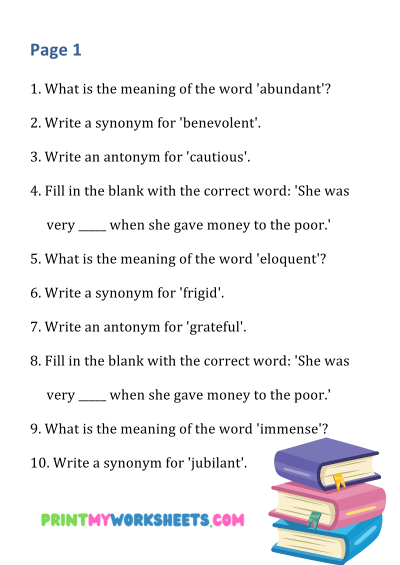
6th Grade Vocabulary and Language Worksheets PDF | Free English Downloadable
Enhance your child’s communication and writing skills with our 6th Grade Vocabulary and Language Worksheets PDF, designed specifically for US homeschool parents, teachers, and classrooms. These interactive worksheets help students build strong vocabulary, improve grammar, and develop language fluency through engaging exercises.
Each worksheet includes word-definition matching, context clues, fill-in-the-blank activities, synonyms and antonyms practice, and sentence-building tasks that encourage creative and critical thinking. Students will expand their vocabulary while learning how to use words effectively in writing and speech.
Why are vocabulary and language worksheets important? A rich vocabulary is the foundation for success in reading, writing, and comprehension. These worksheets help students understand word meanings, improve sentence structure, and strengthen communication skills, which are essential for academic excellence and real-world expression.
Perfect for classroom lessons, homeschool study, or after-school practice, this free printable PDF makes English learning fun, easy, and accessible.
Download and print today to give your little learners the head start they deserve!
You may also like:
[caption id="attachment_6099" align="alignnone" width="212"] 6th Grade Pronouns Worksheets PDF[/caption][caption id="attachment_6063" align="alignnone" width="212"]
 6th Grade Active and Passive Voice Worksheets PDF[/caption][caption id="attachment_6106" align="alignnone" width="212"]
 6th Grade Progressive Tense Worksheets PDF[/caption]
Frequently Asked Questions
Q1. Is this worksheet free to download?Yes, this worksheet is 100% free to download and print. No account, subscription, or payment is required. Click the Download Now button to get your free PDF instantly.Q2. What format is this worksheet available in?This worksheet is available as a printable PDF file. It is black-and-white, printer-friendly, and works on any standard home or classroom printer using A4 or US Letter paper.Q3. Can I use this worksheet for both classroom and home learning?Yes, these worksheets are designed for use by classroom teachers, homeschool parents, and tutors. They can be used as morning work, homework, revision practice, or learning centre activities.Q4. Is this worksheet aligned with Common Core ELA standards?Yes, this English worksheet is aligned with U.S. Common Core English Language Arts standards and supports foundational literacy development.Q5. Can this worksheet be used for phonics instruction?Yes, this worksheet supports phonics-based reading instruction and is suitable for early readers building letter-sound recognition skills.6th Grade Vocabulary and Language Worksheets PDF | Free English Downloadable
Enhance your child’s communication and writing skills with our 6th Grade Vocabulary and Language Worksheets PDF, designed specifically for US homeschool parents, teachers, and classrooms. These interactive worksheets help students build strong vocabulary, improve grammar, and develop language fluency through engaging exercises.
Each worksheet includes word-definition matching, context clues, fill-in-the-blank activities, synonyms and antonyms practice, and sentence-building tasks that encourage creative and critical thinking. Students will expand their vocabulary while learning how to use words effectively in writing and speech.
Why are vocabulary and language worksheets important? A rich vocabulary is the foundation for success in reading, writing, and comprehension. These worksheets help students understand word meanings, improve sentence structure, and strengthen communication skills, which are essential for academic excellence and real-world expression.
Perfect for classroom lessons, homeschool study, or after-school practice, this free printable PDF makes English learning fun, easy, and accessible.
Download and print today to give your little learners the head start they deserve!
You may also like:
[caption id="attachment_6099" align="alignnone" width="212"] 6th Grade Pronouns Worksheets PDF[/caption][caption id="attachment_6063" align="alignnone" width="212"] 6th Grade Active and Passive Voice Worksheets PDF[/caption][caption id="attachment_6106" align="alignnone" width="212"] 6th Grade Progressive Tense Worksheets PDF[/caption]