


Kindergarten English Spiral Review Worksheets PDF – Build Strong Early Literacy Skills
Kindergarten English Spiral Review Worksheets PDF
These worksheets are designed to help young learners build strong early language skills through consistent and engaging practice. These free downloadable PDF worksheets are perfect for US homeschool parents, kindergarten teachers, and children who benefit from repeated exposure to essential English concepts.
A spiral review approach allows students to revisit key skills regularly, helping them retain what they’ve learned over time. These worksheets cover foundational English topics such as letter recognition, phonics, sight words, basic sentence structure, and early grammar skills in a gradual, age-appropriate way. Repetition builds confidence and reduces learning gaps.
Learning English skills in kindergarten is critical because it lays the foundation for reading, writing, and communication in later grades. Spiral review worksheets help children strengthen memory, improve focus, and develop language fluency through short, manageable activities.
Each worksheet includes fun, hands-on exercises like tracing, matching, circling, and simple writing tasks to keep young learners engaged. The printable PDF format makes them ideal for classroom lessons, homeschooling routines, morning work, or independent practice at home.
Whether reinforcing daily lessons or supporting early learners, these worksheets provide a stress-free, effective, and completely free way to build essential English skills aligned with US kindergarten standards.
You may also like:
[gallery ids="6638,6603,6329"]Frequently Asked Questions
Q1. What format is this worksheet available in?This worksheet is available as a printable PDF file. It is black-and-white, printer-friendly, and works on any standard home or classroom printer using A4 or US Letter paper.Q2. Is this worksheet free to download?Yes, this worksheet is 100% free to download and print. No account, subscription, or payment is required. Click the Download Now button to get your free PDF instantly.Q3. Can I use this worksheet for both classroom and home learning?Yes, these worksheets are designed for use by classroom teachers, homeschool parents, and tutors. They can be used as morning work, homework, revision practice, or learning centre activities.Q4. Is this worksheet aligned with Common Core ELA standards?Yes, this English worksheet is aligned with U.S. Common Core English Language Arts standards and supports foundational literacy development.Q5. Can this worksheet be used for phonics instruction?Yes, this worksheet supports phonics-based reading instruction and is suitable for early readers building letter-sound recognition skills.Kindergarten English Spiral Review Worksheets PDF – Build Strong Early Literacy Skills
Kindergarten English Spiral Review Worksheets PDF
These worksheets are designed to help young learners build strong early language skills through consistent and engaging practice. These free downloadable PDF worksheets are perfect for US homeschool parents, kindergarten teachers, and children who benefit from repeated exposure to essential English concepts.
A spiral review approach allows students to revisit key skills regularly, helping them retain what they’ve learned over time. These worksheets cover foundational English topics such as letter recognition, phonics, sight words, basic sentence structure, and early grammar skills in a gradual, age-appropriate way. Repetition builds confidence and reduces learning gaps.
Learning English skills in kindergarten is critical because it lays the foundation for reading, writing, and communication in later grades. Spiral review worksheets help children strengthen memory, improve focus, and develop language fluency through short, manageable activities.
Each worksheet includes fun, hands-on exercises like tracing, matching, circling, and simple writing tasks to keep young learners engaged. The printable PDF format makes them ideal for classroom lessons, homeschooling routines, morning work, or independent practice at home.
Whether reinforcing daily lessons or supporting early learners, these worksheets provide a stress-free, effective, and completely free way to build essential English skills aligned with US kindergarten standards.
You may also like:
[gallery ids="6638,6603,6329"]Frequently Asked Questions
Q1. What format is this worksheet available in?This worksheet is available as a printable PDF file. It is black-and-white, printer-friendly, and works on any standard home or classroom printer using A4 or US Letter paper.Q2. Is this worksheet free to download?Yes, this worksheet is 100% free to download and print. No account, subscription, or payment is required. Click the Download Now button to get your free PDF instantly.Q3. Can I use this worksheet for both classroom and home learning?Yes, these worksheets are designed for use by classroom teachers, homeschool parents, and tutors. They can be used as morning work, homework, revision practice, or learning centre activities.Q4. Is this worksheet aligned with Common Core ELA standards?Yes, this English worksheet is aligned with U.S. Common Core English Language Arts standards and supports foundational literacy development.Q5. Can this worksheet be used for phonics instruction?Yes, this worksheet supports phonics-based reading instruction and is suitable for early readers building letter-sound recognition skills.
Kindergarten Missing Letter Worksheets PDF | Free Downloadable PDF
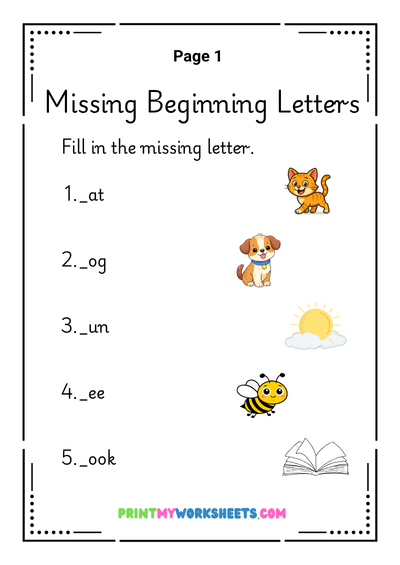
Help young learners build strong early literacy skills with our engaging Kindergarten Missing Letter Worksheets PDF designed for kids, homeschool parents, teachers, and classrooms following the US curriculum. These downloadable PDF worksheets provide fun and interactive letter activities that help children recognize letters, complete words, and strengthen foundational reading and writing skills.
Missing letter activities are an excellent way to improve alphabet recognition, phonics awareness, spelling, vocabulary, and word-building abilities. By identifying and filling in missing letters, children learn how letters work together to form words while developing concentration, memory, and problem-solving skills. These activities also support reading readiness and early writing confidence, helping children become more independent learners.
The printable worksheets include picture-supported exercises, simple word completion tasks, phonics activities, alphabet practice, and engaging puzzles that keep kindergarten students motivated and excited about learning. They are perfect for homeschool lessons, classroom literacy centers, independent practice, homework assignments, and extra phonics review.
The easy-to-download PDF format allows parents and teachers to quickly print educational resources anytime for convenient learning at home or school. These worksheets encourage hands-on learning while making literacy practice fun, educational, and stress-free for young children.
Download our Kindergarten English Missing Letter Activities Worksheets today and help children strengthen early reading, spelling, and language development skills through engaging educational activities.
Frequently Asked Questions
Q1. Is this worksheet free to download?Yes, this worksheet is 100% free to download and print. No account, subscription, or payment is required. Click the Download Now button to get your free PDF instantly.Q2. What format is this worksheet available in?This worksheet is available as a printable PDF file. It is black-and-white, printer-friendly, and works on any standard home or classroom printer using A4 or US Letter paper.Q3. Do I need to create an account to download this worksheet?No account or sign-up is required. All worksheets on Print My Worksheets are freely accessible to teachers, parents, and homeschool families without any registration.Q4. Is this worksheet aligned with Common Core ELA standards?Yes, this English worksheet is aligned with U.S. Common Core English Language Arts standards and supports foundational literacy development.Q5. Can this worksheet be used for phonics instruction?Yes, this worksheet supports phonics-based reading instruction and is suitable for early readers building letter-sound recognition skills.Kindergarten Missing Letter Worksheets PDF | Free Downloadable PDF
Help young learners build strong early literacy skills with our engaging Kindergarten Missing Letter Worksheets PDF designed for kids, homeschool parents, teachers, and classrooms following the US curriculum. These downloadable PDF worksheets provide fun and interactive letter activities that help children recognize letters, complete words, and strengthen foundational reading and writing skills.
Missing letter activities are an excellent way to improve alphabet recognition, phonics awareness, spelling, vocabulary, and word-building abilities. By identifying and filling in missing letters, children learn how letters work together to form words while developing concentration, memory, and problem-solving skills. These activities also support reading readiness and early writing confidence, helping children become more independent learners.
The printable worksheets include picture-supported exercises, simple word completion tasks, phonics activities, alphabet practice, and engaging puzzles that keep kindergarten students motivated and excited about learning. They are perfect for homeschool lessons, classroom literacy centers, independent practice, homework assignments, and extra phonics review.
The easy-to-download PDF format allows parents and teachers to quickly print educational resources anytime for convenient learning at home or school. These worksheets encourage hands-on learning while making literacy practice fun, educational, and stress-free for young children.
Download our Kindergarten English Missing Letter Activities Worksheets today and help children strengthen early reading, spelling, and language development skills through engaging educational activities.
Frequently Asked Questions
Q1. Is this worksheet free to download?Yes, this worksheet is 100% free to download and print. No account, subscription, or payment is required. Click the Download Now button to get your free PDF instantly.Q2. What format is this worksheet available in?This worksheet is available as a printable PDF file. It is black-and-white, printer-friendly, and works on any standard home or classroom printer using A4 or US Letter paper.Q3. Do I need to create an account to download this worksheet?No account or sign-up is required. All worksheets on Print My Worksheets are freely accessible to teachers, parents, and homeschool families without any registration.Q4. Is this worksheet aligned with Common Core ELA standards?Yes, this English worksheet is aligned with U.S. Common Core English Language Arts standards and supports foundational literacy development.Q5. Can this worksheet be used for phonics instruction?Yes, this worksheet supports phonics-based reading instruction and is suitable for early readers building letter-sound recognition skills.
Kindergarten Missing Vowels Worksheets PDF – Phonics Practice with Answer Key
Kindergarten Missing Vowels Worksheets PDF
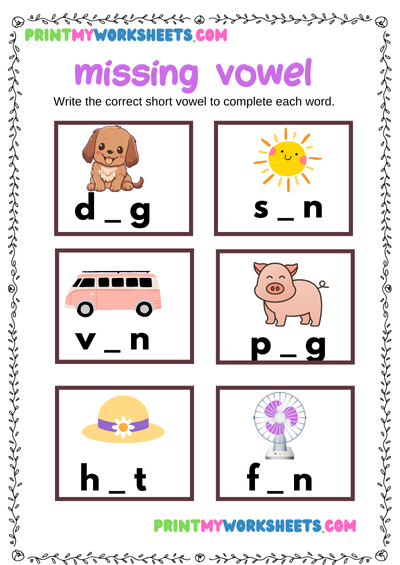
Early literacy skills begin with recognizing letters and understanding how they work together to form words. The Kindergarten Missing Vowels Worksheets PDF helps young learners practice identifying and completing words by filling in the correct vowel sounds. This engaging activity is designed for U.S. parents, teachers, and homeschool families who want to support early reading development in a structured and enjoyable way.
At the kindergarten level, children are developing foundational phonics skills that allow them to recognize simple words and understand how letters represent sounds. Vowels play a key role in this process because they appear in almost every word and influence pronunciation. These worksheets give students the opportunity to identify missing vowel sounds and complete familiar words.
The Kindergarten Missing Vowels Worksheets PDF provides simple word-building exercises that strengthen phonemic awareness, spelling confidence, and early reading abilities. By completing words with the correct vowels, children practice decoding language patterns while building the confidence they need to progress toward independent reading.
What Students Will Learn?
Missing vowel worksheets introduce kindergarten learners to one of the most important elements of early phonics: recognizing vowel sounds within simple words. These activities help students understand how vowels contribute to word formation and pronunciation.
Students practice identifying missing letters in simple three- or four-letter words. They are asked to look at a partially completed word and determine which vowel belongs in the blank space. This encourages children to think about how the word sounds and which vowel completes it correctly.
Many worksheets use familiar objects, animals, or everyday vocabulary words. These visuals help students connect the picture with the word, making the activity easier to understand and more engaging.
Children also develop spelling awareness as they practice completing words such as “c_t,” “d_g,” or “b_t.” Through repeated exposure, students begin recognizing common phonics patterns and vowel placements.
These exercises also strengthen phonemic awareness, which is the ability to hear and manipulate sounds within words. When children listen to a word and determine the missing vowel, they are actively building the skills required for reading fluency.
Over time, students gain greater confidence recognizing words and understanding how vowels function within them.
Educational Value & Skill Development
The Kindergarten Missing Vowels Worksheets PDF supports several important areas of early literacy development.
One of the most valuable benefits is phonics awareness. Kindergarten students are learning how letters represent sounds, and vowel recognition plays a major role in this process. Practicing missing vowel activities helps children hear and identify vowel sounds within words.
These worksheets also strengthen early reading skills. When students learn to recognize patterns in simple words, they begin decoding new words more easily. This skill becomes essential as reading tasks grow more complex in later grades.
Another important area of development is spelling awareness. Filling in missing vowels requires students to analyze the structure of a word and determine which letter fits correctly.
The Kindergarten Missing Vowels Worksheets PDF also encourages independent problem solving. Students must think carefully about each word and use their phonics knowledge to complete it correctly.
In addition, these worksheets support visual recognition and concentration. Students examine each word carefully, identify missing letters, and connect them with familiar vocabulary.
Through repeated practice, children build the foundational literacy skills that prepare them for reading, writing, and spelling activities in elementary school.
Why Focus on Missing Vowels?
Understanding vowels is a critical part of early reading development. While consonants often define the structure of words, vowels provide the sounds that allow words to be pronounced correctly.
Young learners often find vowels challenging because they appear in different positions and may represent different sounds. Practicing missing vowel activities helps children focus specifically on recognizing and using these important letters.
By identifying the missing vowel in a word, students develop phonemic awareness. They learn to listen for sounds within words and connect those sounds with specific letters.
These activities also reinforce common word patterns used in early phonics instruction. Words such as “cat,” “dog,” and “sun” help children recognize simple vowel sounds and develop decoding skills.
Repetition is an important part of early learning. Practicing vowel recognition regularly helps students remember patterns and apply them when reading new words.
These skills align with early literacy standards used in kindergarten classrooms across the United States, which emphasize phonics development, sound recognition, and basic word construction.
How to Use These Worksheets?
The Kindergarten Missing Vowels Worksheets PDF can be used in many different learning environments, including classrooms, homeschool lessons, and small group instruction.
Teachers often incorporate these worksheets into phonics practice sessions. Students can complete the activities individually or work together to identify the correct vowel for each word.
In small group settings, educators may guide students through the worksheet by sounding out each word together. This approach helps reinforce phonics instruction and encourages discussion about vowel sounds.
Parents who homeschool can use the worksheets as part of daily reading practice. Children may say the word aloud, listen carefully to its sound, and choose the vowel that completes it correctly.
Because the worksheets are provided as a free printable PDF, they can be downloaded quickly and printed whenever needed. Teachers may use them for literacy centers, early reading practice, or review sessions.
These worksheets can also serve as quiet independent work activities. Students can complete them at their own pace while practicing important phonics skills.
Related Worksheets / Extensions:
Frequently Asked Questions
Q1. Is this worksheet free to download?Yes, this worksheet is 100% free to download and print. No account, subscription, or payment is required. Click the Download Now button to get your free PDF instantly.Q2. What format is this worksheet available in?This worksheet is available as a printable PDF file. It is black-and-white, printer-friendly, and works on any standard home or classroom printer using A4 or US Letter paper.Q3. Can I use this worksheet for both classroom and home learning?Yes, these worksheets are designed for use by classroom teachers, homeschool parents, and tutors. They can be used as morning work, homework, revision practice, or learning centre activities.Q4. Can this coloring worksheet be used as a classroom activity?Yes, this worksheet works well as a quiet time activity, early finisher work, morning warm-up, or take-home creative activity.Q5. Is this coloring worksheet themed around learning content?Yes, our coloring worksheets are designed to combine creative activity with educational content such as alphabet recognition, numbers, animals, and seasonal themes.Kindergarten Missing Vowels Worksheets PDF – Phonics Practice with Answer Key
Kindergarten Missing Vowels Worksheets PDF
Early literacy skills begin with recognizing letters and understanding how they work together to form words. The Kindergarten Missing Vowels Worksheets PDF helps young learners practice identifying and completing words by filling in the correct vowel sounds. This engaging activity is designed for U.S. parents, teachers, and homeschool families who want to support early reading development in a structured and enjoyable way.
At the kindergarten level, children are developing foundational phonics skills that allow them to recognize simple words and understand how letters represent sounds. Vowels play a key role in this process because they appear in almost every word and influence pronunciation. These worksheets give students the opportunity to identify missing vowel sounds and complete familiar words.
The Kindergarten Missing Vowels Worksheets PDF provides simple word-building exercises that strengthen phonemic awareness, spelling confidence, and early reading abilities. By completing words with the correct vowels, children practice decoding language patterns while building the confidence they need to progress toward independent reading.
What Students Will Learn?
Missing vowel worksheets introduce kindergarten learners to one of the most important elements of early phonics: recognizing vowel sounds within simple words. These activities help students understand how vowels contribute to word formation and pronunciation.
Students practice identifying missing letters in simple three- or four-letter words. They are asked to look at a partially completed word and determine which vowel belongs in the blank space. This encourages children to think about how the word sounds and which vowel completes it correctly.
Many worksheets use familiar objects, animals, or everyday vocabulary words. These visuals help students connect the picture with the word, making the activity easier to understand and more engaging.
Children also develop spelling awareness as they practice completing words such as “c_t,” “d_g,” or “b_t.” Through repeated exposure, students begin recognizing common phonics patterns and vowel placements.
These exercises also strengthen phonemic awareness, which is the ability to hear and manipulate sounds within words. When children listen to a word and determine the missing vowel, they are actively building the skills required for reading fluency.
Over time, students gain greater confidence recognizing words and understanding how vowels function within them.
Educational Value & Skill Development
The Kindergarten Missing Vowels Worksheets PDF supports several important areas of early literacy development.
One of the most valuable benefits is phonics awareness. Kindergarten students are learning how letters represent sounds, and vowel recognition plays a major role in this process. Practicing missing vowel activities helps children hear and identify vowel sounds within words.
These worksheets also strengthen early reading skills. When students learn to recognize patterns in simple words, they begin decoding new words more easily. This skill becomes essential as reading tasks grow more complex in later grades.
Another important area of development is spelling awareness. Filling in missing vowels requires students to analyze the structure of a word and determine which letter fits correctly.
The Kindergarten Missing Vowels Worksheets PDF also encourages independent problem solving. Students must think carefully about each word and use their phonics knowledge to complete it correctly.
In addition, these worksheets support visual recognition and concentration. Students examine each word carefully, identify missing letters, and connect them with familiar vocabulary.
Through repeated practice, children build the foundational literacy skills that prepare them for reading, writing, and spelling activities in elementary school.
Why Focus on Missing Vowels?
Understanding vowels is a critical part of early reading development. While consonants often define the structure of words, vowels provide the sounds that allow words to be pronounced correctly.
Young learners often find vowels challenging because they appear in different positions and may represent different sounds. Practicing missing vowel activities helps children focus specifically on recognizing and using these important letters.
By identifying the missing vowel in a word, students develop phonemic awareness. They learn to listen for sounds within words and connect those sounds with specific letters.
These activities also reinforce common word patterns used in early phonics instruction. Words such as “cat,” “dog,” and “sun” help children recognize simple vowel sounds and develop decoding skills.
Repetition is an important part of early learning. Practicing vowel recognition regularly helps students remember patterns and apply them when reading new words.
These skills align with early literacy standards used in kindergarten classrooms across the United States, which emphasize phonics development, sound recognition, and basic word construction.
How to Use These Worksheets?
The Kindergarten Missing Vowels Worksheets PDF can be used in many different learning environments, including classrooms, homeschool lessons, and small group instruction.
Teachers often incorporate these worksheets into phonics practice sessions. Students can complete the activities individually or work together to identify the correct vowel for each word.
In small group settings, educators may guide students through the worksheet by sounding out each word together. This approach helps reinforce phonics instruction and encourages discussion about vowel sounds.
Parents who homeschool can use the worksheets as part of daily reading practice. Children may say the word aloud, listen carefully to its sound, and choose the vowel that completes it correctly.
Because the worksheets are provided as a free printable PDF, they can be downloaded quickly and printed whenever needed. Teachers may use them for literacy centers, early reading practice, or review sessions.
These worksheets can also serve as quiet independent work activities. Students can complete them at their own pace while practicing important phonics skills.
Related Worksheets / Extensions:
Frequently Asked Questions
Q1. Is this worksheet free to download?Yes, this worksheet is 100% free to download and print. No account, subscription, or payment is required. Click the Download Now button to get your free PDF instantly.Q2. What format is this worksheet available in?This worksheet is available as a printable PDF file. It is black-and-white, printer-friendly, and works on any standard home or classroom printer using A4 or US Letter paper.Q3. Can I use this worksheet for both classroom and home learning?Yes, these worksheets are designed for use by classroom teachers, homeschool parents, and tutors. They can be used as morning work, homework, revision practice, or learning centre activities.Q4. Can this coloring worksheet be used as a classroom activity?Yes, this worksheet works well as a quiet time activity, early finisher work, morning warm-up, or take-home creative activity.Q5. Is this coloring worksheet themed around learning content?Yes, our coloring worksheets are designed to combine creative activity with educational content such as alphabet recognition, numbers, animals, and seasonal themes.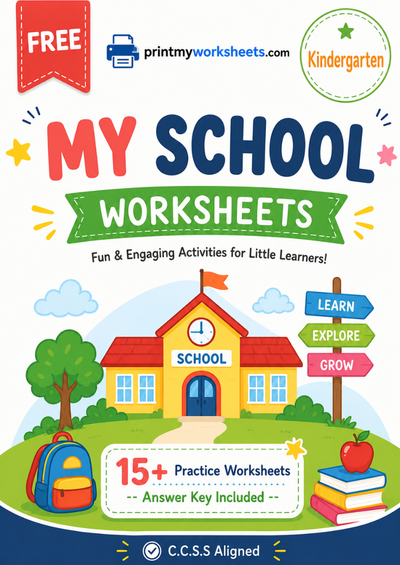
Kindergarten My School Worksheets | Free Downloadable PDF
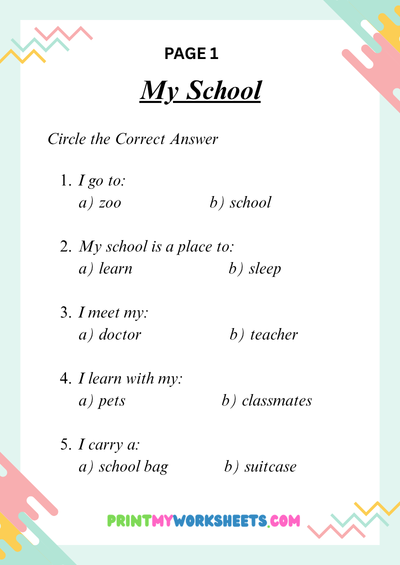
Help young learners explore and understand their school environment with our Kindergarten My School Worksheets, designed for homeschool families, teachers, and kindergarten students across the United States. These downloadable PDF worksheets introduce children to familiar school-related vocabulary, people, places, routines, and experiences through simple, age-appropriate learning activities.
Children can practice identifying common school items, recognizing classroom areas, learning about teachers and classmates, discussing school routines, and building vocabulary related to their everyday learning environment. These activities encourage communication, observation, early literacy, and social-emotional development while helping children feel more comfortable and confident about school.
These no-prep worksheets are ideal for kindergarten classrooms, homeschool lessons, back-to-school activities, morning work, literacy centers, classroom discussions, homework, and independent practice. Parents and teachers can easily download and print the PDF worksheets for convenient use at home or in the classroom.
Learning about school helps children connect familiar experiences with new vocabulary and classroom concepts. Whether your child is preparing for kindergarten, learning about school for the first time, or reviewing familiar school-related words, these worksheets provide engaging opportunities for meaningful practice.
Download the Free Kindergarten My School Worksheets PDF today and help children explore their school world while developing vocabulary, communication, confidence, and essential early learning skills through fun, structured activities.Frequently Asked Questions
Q1. Is this worksheet free to download?Yes, this worksheet is 100% free to download and print. No account, subscription, or payment is required. Click the Download Now button to get your free PDF instantly.Q2. What format is this worksheet available in?This worksheet is available as a printable PDF file. It is black-and-white, printer-friendly, and works on any standard home or classroom printer using A4 or US Letter paper.Q3. Can I use this worksheet for both classroom and home learning?Yes, these worksheets are designed for use by classroom teachers, homeschool parents, and tutors. They can be used as morning work, homework, revision practice, or learning centre activities.Q4. Is this worksheet aligned with Common Core ELA standards?Yes, this English worksheet is aligned with U.S. Common Core English Language Arts standards and supports foundational literacy development.Q5. Can this worksheet be used for phonics instruction?Yes, this worksheet supports phonics-based reading instruction and is suitable for early readers building letter-sound recognition skills.Kindergarten My School Worksheets | Free Downloadable PDF
Help young learners explore and understand their school environment with our Kindergarten My School Worksheets, designed for homeschool families, teachers, and kindergarten students across the United States. These downloadable PDF worksheets introduce children to familiar school-related vocabulary, people, places, routines, and experiences through simple, age-appropriate learning activities.
Children can practice identifying common school items, recognizing classroom areas, learning about teachers and classmates, discussing school routines, and building vocabulary related to their everyday learning environment. These activities encourage communication, observation, early literacy, and social-emotional development while helping children feel more comfortable and confident about school.
These no-prep worksheets are ideal for kindergarten classrooms, homeschool lessons, back-to-school activities, morning work, literacy centers, classroom discussions, homework, and independent practice. Parents and teachers can easily download and print the PDF worksheets for convenient use at home or in the classroom.
Learning about school helps children connect familiar experiences with new vocabulary and classroom concepts. Whether your child is preparing for kindergarten, learning about school for the first time, or reviewing familiar school-related words, these worksheets provide engaging opportunities for meaningful practice.
Download the Free Kindergarten My School Worksheets PDF today and help children explore their school world while developing vocabulary, communication, confidence, and essential early learning skills through fun, structured activities.Frequently Asked Questions
Q1. Is this worksheet free to download?Yes, this worksheet is 100% free to download and print. No account, subscription, or payment is required. Click the Download Now button to get your free PDF instantly.Q2. What format is this worksheet available in?This worksheet is available as a printable PDF file. It is black-and-white, printer-friendly, and works on any standard home or classroom printer using A4 or US Letter paper.Q3. Can I use this worksheet for both classroom and home learning?Yes, these worksheets are designed for use by classroom teachers, homeschool parents, and tutors. They can be used as morning work, homework, revision practice, or learning centre activities.Q4. Is this worksheet aligned with Common Core ELA standards?Yes, this English worksheet is aligned with U.S. Common Core English Language Arts standards and supports foundational literacy development.Q5. Can this worksheet be used for phonics instruction?Yes, this worksheet supports phonics-based reading instruction and is suitable for early readers building letter-sound recognition skills.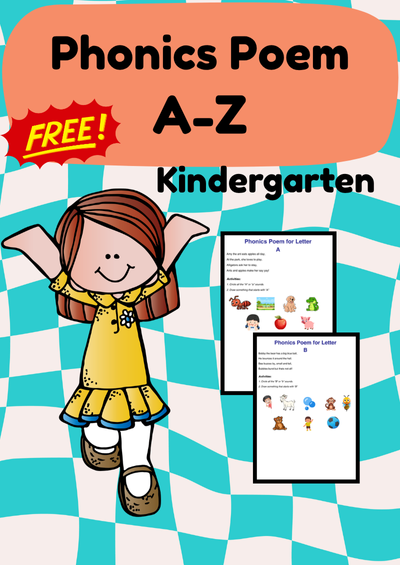
Kindergarten Phonics Poems A–Z PDF | Free Downloadable
Looking for an effective and enjoyable way to introduce letter sounds to your early learner? Our Kindergarten Phonics Poems A–Z PDF for Kindergarten is the perfect tool to bring phonics to life with rhythm and rhyme.
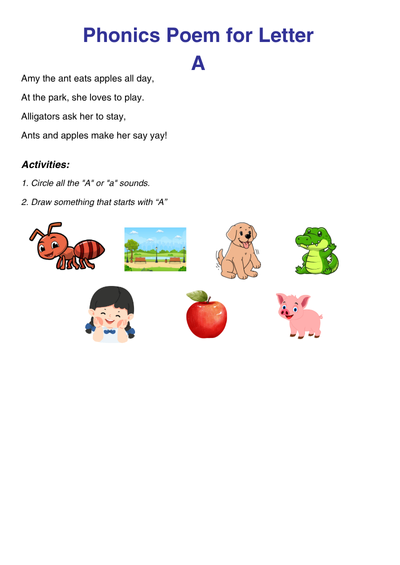
Each letter of the alphabet is represented with a short, catchy poem that features a key phonics sound and a focus word, like "A is for Apple that I like to eat" or "B is for Ball I kick with my feet." This format encourages sound association, early decoding, and memory retention, all critical for strong reading foundations.
These worksheets are aligned with early literacy objectives and ideal for:
Daily phonics warm-ups
Independent practice
Small group literacy centers
Morning journals or homework
Homeschool phonics lessons
This phonics pack reinforces:
Letter identification
Phonemic awareness
Vocabulary building
Reading fluency through repetition
Each poem is followed by:
A tracing activity (e.g., trace the letter A)
A coloring section (e.g., color the apple)
A sound identification question (e.g., circle the word that starts with A)
✅ Why Kids Should Learn Phonics with Poems:
🗣️ Rhythm helps retention – Rhymes make sounds easier to remember
📚 Reinforces letter-sound relationships
🧠 Improves listening skills and vocabulary
🎓 Builds phonemic awareness—a cornerstone of early reading success
🎨 Encourages creativity through reading, drawing, and interaction
✅ Who Can Use This:
Kindergarten teachers in U.S. classrooms
Homeschooling parents
Reading tutors
ESL/ELL instructors
Daycare centers
✅ File Format & Compatibility:
🖨️ PDF format, 8.5" x 11" U.S. Letter size
🖍️ Black-and-white print-friendly
📥 Easy to download, save, and print
Download and print today to give your little learners the head start they deserve!
Frequently Asked Questions
Q1. Is this worksheet free to download?Yes, this worksheet is 100% free to download and print. No account, subscription, or payment is required. Click the Download Now button to get your free PDF instantly.Q2. What format is this worksheet available in?This worksheet is available as a printable PDF file. It is black-and-white, printer-friendly, and works on any standard home or classroom printer using A4 or US Letter paper.Q3. Can I use this worksheet for both classroom and home learning?Yes, these worksheets are designed for use by classroom teachers, homeschool parents, and tutors. They can be used as morning work, homework, revision practice, or learning centre activities.Q4. Is this worksheet aligned with Common Core ELA standards?Yes, this English worksheet is aligned with U.S. Common Core English Language Arts standards and supports foundational literacy development.Q5. Can this worksheet be used for phonics instruction?Yes, this worksheet supports phonics-based reading instruction and is suitable for early readers building letter-sound recognition skills.Kindergarten Phonics Poems A–Z PDF | Free Downloadable
Looking for an effective and enjoyable way to introduce letter sounds to your early learner? Our Kindergarten Phonics Poems A–Z PDF for Kindergarten is the perfect tool to bring phonics to life with rhythm and rhyme.
Each letter of the alphabet is represented with a short, catchy poem that features a key phonics sound and a focus word, like "A is for Apple that I like to eat" or "B is for Ball I kick with my feet." This format encourages sound association, early decoding, and memory retention, all critical for strong reading foundations.
These worksheets are aligned with early literacy objectives and ideal for:
Daily phonics warm-ups
Independent practice
Small group literacy centers
Morning journals or homework
Homeschool phonics lessons
This phonics pack reinforces:
Letter identification
Phonemic awareness
Vocabulary building
Reading fluency through repetition
Each poem is followed by:
A tracing activity (e.g., trace the letter A)
A coloring section (e.g., color the apple)
A sound identification question (e.g., circle the word that starts with A)
✅ Why Kids Should Learn Phonics with Poems:
🗣️ Rhythm helps retention – Rhymes make sounds easier to remember
📚 Reinforces letter-sound relationships
🧠 Improves listening skills and vocabulary
🎓 Builds phonemic awareness—a cornerstone of early reading success
🎨 Encourages creativity through reading, drawing, and interaction
✅ Who Can Use This:
Kindergarten teachers in U.S. classrooms
Homeschooling parents
Reading tutors
ESL/ELL instructors
Daycare centers
✅ File Format & Compatibility:
🖨️ PDF format, 8.5" x 11" U.S. Letter size
🖍️ Black-and-white print-friendly
📥 Easy to download, save, and print
Download and print today to give your little learners the head start they deserve!
Frequently Asked Questions
Q1. Is this worksheet free to download?Yes, this worksheet is 100% free to download and print. No account, subscription, or payment is required. Click the Download Now button to get your free PDF instantly.Q2. What format is this worksheet available in?This worksheet is available as a printable PDF file. It is black-and-white, printer-friendly, and works on any standard home or classroom printer using A4 or US Letter paper.Q3. Can I use this worksheet for both classroom and home learning?Yes, these worksheets are designed for use by classroom teachers, homeschool parents, and tutors. They can be used as morning work, homework, revision practice, or learning centre activities.Q4. Is this worksheet aligned with Common Core ELA standards?Yes, this English worksheet is aligned with U.S. Common Core English Language Arts standards and supports foundational literacy development.Q5. Can this worksheet be used for phonics instruction?Yes, this worksheet supports phonics-based reading instruction and is suitable for early readers building letter-sound recognition skills.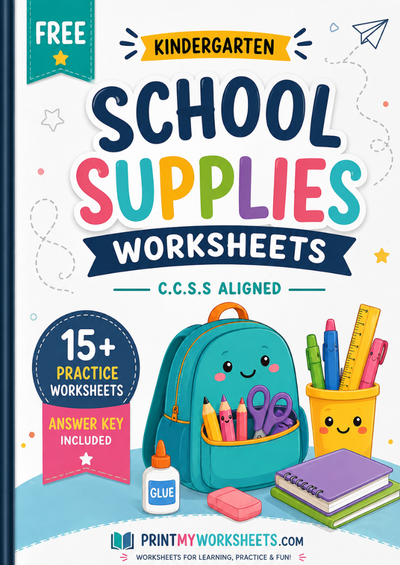
Kindergarten School Supplies Printable Worksheets | Free Downloadable PDF
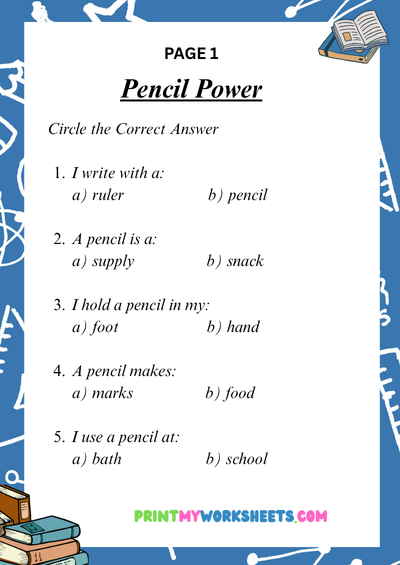
Help young learners recognize and learn common classroom items with our Kindergarten School Supplies Printable Worksheets, designed for homeschool families, teachers, and kindergarten students across the United States. These downloadable PDF worksheets provide simple, engaging activities focused on familiar school supplies and early vocabulary development.
Children can practice identifying and naming everyday school items such as pencils, books, crayons, scissors, glue, rulers, backpacks, and other classroom supplies. Activities help students build vocabulary, strengthen word recognition, improve communication, and become more familiar with the materials they use during their school day.
These no-prep worksheets are ideal for kindergarten classrooms, homeschool lessons, back-to-school activities, morning work, literacy centers, vocabulary practice, homework, and independent learning. Parents and teachers can easily download and print the PDF worksheets for convenient use at home or in the classroom.
Learning school-supply vocabulary helps children connect words with familiar objects while building confidence in their new learning environment. Whether you're preparing a child for kindergarten, introducing classroom vocabulary, or reviewing familiar school items, these worksheets provide enjoyable and age-appropriate practice.
Download the Free Kindergarten School Supplies Worksheets PDF today and help children learn important classroom vocabulary while developing early literacy, communication, recognition, and school-readiness skills through fun, structured activities.Frequently Asked Questions
Q1. Is this worksheet free to download?Yes, this worksheet is 100% free to download and print. No account, subscription, or payment is required. Click the Download Now button to get your free PDF instantly.Q2. What format is this worksheet available in?This worksheet is available as a printable PDF file. It is black-and-white, printer-friendly, and works on any standard home or classroom printer using A4 or US Letter paper.Q3. Can I use this worksheet for both classroom and home learning?Yes, these worksheets are designed for use by classroom teachers, homeschool parents, and tutors. They can be used as morning work, homework, revision practice, or learning centre activities.Q4. Is this worksheet aligned with Common Core ELA standards?Yes, this English worksheet is aligned with U.S. Common Core English Language Arts standards and supports foundational literacy development.Q5. Can this worksheet be used for phonics instruction?Yes, this worksheet supports phonics-based reading instruction and is suitable for early readers building letter-sound recognition skills.Kindergarten School Supplies Printable Worksheets | Free Downloadable PDF
Help young learners recognize and learn common classroom items with our Kindergarten School Supplies Printable Worksheets, designed for homeschool families, teachers, and kindergarten students across the United States. These downloadable PDF worksheets provide simple, engaging activities focused on familiar school supplies and early vocabulary development.
Children can practice identifying and naming everyday school items such as pencils, books, crayons, scissors, glue, rulers, backpacks, and other classroom supplies. Activities help students build vocabulary, strengthen word recognition, improve communication, and become more familiar with the materials they use during their school day.
These no-prep worksheets are ideal for kindergarten classrooms, homeschool lessons, back-to-school activities, morning work, literacy centers, vocabulary practice, homework, and independent learning. Parents and teachers can easily download and print the PDF worksheets for convenient use at home or in the classroom.
Learning school-supply vocabulary helps children connect words with familiar objects while building confidence in their new learning environment. Whether you're preparing a child for kindergarten, introducing classroom vocabulary, or reviewing familiar school items, these worksheets provide enjoyable and age-appropriate practice.
Download the Free Kindergarten School Supplies Worksheets PDF today and help children learn important classroom vocabulary while developing early literacy, communication, recognition, and school-readiness skills through fun, structured activities.Frequently Asked Questions
Q1. Is this worksheet free to download?Yes, this worksheet is 100% free to download and print. No account, subscription, or payment is required. Click the Download Now button to get your free PDF instantly.Q2. What format is this worksheet available in?This worksheet is available as a printable PDF file. It is black-and-white, printer-friendly, and works on any standard home or classroom printer using A4 or US Letter paper.Q3. Can I use this worksheet for both classroom and home learning?Yes, these worksheets are designed for use by classroom teachers, homeschool parents, and tutors. They can be used as morning work, homework, revision practice, or learning centre activities.Q4. Is this worksheet aligned with Common Core ELA standards?Yes, this English worksheet is aligned with U.S. Common Core English Language Arts standards and supports foundational literacy development.Q5. Can this worksheet be used for phonics instruction?Yes, this worksheet supports phonics-based reading instruction and is suitable for early readers building letter-sound recognition skills.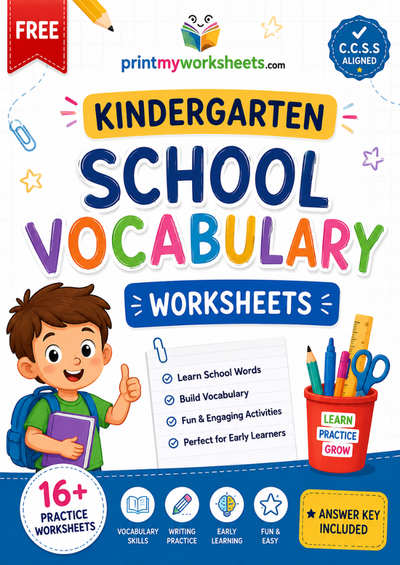
Kindergarten School Vocabulary Printable Worksheets | Free Downloadable PDF
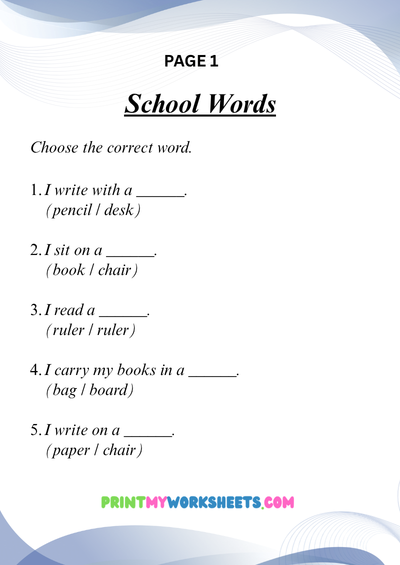
Build essential vocabulary and school-readiness skills with our Kindergarten School Vocabulary Printable Worksheets, designed for homeschool families, teachers, and kindergarten students across the United States. These downloadable PDF worksheets introduce young learners to familiar school-related words through simple, engaging, and age-appropriate activities.
Children can practice recognizing and using vocabulary related to classrooms, teachers, classmates, school supplies, learning spaces, and everyday school routines. These activities help strengthen word recognition, communication, early literacy, listening skills, and confidence while helping children become more familiar with their school environment.
These no-prep worksheets are ideal for kindergarten classrooms, homeschool lessons, back-to-school activities, morning work, literacy centers, vocabulary practice, homework, and independent learning. Parents and teachers can easily download and print the PDF worksheets for convenient use at home or in the classroom.
Learning school vocabulary helps children connect new words with familiar experiences and supports effective communication in everyday school situations. Whether your child is preparing for kindergarten, learning school-related words for the first time, or reviewing familiar vocabulary, these worksheets provide meaningful opportunities for practice.
Download the Free Kindergarten School Vocabulary Worksheets PDF today and help young learners expand their vocabulary, strengthen early literacy skills, and feel more confident communicating about school through fun, structured learning activities.Frequently Asked Questions
Q1. Is this worksheet free to download?Yes, this worksheet is 100% free to download and print. No account, subscription, or payment is required. Click the Download Now button to get your free PDF instantly.Q2. What format is this worksheet available in?This worksheet is available as a printable PDF file. It is black-and-white, printer-friendly, and works on any standard home or classroom printer using A4 or US Letter paper.Q3. Can I use this worksheet for both classroom and home learning?Yes, these worksheets are designed for use by classroom teachers, homeschool parents, and tutors. They can be used as morning work, homework, revision practice, or learning centre activities.Q4. Is this worksheet aligned with Common Core ELA standards?Yes, this English worksheet is aligned with U.S. Common Core English Language Arts standards and supports foundational literacy development.Q5. Can this worksheet be used for phonics instruction?Yes, this worksheet supports phonics-based reading instruction and is suitable for early readers building letter-sound recognition skills.Kindergarten School Vocabulary Printable Worksheets | Free Downloadable PDF
Build essential vocabulary and school-readiness skills with our Kindergarten School Vocabulary Printable Worksheets, designed for homeschool families, teachers, and kindergarten students across the United States. These downloadable PDF worksheets introduce young learners to familiar school-related words through simple, engaging, and age-appropriate activities.
Children can practice recognizing and using vocabulary related to classrooms, teachers, classmates, school supplies, learning spaces, and everyday school routines. These activities help strengthen word recognition, communication, early literacy, listening skills, and confidence while helping children become more familiar with their school environment.
These no-prep worksheets are ideal for kindergarten classrooms, homeschool lessons, back-to-school activities, morning work, literacy centers, vocabulary practice, homework, and independent learning. Parents and teachers can easily download and print the PDF worksheets for convenient use at home or in the classroom.
Learning school vocabulary helps children connect new words with familiar experiences and supports effective communication in everyday school situations. Whether your child is preparing for kindergarten, learning school-related words for the first time, or reviewing familiar vocabulary, these worksheets provide meaningful opportunities for practice.
Download the Free Kindergarten School Vocabulary Worksheets PDF today and help young learners expand their vocabulary, strengthen early literacy skills, and feel more confident communicating about school through fun, structured learning activities.Frequently Asked Questions
Q1. Is this worksheet free to download?Yes, this worksheet is 100% free to download and print. No account, subscription, or payment is required. Click the Download Now button to get your free PDF instantly.Q2. What format is this worksheet available in?This worksheet is available as a printable PDF file. It is black-and-white, printer-friendly, and works on any standard home or classroom printer using A4 or US Letter paper.Q3. Can I use this worksheet for both classroom and home learning?Yes, these worksheets are designed for use by classroom teachers, homeschool parents, and tutors. They can be used as morning work, homework, revision practice, or learning centre activities.Q4. Is this worksheet aligned with Common Core ELA standards?Yes, this English worksheet is aligned with U.S. Common Core English Language Arts standards and supports foundational literacy development.Q5. Can this worksheet be used for phonics instruction?Yes, this worksheet supports phonics-based reading instruction and is suitable for early readers building letter-sound recognition skills.
Kindergarten Sentence Building Worksheets PDF – Writing Practice with Answer Key
Kindergarten Sentence Building Worksheets PDF
The Kindergarten Sentence Building Worksheets PDF is designed to help young learners begin forming simple sentences with confidence. This free printable resource supports early literacy development by guiding children through structured sentence-building activities. It is especially useful for U.S. parents, kindergarten teachers, and homeschool families who want to strengthen foundational reading and writing skills.
At the kindergarten level, children are learning how words work together to express ideas. Sentence building helps students understand word order, grammar basics, and how language forms meaningful statements. Through guided practice, children begin to recognize how individual words combine to create complete sentences.
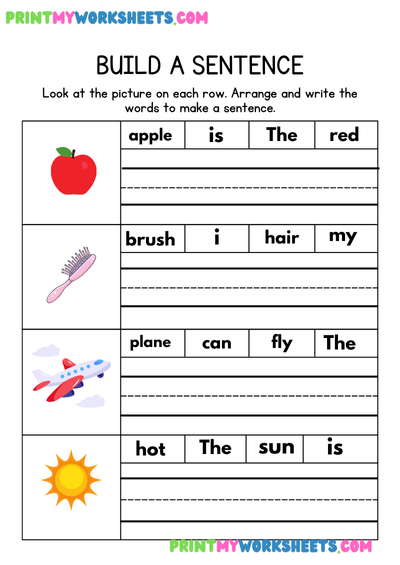
The Kindergarten Sentence Building Worksheets PDF introduces sentence structure in a simple and engaging way. Students practice arranging words, completing short sentences, and matching pictures with appropriate phrases. These activities make learning interactive while reinforcing early writing and reading skills. With regular practice, children gain confidence in constructing their own sentences and communicating ideas clearly.
What Students Will Learn?
Sentence building worksheets help kindergarten learners understand how words connect to form complete thoughts. At this stage, students are beginning to transition from recognizing individual words to using them in short written statements.
Through these activities, children practice identifying basic sentence components such as nouns, verbs, and descriptive words. They learn that sentences must follow a specific order to make sense. For example, students may practice arranging words like “The cat runs” rather than placing them randomly.
Many worksheets include picture-supported tasks that encourage students to match images with appropriate sentences. These activities help children understand how language relates to real-world objects and actions.
Students also practice reading short phrases and completing partially written sentences. These exercises strengthen both reading comprehension and writing skills.
The worksheets are designed with simple instructions and clear visual layouts to support early learners. With guided practice, children begin to recognize sentence patterns and gain confidence in expressing ideas through writing.
These activities also encourage language development by expanding vocabulary and helping students understand how different words contribute to meaning within a sentence.
Educational Value & Skill Development
The Kindergarten Sentence Building Worksheets PDF provides valuable support for developing early writing and reading skills. Sentence construction is an important step in helping children move from single-word recognition to complete written communication.
One of the key academic benefits is understanding sentence structure. When children practice arranging words into logical sequences, they develop an awareness of grammar and word order. This knowledge helps them read sentences more accurately and write their own ideas clearly.
These worksheets also strengthen reading comprehension. As students build sentences, they must think about how each word contributes to meaning. This encourages deeper engagement with language and improves understanding of written text.
Another benefit is vocabulary development. Sentence-building activities introduce new words in context, allowing students to learn how different terms function within a sentence.
The Kindergarten Sentence Building Worksheets PDF also supports cognitive development. Children practice sequencing, pattern recognition, and logical thinking while organizing words into meaningful statements.
Repeated practice builds confidence as students successfully construct sentences on their own. When children feel capable of expressing their ideas through writing, they become more motivated to engage with reading and language activities.
Why Focus on Sentence Building?
Sentence building is a crucial step in early literacy development because it teaches children how language works beyond individual words. Kindergarten students are beginning to understand that words combine to create meaningful messages.
By practicing sentence construction, children learn the importance of word order. They begin to recognize that rearranging words changes the meaning of a sentence. This awareness supports both reading comprehension and writing skills.
Sentence-building practice also helps students develop grammar awareness. Even simple sentences introduce concepts such as capitalization, punctuation, and subject-verb relationships.
Another important benefit is communication development. When children learn to form sentences, they gain the ability to express their thoughts, ideas, and experiences more clearly. This supports both academic learning and everyday communication.
Repetition plays an important role in mastering sentence structure. Regular practice helps children recognize patterns and become comfortable writing simple statements.
In the United States, early literacy standards emphasize sentence construction as part of kindergarten language development. Teaching children how to build sentences prepares them for more advanced writing tasks in later grades.How to Use These Worksheets?
The Kindergarten Sentence Building Worksheets PDF can be used in classrooms, homeschool settings, and small-group literacy instruction to support early writing practice.
Teachers can incorporate these worksheets into daily language arts activities. Students may complete sentence-building exercises during writing centers or reading stations. Teachers may guide students through each activity by discussing word order and sentence meaning.
In small groups, educators can encourage students to read the completed sentences aloud. This helps reinforce the connection between spoken language and written text.
Parents who homeschool can use these worksheets as part of a structured literacy routine. Children may begin by reading simple words and then arranging them into short sentences. Parents can support learning by discussing what each sentence means.
Because the worksheets are provided as a free printable PDF, they can be downloaded and printed quickly. This allows families and teachers to reuse the materials for practice sessions, homework activities, or review exercises.
The worksheets are also suitable for independent learning. Clear instructions and visual cues make it easy for young learners to follow along and complete the activities successfully.
Related Worksheets / Extensions:
Frequently Asked Questions
Q1. Is this worksheet free to download?Yes, this worksheet is 100% free to download and print. No account, subscription, or payment is required. Click the Download Now button to get your free PDF instantly.Q2. What format is this worksheet available in?This worksheet is available as a printable PDF file. It is black-and-white, printer-friendly, and works on any standard home or classroom printer using A4 or US Letter paper.Q3. Can I use this worksheet for both classroom and home learning?Yes, these worksheets are designed for use by classroom teachers, homeschool parents, and tutors. They can be used as morning work, homework, revision practice, or learning centre activities.Q4. Is this worksheet aligned with Common Core ELA standards?Yes, this English worksheet is aligned with U.S. Common Core English Language Arts standards and supports foundational literacy development.Q5. Can this worksheet be used for phonics instruction?Yes, this worksheet supports phonics-based reading instruction and is suitable for early readers building letter-sound recognition skills.Kindergarten Sentence Building Worksheets PDF – Writing Practice with Answer Key
Kindergarten Sentence Building Worksheets PDF
The Kindergarten Sentence Building Worksheets PDF is designed to help young learners begin forming simple sentences with confidence. This free printable resource supports early literacy development by guiding children through structured sentence-building activities. It is especially useful for U.S. parents, kindergarten teachers, and homeschool families who want to strengthen foundational reading and writing skills.
At the kindergarten level, children are learning how words work together to express ideas. Sentence building helps students understand word order, grammar basics, and how language forms meaningful statements. Through guided practice, children begin to recognize how individual words combine to create complete sentences.
The Kindergarten Sentence Building Worksheets PDF introduces sentence structure in a simple and engaging way. Students practice arranging words, completing short sentences, and matching pictures with appropriate phrases. These activities make learning interactive while reinforcing early writing and reading skills. With regular practice, children gain confidence in constructing their own sentences and communicating ideas clearly.
What Students Will Learn?
Sentence building worksheets help kindergarten learners understand how words connect to form complete thoughts. At this stage, students are beginning to transition from recognizing individual words to using them in short written statements.
Through these activities, children practice identifying basic sentence components such as nouns, verbs, and descriptive words. They learn that sentences must follow a specific order to make sense. For example, students may practice arranging words like “The cat runs” rather than placing them randomly.
Many worksheets include picture-supported tasks that encourage students to match images with appropriate sentences. These activities help children understand how language relates to real-world objects and actions.
Students also practice reading short phrases and completing partially written sentences. These exercises strengthen both reading comprehension and writing skills.
The worksheets are designed with simple instructions and clear visual layouts to support early learners. With guided practice, children begin to recognize sentence patterns and gain confidence in expressing ideas through writing.
These activities also encourage language development by expanding vocabulary and helping students understand how different words contribute to meaning within a sentence.
Educational Value & Skill Development
The Kindergarten Sentence Building Worksheets PDF provides valuable support for developing early writing and reading skills. Sentence construction is an important step in helping children move from single-word recognition to complete written communication.
One of the key academic benefits is understanding sentence structure. When children practice arranging words into logical sequences, they develop an awareness of grammar and word order. This knowledge helps them read sentences more accurately and write their own ideas clearly.
These worksheets also strengthen reading comprehension. As students build sentences, they must think about how each word contributes to meaning. This encourages deeper engagement with language and improves understanding of written text.
Another benefit is vocabulary development. Sentence-building activities introduce new words in context, allowing students to learn how different terms function within a sentence.
The Kindergarten Sentence Building Worksheets PDF also supports cognitive development. Children practice sequencing, pattern recognition, and logical thinking while organizing words into meaningful statements.
Repeated practice builds confidence as students successfully construct sentences on their own. When children feel capable of expressing their ideas through writing, they become more motivated to engage with reading and language activities.
Why Focus on Sentence Building?
Sentence building is a crucial step in early literacy development because it teaches children how language works beyond individual words. Kindergarten students are beginning to understand that words combine to create meaningful messages.
By practicing sentence construction, children learn the importance of word order. They begin to recognize that rearranging words changes the meaning of a sentence. This awareness supports both reading comprehension and writing skills.
Sentence-building practice also helps students develop grammar awareness. Even simple sentences introduce concepts such as capitalization, punctuation, and subject-verb relationships.
Another important benefit is communication development. When children learn to form sentences, they gain the ability to express their thoughts, ideas, and experiences more clearly. This supports both academic learning and everyday communication.
Repetition plays an important role in mastering sentence structure. Regular practice helps children recognize patterns and become comfortable writing simple statements.
In the United States, early literacy standards emphasize sentence construction as part of kindergarten language development. Teaching children how to build sentences prepares them for more advanced writing tasks in later grades.How to Use These Worksheets?
The Kindergarten Sentence Building Worksheets PDF can be used in classrooms, homeschool settings, and small-group literacy instruction to support early writing practice.
Teachers can incorporate these worksheets into daily language arts activities. Students may complete sentence-building exercises during writing centers or reading stations. Teachers may guide students through each activity by discussing word order and sentence meaning.
In small groups, educators can encourage students to read the completed sentences aloud. This helps reinforce the connection between spoken language and written text.
Parents who homeschool can use these worksheets as part of a structured literacy routine. Children may begin by reading simple words and then arranging them into short sentences. Parents can support learning by discussing what each sentence means.
Because the worksheets are provided as a free printable PDF, they can be downloaded and printed quickly. This allows families and teachers to reuse the materials for practice sessions, homework activities, or review exercises.
The worksheets are also suitable for independent learning. Clear instructions and visual cues make it easy for young learners to follow along and complete the activities successfully.
Related Worksheets / Extensions:
Frequently Asked Questions
Q1. Is this worksheet free to download?Yes, this worksheet is 100% free to download and print. No account, subscription, or payment is required. Click the Download Now button to get your free PDF instantly.Q2. What format is this worksheet available in?This worksheet is available as a printable PDF file. It is black-and-white, printer-friendly, and works on any standard home or classroom printer using A4 or US Letter paper.Q3. Can I use this worksheet for both classroom and home learning?Yes, these worksheets are designed for use by classroom teachers, homeschool parents, and tutors. They can be used as morning work, homework, revision practice, or learning centre activities.Q4. Is this worksheet aligned with Common Core ELA standards?Yes, this English worksheet is aligned with U.S. Common Core English Language Arts standards and supports foundational literacy development.Q5. Can this worksheet be used for phonics instruction?Yes, this worksheet supports phonics-based reading instruction and is suitable for early readers building letter-sound recognition skills.
Kindergarten Shapes Worksheets PDF | Free Downloadable Activity Sheets Kids Love
Kindergarten Shapes Worksheets PDF
Learning about shapes is one of the first and most important math skills children develop in kindergarten. The Kindergarten Shapes Worksheets PDF is designed to introduce young learners to basic geometric shapes through engaging, age-appropriate activities. This free printable resource is ideal for U.S. parents, classroom teachers, and homeschool families looking to build a strong early math foundation.
In kindergarten, children begin recognizing and describing shapes they see in their everyday environment, such as circles, squares, triangles, and rectangles. These worksheets support that learning by providing structured practice that is both visual and hands-on. By working with shapes regularly, students strengthen observation skills, vocabulary, and early problem-solving abilities. The worksheets are easy to use, developmentally appropriate, and designed to help children feel confident as they explore math concepts in a fun and supportive way.
What Students Will Learn?
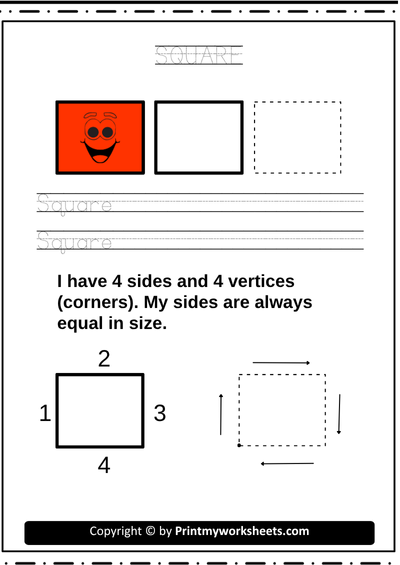
These worksheets help kindergarten students develop a clear understanding of basic shapes and how they appear in the world around them. Children practice identifying common shapes, matching shapes, and distinguishing between different forms based on size and orientation. Activities may include tracing shapes, coloring specific shapes, and finding shapes within pictures.
Students also begin learning shape-related vocabulary, such as sides, corners, and curves, in a simple and accessible way. Worksheets are structured to encourage focus and repetition, which is essential at this age. Each activity builds upon previous skills, allowing children to gradually improve recognition and confidence.
The activities are aligned with kindergarten-level expectations and designed to hold young learners’ attention without overwhelming them. Clear instructions and consistent layouts help children understand what is expected, supporting independent work as well as guided instruction with an adult.
Educational Value & Skill Development
The Kindergarten Shapes Worksheets PDF provides strong educational value by supporting both math readiness and overall cognitive development. Academically, shape recognition is a key component of early geometry and helps prepare students for more advanced math concepts in later grades, such as measurement and spatial reasoning.
Cognitively, working with shapes strengthens visual discrimination, attention to detail, and memory. Children learn to notice similarities and differences, which supports critical thinking skills. Fine motor skills are also reinforced through tracing and coloring activities, helping students develop better pencil control.
As children successfully complete activities, they gain confidence in their abilities and develop a positive attitude toward learning. Worksheets allow for self-paced practice, giving students the opportunity to revisit concepts as needed. This gradual skill progression helps ensure that learners feel supported while building a solid foundation in early math concepts.
Why Focus on Shapes?
Understanding shapes is essential for early math development and plays a significant role in how children perceive and interact with their environment. Shapes help children make sense of objects, patterns, and spatial relationships, which are important skills both inside and outside the classroom.
Focusing on shapes in kindergarten supports future learning in geometry, problem-solving, and even reading readiness, as students learn to recognize visual patterns. Repetition and guided practice are especially important at this stage, as young learners benefit from seeing and working with shapes in multiple ways.
Shape activities align with early learning standards used across the United States, emphasizing recognition, comparison, and description of shapes. By mastering these concepts early, students are better prepared for first-grade math and other academic challenges that require strong visual and analytical skills.
How to Use These Worksheets?
These worksheets are flexible and can be used in a variety of learning settings. In classrooms, teachers can incorporate them into math centers, small-group instruction, or whole-class lessons. They are also useful as morning work or review activities to reinforce previously taught concepts.
For homeschool families, the worksheets provide a structured and simple way to introduce shape concepts. Parents can work alongside their child, discussing shapes found around the house or outdoors to extend learning beyond the page. The Kindergarten Shapes Worksheets PDF can be printed multiple times, making it easy to revisit activities as skills develop.
As a free printable PDF, the worksheets are easy to download and store. They are designed for repeated use, making them a practical resource for ongoing practice and reinforcement throughout the school year.
Related Worksheets / Extensions:
Frequently Asked Questions
Q1. Is this worksheet free to download?Yes, this worksheet is 100% free to download and print. No account, subscription, or payment is required. Click the Download Now button to get your free PDF instantly.Q2. What format is this worksheet available in?This worksheet is available as a printable PDF file. It is black-and-white, printer-friendly, and works on any standard home or classroom printer using A4 or US Letter paper.Q3. Can I use this worksheet for both classroom and home learning?Yes, these worksheets are designed for use by classroom teachers, homeschool parents, and tutors. They can be used as morning work, homework, revision practice, or learning centre activities.Q4. Is this worksheet aligned with Common Core ELA standards?Yes, this English worksheet is aligned with U.S. Common Core English Language Arts standards and supports foundational literacy development.Q5. Can this worksheet be used for phonics instruction?Yes, this worksheet supports phonics-based reading instruction and is suitable for early readers building letter-sound recognition skills.Kindergarten Shapes Worksheets PDF | Free Downloadable Activity Sheets Kids Love
Kindergarten Shapes Worksheets PDF
Learning about shapes is one of the first and most important math skills children develop in kindergarten. The Kindergarten Shapes Worksheets PDF is designed to introduce young learners to basic geometric shapes through engaging, age-appropriate activities. This free printable resource is ideal for U.S. parents, classroom teachers, and homeschool families looking to build a strong early math foundation.
In kindergarten, children begin recognizing and describing shapes they see in their everyday environment, such as circles, squares, triangles, and rectangles. These worksheets support that learning by providing structured practice that is both visual and hands-on. By working with shapes regularly, students strengthen observation skills, vocabulary, and early problem-solving abilities. The worksheets are easy to use, developmentally appropriate, and designed to help children feel confident as they explore math concepts in a fun and supportive way.
What Students Will Learn?
These worksheets help kindergarten students develop a clear understanding of basic shapes and how they appear in the world around them. Children practice identifying common shapes, matching shapes, and distinguishing between different forms based on size and orientation. Activities may include tracing shapes, coloring specific shapes, and finding shapes within pictures.
Students also begin learning shape-related vocabulary, such as sides, corners, and curves, in a simple and accessible way. Worksheets are structured to encourage focus and repetition, which is essential at this age. Each activity builds upon previous skills, allowing children to gradually improve recognition and confidence.
The activities are aligned with kindergarten-level expectations and designed to hold young learners’ attention without overwhelming them. Clear instructions and consistent layouts help children understand what is expected, supporting independent work as well as guided instruction with an adult.
Educational Value & Skill Development
The Kindergarten Shapes Worksheets PDF provides strong educational value by supporting both math readiness and overall cognitive development. Academically, shape recognition is a key component of early geometry and helps prepare students for more advanced math concepts in later grades, such as measurement and spatial reasoning.
Cognitively, working with shapes strengthens visual discrimination, attention to detail, and memory. Children learn to notice similarities and differences, which supports critical thinking skills. Fine motor skills are also reinforced through tracing and coloring activities, helping students develop better pencil control.
As children successfully complete activities, they gain confidence in their abilities and develop a positive attitude toward learning. Worksheets allow for self-paced practice, giving students the opportunity to revisit concepts as needed. This gradual skill progression helps ensure that learners feel supported while building a solid foundation in early math concepts.
Why Focus on Shapes?
Understanding shapes is essential for early math development and plays a significant role in how children perceive and interact with their environment. Shapes help children make sense of objects, patterns, and spatial relationships, which are important skills both inside and outside the classroom.
Focusing on shapes in kindergarten supports future learning in geometry, problem-solving, and even reading readiness, as students learn to recognize visual patterns. Repetition and guided practice are especially important at this stage, as young learners benefit from seeing and working with shapes in multiple ways.
Shape activities align with early learning standards used across the United States, emphasizing recognition, comparison, and description of shapes. By mastering these concepts early, students are better prepared for first-grade math and other academic challenges that require strong visual and analytical skills.
How to Use These Worksheets?
These worksheets are flexible and can be used in a variety of learning settings. In classrooms, teachers can incorporate them into math centers, small-group instruction, or whole-class lessons. They are also useful as morning work or review activities to reinforce previously taught concepts.
For homeschool families, the worksheets provide a structured and simple way to introduce shape concepts. Parents can work alongside their child, discussing shapes found around the house or outdoors to extend learning beyond the page. The Kindergarten Shapes Worksheets PDF can be printed multiple times, making it easy to revisit activities as skills develop.
As a free printable PDF, the worksheets are easy to download and store. They are designed for repeated use, making them a practical resource for ongoing practice and reinforcement throughout the school year.
Related Worksheets / Extensions:
Frequently Asked Questions
Q1. Is this worksheet free to download?Yes, this worksheet is 100% free to download and print. No account, subscription, or payment is required. Click the Download Now button to get your free PDF instantly.Q2. What format is this worksheet available in?This worksheet is available as a printable PDF file. It is black-and-white, printer-friendly, and works on any standard home or classroom printer using A4 or US Letter paper.Q3. Can I use this worksheet for both classroom and home learning?Yes, these worksheets are designed for use by classroom teachers, homeschool parents, and tutors. They can be used as morning work, homework, revision practice, or learning centre activities.Q4. Is this worksheet aligned with Common Core ELA standards?Yes, this English worksheet is aligned with U.S. Common Core English Language Arts standards and supports foundational literacy development.Q5. Can this worksheet be used for phonics instruction?Yes, this worksheet supports phonics-based reading instruction and is suitable for early readers building letter-sound recognition skills.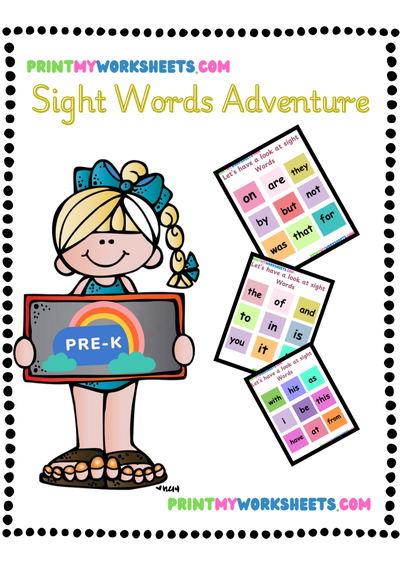
Kindergarten Sight Words Worksheet PDF – Easy Home Reading Review Pack
Kindergarten Sight Words Worksheet PDF
The Kindergarten Sight Words Worksheet PDF is designed to help young learners build early reading confidence through structured, engaging practice. This free printable PDF supports U.S. parents, teachers, and homeschool families who want to strengthen foundational literacy skills at home or in the classroom.
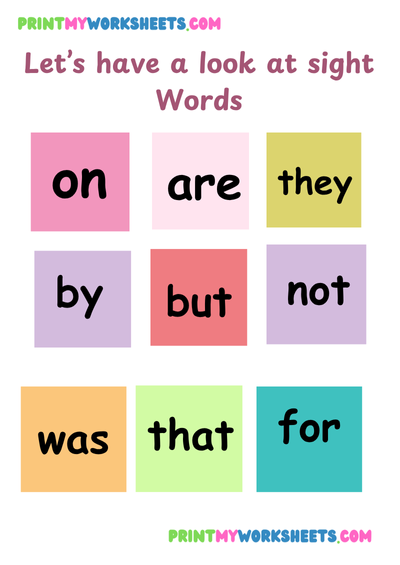
Sight words are high-frequency words that children are encouraged to recognize instantly without sounding them out. In kindergarten, students begin learning essential words such as “the,” “and,” “is,” and “can.” Mastering these common words allows children to read simple sentences more fluently and with greater understanding.
This worksheet collection provides clear, age-appropriate activities that help children recognize, read, trace, and write frequently used words. With consistent exposure and practice, young learners begin to build automatic word recognition skills, which are essential for reading success in first grade and beyond.
What Students Will Learn?
These kindergarten sight word worksheets focus on helping students quickly recognize and correctly use high-frequency words in context. The activities are carefully structured to match the developmental level of kindergarten learners.
Students will practice:
Identifying common high-frequency words
Tracing and writing sight words
Reading simple sentences that include familiar words
Matching words to pictures
Completing fill-in-the-blank sentences
Building short phrases using known vocabulary
The worksheets support gradual learning. Children begin by recognizing individual words, then progress to reading short phrases and sentences. This step-by-step approach ensures students feel successful while strengthening reading fluency.
Each activity is designed to be clear and manageable. Directions are simple, and tasks are visually organized to reduce frustration. By practicing word recognition in multiple ways—reading, writing, and matching—students reinforce learning through repetition.
Aligned with U.S. kindergarten literacy standards, these worksheets help develop early decoding skills while also strengthening vocabulary and comprehension. The goal is to build automatic recognition so students can focus more on understanding what they read.
Educational Value & Skill Development
The Kindergarten Sight Words Worksheet PDF supports essential early literacy development. Sight word mastery is a major milestone in kindergarten reading instruction, as it allows students to recognize frequently used words without decoding each letter.
Academically, recognizing common words quickly improves reading fluency. When children do not need to stop and sound out every word, they can read sentences more smoothly and with better expression. This builds comprehension because students can focus on meaning rather than decoding.
Cognitively, sight word practice strengthens memory and visual recognition skills. Repeated exposure helps students store words in long-term memory, making recall faster and more automatic.
Writing activities also improve fine motor skills and reinforce spelling patterns. When students trace and write words, they connect visual recognition with physical practice, strengthening retention.
Most importantly, confidence grows as children realize they can read sentences independently. Early reading success motivates students to practice more, which leads to steady progress throughout elementary school.
Why Focus on Sight Words?
Sight words form the foundation of early reading. In kindergarten classrooms across the United States, students are introduced to high-frequency word lists that appear often in children’s books and reading materials.
These words do not always follow standard phonics patterns, which means students benefit from memorizing them by sight. When children instantly recognize words like “you,” “was,” or “said,” their reading becomes smoother and more natural.
Repetition is essential. Seeing the same words in different contexts helps children build familiarity and recall. Guided practice, combined with independent review, ensures steady growth.
Strong sight word knowledge supports success in first grade and beyond. As reading materials become more complex, students rely on quick word recognition to maintain fluency and comprehension. Developing these skills early ensures a strong literacy foundation.
How to Use These Worksheets?
The Kindergarten Sight Words Worksheet PDF can be used in a variety of learning environments. Teachers may include the worksheets in literacy centers, small reading groups, or independent seatwork. They also work well for morning work or homework practice.
Homeschool families can incorporate the worksheets into a daily reading routine. Reviewing words aloud before completing the page helps reinforce pronunciation and recognition. Parents may also turn the activities into interactive games by timing word reading or creating simple flashcards.
Because this resource is provided as a free printable PDF, it can be downloaded and printed as needed. The pages can be reused throughout the year for review, especially before reading assessments or report periods.
These worksheets are ideal for reinforcement and extra practice. Students who need additional support can revisit word lists regularly, while confident readers can use the activities for fluency-building practice.
Related Worksheets / Extensions:
Frequently Asked Questions
Q1. Is this worksheet free to download?Yes, this worksheet is 100% free to download and print. No account, subscription, or payment is required. Click the Download Now button to get your free PDF instantly.Q2. What format is this worksheet available in?This worksheet is available as a printable PDF file. It is black-and-white, printer-friendly, and works on any standard home or classroom printer using A4 or US Letter paper.Q3. Can I use this worksheet for both classroom and home learning?Yes, these worksheets are designed for use by classroom teachers, homeschool parents, and tutors. They can be used as morning work, homework, revision practice, or learning centre activities.Q4. Is this worksheet aligned with Common Core ELA standards?Yes, this English worksheet is aligned with U.S. Common Core English Language Arts standards and supports foundational literacy development.Q5. Is this worksheet suitable for ESL or ELL students?This worksheet can be used as a supplemental resource for ESL and ELL students, particularly for vocabulary building and language pattern practice.Kindergarten Sight Words Worksheet PDF – Easy Home Reading Review Pack
Kindergarten Sight Words Worksheet PDF
The Kindergarten Sight Words Worksheet PDF is designed to help young learners build early reading confidence through structured, engaging practice. This free printable PDF supports U.S. parents, teachers, and homeschool families who want to strengthen foundational literacy skills at home or in the classroom.
Sight words are high-frequency words that children are encouraged to recognize instantly without sounding them out. In kindergarten, students begin learning essential words such as “the,” “and,” “is,” and “can.” Mastering these common words allows children to read simple sentences more fluently and with greater understanding.
This worksheet collection provides clear, age-appropriate activities that help children recognize, read, trace, and write frequently used words. With consistent exposure and practice, young learners begin to build automatic word recognition skills, which are essential for reading success in first grade and beyond.
What Students Will Learn?
These kindergarten sight word worksheets focus on helping students quickly recognize and correctly use high-frequency words in context. The activities are carefully structured to match the developmental level of kindergarten learners.
Students will practice:
Identifying common high-frequency words
Tracing and writing sight words
Reading simple sentences that include familiar words
Matching words to pictures
Completing fill-in-the-blank sentences
Building short phrases using known vocabulary
The worksheets support gradual learning. Children begin by recognizing individual words, then progress to reading short phrases and sentences. This step-by-step approach ensures students feel successful while strengthening reading fluency.
Each activity is designed to be clear and manageable. Directions are simple, and tasks are visually organized to reduce frustration. By practicing word recognition in multiple ways—reading, writing, and matching—students reinforce learning through repetition.
Aligned with U.S. kindergarten literacy standards, these worksheets help develop early decoding skills while also strengthening vocabulary and comprehension. The goal is to build automatic recognition so students can focus more on understanding what they read.
Educational Value & Skill Development
The Kindergarten Sight Words Worksheet PDF supports essential early literacy development. Sight word mastery is a major milestone in kindergarten reading instruction, as it allows students to recognize frequently used words without decoding each letter.
Academically, recognizing common words quickly improves reading fluency. When children do not need to stop and sound out every word, they can read sentences more smoothly and with better expression. This builds comprehension because students can focus on meaning rather than decoding.
Cognitively, sight word practice strengthens memory and visual recognition skills. Repeated exposure helps students store words in long-term memory, making recall faster and more automatic.
Writing activities also improve fine motor skills and reinforce spelling patterns. When students trace and write words, they connect visual recognition with physical practice, strengthening retention.
Most importantly, confidence grows as children realize they can read sentences independently. Early reading success motivates students to practice more, which leads to steady progress throughout elementary school.
Why Focus on Sight Words?
Sight words form the foundation of early reading. In kindergarten classrooms across the United States, students are introduced to high-frequency word lists that appear often in children’s books and reading materials.
These words do not always follow standard phonics patterns, which means students benefit from memorizing them by sight. When children instantly recognize words like “you,” “was,” or “said,” their reading becomes smoother and more natural.
Repetition is essential. Seeing the same words in different contexts helps children build familiarity and recall. Guided practice, combined with independent review, ensures steady growth.
Strong sight word knowledge supports success in first grade and beyond. As reading materials become more complex, students rely on quick word recognition to maintain fluency and comprehension. Developing these skills early ensures a strong literacy foundation.
How to Use These Worksheets?
The Kindergarten Sight Words Worksheet PDF can be used in a variety of learning environments. Teachers may include the worksheets in literacy centers, small reading groups, or independent seatwork. They also work well for morning work or homework practice.
Homeschool families can incorporate the worksheets into a daily reading routine. Reviewing words aloud before completing the page helps reinforce pronunciation and recognition. Parents may also turn the activities into interactive games by timing word reading or creating simple flashcards.
Because this resource is provided as a free printable PDF, it can be downloaded and printed as needed. The pages can be reused throughout the year for review, especially before reading assessments or report periods.
These worksheets are ideal for reinforcement and extra practice. Students who need additional support can revisit word lists regularly, while confident readers can use the activities for fluency-building practice.
Related Worksheets / Extensions:
Frequently Asked Questions
Q1. Is this worksheet free to download?Yes, this worksheet is 100% free to download and print. No account, subscription, or payment is required. Click the Download Now button to get your free PDF instantly.Q2. What format is this worksheet available in?This worksheet is available as a printable PDF file. It is black-and-white, printer-friendly, and works on any standard home or classroom printer using A4 or US Letter paper.Q3. Can I use this worksheet for both classroom and home learning?Yes, these worksheets are designed for use by classroom teachers, homeschool parents, and tutors. They can be used as morning work, homework, revision practice, or learning centre activities.Q4. Is this worksheet aligned with Common Core ELA standards?Yes, this English worksheet is aligned with U.S. Common Core English Language Arts standards and supports foundational literacy development.Q5. Is this worksheet suitable for ESL or ELL students?This worksheet can be used as a supplemental resource for ESL and ELL students, particularly for vocabulary building and language pattern practice.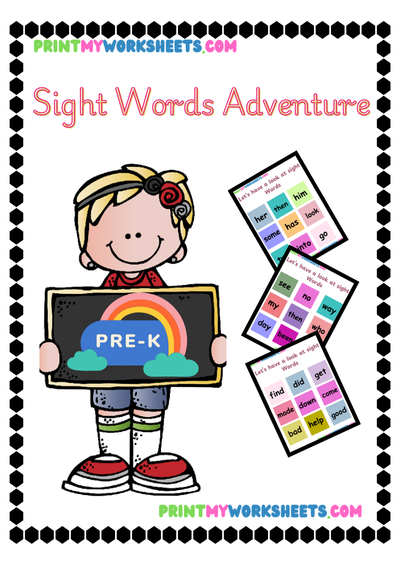
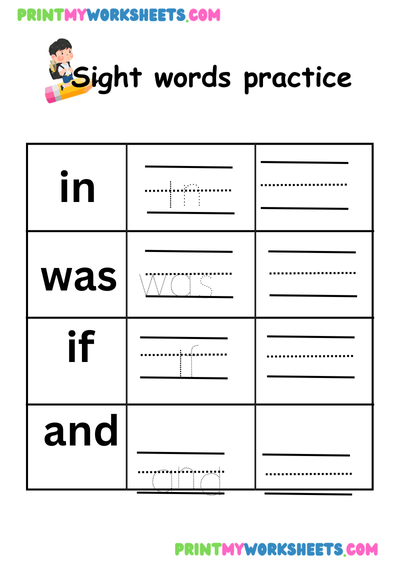
Kindergarten Sight Words Worksheets PDF | Free English II Downloadable – High Frequency Word Practice Pack
Kindergarten Sight Words Worksheets PDF
Early reading success begins with recognizing common words quickly and confidently. The Kindergarten Sight Words Worksheets PDF is designed to help young learners build strong reading foundations by practicing frequently used words that appear in everyday texts. These printable worksheets are helpful for U.S. parents, teachers, and homeschool families who want to support early literacy skills through structured and engaging activities.
Sight words are words that children learn to recognize instantly without needing to sound them out. Words such as “the,” “and,” “is,” and “you” appear often in early reading materials, making them important for developing reading fluency. Practicing these words regularly helps children read sentences more smoothly and confidently.
The Kindergarten Sight Words Worksheets PDF provides simple activities that encourage students to recognize, read, and practice these common words. Through repetition and visual learning, children strengthen their vocabulary and improve their ability to read basic sentences. These worksheets support kindergarten students as they begin their journey toward becoming confident and independent readers.
What Students Will Learn?
Sight word worksheets provide kindergarten students with important practice in recognizing high-frequency words that appear regularly in early reading materials. These activities help students build confidence in reading by learning words that are often difficult to decode using phonics alone.
Students practice identifying sight words in different formats, including reading the words, tracing them, and using them within simple sentences. These exercises reinforce familiarity with common vocabulary and strengthen early reading skills.
Many worksheets include activities where students match words to pictures, circle the correct word, or fill in blanks in short sentences. These exercises encourage students to recognize words in context while building comprehension skills.
Children also develop handwriting skills by tracing and writing sight words repeatedly. This helps reinforce memory and recognition through both visual and motor learning.
Visual cues, simple sentence structures, and repetition make these activities accessible and engaging for young learners. By seeing and practicing the same words multiple times, students begin to recognize them automatically.
As children continue practicing, they build the confidence needed to read short passages and participate in early literacy activities more independently.
Educational Value & Skill Development
The Kindergarten Sight Words Worksheets PDF supports multiple aspects of early literacy development that are essential for young readers.
One of the most important benefits is reading fluency. When children recognize sight words quickly, they spend less time decoding individual letters and more time understanding the meaning of the sentence. This helps reading become smoother and more natural.
Sight word practice also strengthens vocabulary development. By repeatedly seeing and using common words, children expand their language skills and become more comfortable recognizing words in books and classroom materials.
The Kindergarten Sight Words Worksheets PDF also promotes confidence and independence in early readers. When children can easily recognize frequently used words, they feel more capable when reading simple texts.
These worksheets also support memory development. Repetition helps children store these words in long-term memory, making it easier for them to recall the words instantly during reading.
Additionally, tracing and writing activities help improve fine motor skills and handwriting practice. These physical actions reinforce word recognition and strengthen the connection between reading and writing.
Together, these skills create a strong literacy foundation that supports continued growth in reading and writing throughout elementary school.
Why Focus on Sight Words?
Sight words are a crucial part of early reading instruction because they appear so frequently in children’s books and classroom texts. Learning these words allows students to read sentences more smoothly without stopping to decode each letter.
Many sight words do not follow simple phonics rules. Because of this, children benefit from memorizing them through repeated exposure and practice. Once these words become familiar, reading becomes much easier.
Practicing sight words also helps improve reading confidence. When children recognize many of the words on a page, they are more likely to enjoy reading and feel successful in their learning.
Sight word activities also strengthen comprehension. When students recognize common words instantly, they can focus on understanding the meaning of the sentence rather than struggling with individual words.
Early literacy standards used in kindergarten classrooms across the United States emphasize sight word recognition as an essential component of reading instruction. These words help students transition from basic phonics practice to reading simple sentences and short stories.
Regular practice with sight words helps children develop the fluency and vocabulary needed for future reading success.
How to Use These Worksheets?
The Kindergarten Sight Words Worksheets PDF can be used effectively in a variety of learning environments, including classrooms, homeschool settings, and independent learning time.
Teachers often use sight word worksheets as part of daily literacy centers or reading stations. Students can work individually to read, trace, and practice the words included in each activity.
Small group instruction is another effective way to use these worksheets. Teachers can guide students through each word, discuss its meaning, and practice reading it together.
Parents who homeschool can incorporate the worksheets into daily reading routines. Children may read the words aloud, trace them with a pencil or marker, and practice writing them independently.
Since the worksheets are available as a free printable PDF, they can be downloaded and printed easily whenever additional practice is needed. They can be reused for review sessions or extra reading support at home.
The worksheets are also helpful for quiet independent work time. Children can complete the activities at their own pace while strengthening their sight word recognition and handwriting skills.
Related Worksheets / Extensions:
You may also like:
• Kindergarten phonics worksheets
• CVC word reading worksheets for early learners
• Beginning sounds worksheets for kindergarten
• Word building worksheets for early literacy practice
• Simple sentence reading worksheets for kindergarten students
The Kindergarten Sight Words Worksheets PDF can also be combined with other early reading activities that focus on phonics, vocabulary building, and sentence formation. When children practice sight words alongside phonics skills, they develop a balanced approach to reading.
Parents and teachers may extend learning by encouraging students to identify sight words in storybooks or classroom reading materials. Highlighting these words during reading activities reinforces recognition and helps students apply what they learned from worksheets.
With consistent practice and repetition, kindergarten students become more comfortable recognizing sight words instantly. These early reading skills play an important role in helping children develop fluency, comprehension, and a lifelong interest in reading.
Frequently Asked Questions
Q1. Is this worksheet free to download?Yes, this worksheet is 100% free to download and print. No account, subscription, or payment is required. Click the Download Now button to get your free PDF instantly.Q2. What format is this worksheet available in?This worksheet is available as a printable PDF file. It is black-and-white, printer-friendly, and works on any standard home or classroom printer using A4 or US Letter paper.Q3. Can I use this worksheet for both classroom and home learning?Yes, these worksheets are designed for use by classroom teachers, homeschool parents, and tutors. They can be used as morning work, homework, revision practice, or learning centre activities.Q4. Is this worksheet aligned with Common Core ELA standards?Yes, this English worksheet is aligned with U.S. Common Core English Language Arts standards and supports foundational literacy development.Q5. Is this worksheet suitable for ESL or ELL students?This worksheet can be used as a supplemental resource for ESL and ELL students, particularly for vocabulary building and language pattern practice.Kindergarten Sight Words Worksheets PDF | Free English II Downloadable – High Frequency Word Practice Pack
Kindergarten Sight Words Worksheets PDF
Early reading success begins with recognizing common words quickly and confidently. The Kindergarten Sight Words Worksheets PDF is designed to help young learners build strong reading foundations by practicing frequently used words that appear in everyday texts. These printable worksheets are helpful for U.S. parents, teachers, and homeschool families who want to support early literacy skills through structured and engaging activities.
Sight words are words that children learn to recognize instantly without needing to sound them out. Words such as “the,” “and,” “is,” and “you” appear often in early reading materials, making them important for developing reading fluency. Practicing these words regularly helps children read sentences more smoothly and confidently.
The Kindergarten Sight Words Worksheets PDF provides simple activities that encourage students to recognize, read, and practice these common words. Through repetition and visual learning, children strengthen their vocabulary and improve their ability to read basic sentences. These worksheets support kindergarten students as they begin their journey toward becoming confident and independent readers.
What Students Will Learn?
Sight word worksheets provide kindergarten students with important practice in recognizing high-frequency words that appear regularly in early reading materials. These activities help students build confidence in reading by learning words that are often difficult to decode using phonics alone.
Students practice identifying sight words in different formats, including reading the words, tracing them, and using them within simple sentences. These exercises reinforce familiarity with common vocabulary and strengthen early reading skills.
Many worksheets include activities where students match words to pictures, circle the correct word, or fill in blanks in short sentences. These exercises encourage students to recognize words in context while building comprehension skills.
Children also develop handwriting skills by tracing and writing sight words repeatedly. This helps reinforce memory and recognition through both visual and motor learning.
Visual cues, simple sentence structures, and repetition make these activities accessible and engaging for young learners. By seeing and practicing the same words multiple times, students begin to recognize them automatically.
As children continue practicing, they build the confidence needed to read short passages and participate in early literacy activities more independently.
Educational Value & Skill Development
The Kindergarten Sight Words Worksheets PDF supports multiple aspects of early literacy development that are essential for young readers.
One of the most important benefits is reading fluency. When children recognize sight words quickly, they spend less time decoding individual letters and more time understanding the meaning of the sentence. This helps reading become smoother and more natural.
Sight word practice also strengthens vocabulary development. By repeatedly seeing and using common words, children expand their language skills and become more comfortable recognizing words in books and classroom materials.
The Kindergarten Sight Words Worksheets PDF also promotes confidence and independence in early readers. When children can easily recognize frequently used words, they feel more capable when reading simple texts.
These worksheets also support memory development. Repetition helps children store these words in long-term memory, making it easier for them to recall the words instantly during reading.
Additionally, tracing and writing activities help improve fine motor skills and handwriting practice. These physical actions reinforce word recognition and strengthen the connection between reading and writing.
Together, these skills create a strong literacy foundation that supports continued growth in reading and writing throughout elementary school.
Why Focus on Sight Words?
Sight words are a crucial part of early reading instruction because they appear so frequently in children’s books and classroom texts. Learning these words allows students to read sentences more smoothly without stopping to decode each letter.
Many sight words do not follow simple phonics rules. Because of this, children benefit from memorizing them through repeated exposure and practice. Once these words become familiar, reading becomes much easier.
Practicing sight words also helps improve reading confidence. When children recognize many of the words on a page, they are more likely to enjoy reading and feel successful in their learning.
Sight word activities also strengthen comprehension. When students recognize common words instantly, they can focus on understanding the meaning of the sentence rather than struggling with individual words.
Early literacy standards used in kindergarten classrooms across the United States emphasize sight word recognition as an essential component of reading instruction. These words help students transition from basic phonics practice to reading simple sentences and short stories.
Regular practice with sight words helps children develop the fluency and vocabulary needed for future reading success.
How to Use These Worksheets?
The Kindergarten Sight Words Worksheets PDF can be used effectively in a variety of learning environments, including classrooms, homeschool settings, and independent learning time.
Teachers often use sight word worksheets as part of daily literacy centers or reading stations. Students can work individually to read, trace, and practice the words included in each activity.
Small group instruction is another effective way to use these worksheets. Teachers can guide students through each word, discuss its meaning, and practice reading it together.
Parents who homeschool can incorporate the worksheets into daily reading routines. Children may read the words aloud, trace them with a pencil or marker, and practice writing them independently.
Since the worksheets are available as a free printable PDF, they can be downloaded and printed easily whenever additional practice is needed. They can be reused for review sessions or extra reading support at home.
The worksheets are also helpful for quiet independent work time. Children can complete the activities at their own pace while strengthening their sight word recognition and handwriting skills.
Related Worksheets / Extensions:
You may also like:
• Kindergarten phonics worksheets
• CVC word reading worksheets for early learners
• Beginning sounds worksheets for kindergarten
• Word building worksheets for early literacy practice
• Simple sentence reading worksheets for kindergarten students
The Kindergarten Sight Words Worksheets PDF can also be combined with other early reading activities that focus on phonics, vocabulary building, and sentence formation. When children practice sight words alongside phonics skills, they develop a balanced approach to reading.
Parents and teachers may extend learning by encouraging students to identify sight words in storybooks or classroom reading materials. Highlighting these words during reading activities reinforces recognition and helps students apply what they learned from worksheets.
With consistent practice and repetition, kindergarten students become more comfortable recognizing sight words instantly. These early reading skills play an important role in helping children develop fluency, comprehension, and a lifelong interest in reading.
Frequently Asked Questions
Q1. Is this worksheet free to download?Yes, this worksheet is 100% free to download and print. No account, subscription, or payment is required. Click the Download Now button to get your free PDF instantly.Q2. What format is this worksheet available in?This worksheet is available as a printable PDF file. It is black-and-white, printer-friendly, and works on any standard home or classroom printer using A4 or US Letter paper.Q3. Can I use this worksheet for both classroom and home learning?Yes, these worksheets are designed for use by classroom teachers, homeschool parents, and tutors. They can be used as morning work, homework, revision practice, or learning centre activities.Q4. Is this worksheet aligned with Common Core ELA standards?Yes, this English worksheet is aligned with U.S. Common Core English Language Arts standards and supports foundational literacy development.Q5. Is this worksheet suitable for ESL or ELL students?This worksheet can be used as a supplemental resource for ESL and ELL students, particularly for vocabulary building and language pattern practice.
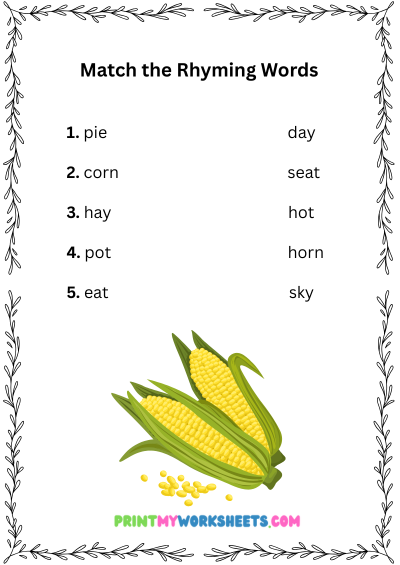
Kindergarten Thanksgiving Rhyming Words Worksheets PDF – Build Early Phonemic Awareness Skills
Make learning sound patterns festive and fun with our Kindergarten Thanksgiving Rhyming Words Worksheets PDF, created for US homeschool parents, teachers, and classrooms. 🦃🍂 These engaging worksheets combine early literacy and holiday excitement to help kids strengthen their phonemic awareness, listening, and reading skills.
Each worksheet features Thanksgiving-themed pictures and words like pie–sky, corn–horn, and hat–cat for kids to match and color. As children connect rhyming pairs, they learn to recognize sound patterns, improve pronunciation, and develop a love for language through playful learning.
Why learn rhyming words? Rhyming is an essential early literacy skill that builds phonics awareness, vocabulary development, and memory retention. It helps children understand how words work together, paving the way for stronger reading and spelling abilities later on.
Perfect for classroom lessons, homeschool activities, or Thanksgiving literacy fun at home, this free printable PDF is both educational and entertaining.
Download your Thanksgiving Match the Rhyming Words Worksheets today and let your little learners celebrate the season with joyful word play, colorful rhymes, and early reading confidence!
You may also like:
[caption id="attachment_6329" align="alignnone" width="212"] Kindergarten Thanksgiving Rhyming Words Worksheets PDF[/caption][caption id="attachment_5326" align="alignnone" width="212"]
 Kindergarten Two-Digit Subtraction Worksheets PDF[/caption][caption id="attachment_5313" align="alignnone" width="212"]
 Kindergarten Addition Worksheets PDF[/caption]
Frequently Asked Questions
Q1. What format is this worksheet available in?This worksheet is available as a printable PDF file. It is black-and-white, printer-friendly, and works on any standard home or classroom printer using A4 or US Letter paper.Q2. Is this worksheet free to download?Yes, this worksheet is 100% free to download and print. No account, subscription, or payment is required. Click the Download Now button to get your free PDF instantly.Q3. Can I use this worksheet for both classroom and home learning?Yes, these worksheets are designed for use by classroom teachers, homeschool parents, and tutors. They can be used as morning work, homework, revision practice, or learning centre activities.Q4. Is this worksheet aligned with Common Core ELA standards?Yes, this English worksheet is aligned with U.S. Common Core English Language Arts standards and supports foundational literacy development.Q5. Can this worksheet be used for phonics instruction?Yes, this worksheet supports phonics-based reading instruction and is suitable for early readers building letter-sound recognition skills.Kindergarten Thanksgiving Rhyming Words Worksheets PDF – Build Early Phonemic Awareness Skills
Make learning sound patterns festive and fun with our Kindergarten Thanksgiving Rhyming Words Worksheets PDF, created for US homeschool parents, teachers, and classrooms. 🦃🍂 These engaging worksheets combine early literacy and holiday excitement to help kids strengthen their phonemic awareness, listening, and reading skills.
Each worksheet features Thanksgiving-themed pictures and words like pie–sky, corn–horn, and hat–cat for kids to match and color. As children connect rhyming pairs, they learn to recognize sound patterns, improve pronunciation, and develop a love for language through playful learning.
Why learn rhyming words? Rhyming is an essential early literacy skill that builds phonics awareness, vocabulary development, and memory retention. It helps children understand how words work together, paving the way for stronger reading and spelling abilities later on.
Perfect for classroom lessons, homeschool activities, or Thanksgiving literacy fun at home, this free printable PDF is both educational and entertaining.
Download your Thanksgiving Match the Rhyming Words Worksheets today and let your little learners celebrate the season with joyful word play, colorful rhymes, and early reading confidence!
You may also like:
[caption id="attachment_6329" align="alignnone" width="212"] Kindergarten Thanksgiving Rhyming Words Worksheets PDF[/caption][caption id="attachment_5326" align="alignnone" width="212"] Kindergarten Two-Digit Subtraction Worksheets PDF[/caption][caption id="attachment_5313" align="alignnone" width="212"] Kindergarten Addition Worksheets PDF[/caption]Frequently Asked Questions
Q1. What format is this worksheet available in?This worksheet is available as a printable PDF file. It is black-and-white, printer-friendly, and works on any standard home or classroom printer using A4 or US Letter paper.Q2. Is this worksheet free to download?Yes, this worksheet is 100% free to download and print. No account, subscription, or payment is required. Click the Download Now button to get your free PDF instantly.Q3. Can I use this worksheet for both classroom and home learning?Yes, these worksheets are designed for use by classroom teachers, homeschool parents, and tutors. They can be used as morning work, homework, revision practice, or learning centre activities.Q4. Is this worksheet aligned with Common Core ELA standards?Yes, this English worksheet is aligned with U.S. Common Core English Language Arts standards and supports foundational literacy development.Q5. Can this worksheet be used for phonics instruction?Yes, this worksheet supports phonics-based reading instruction and is suitable for early readers building letter-sound recognition skills.
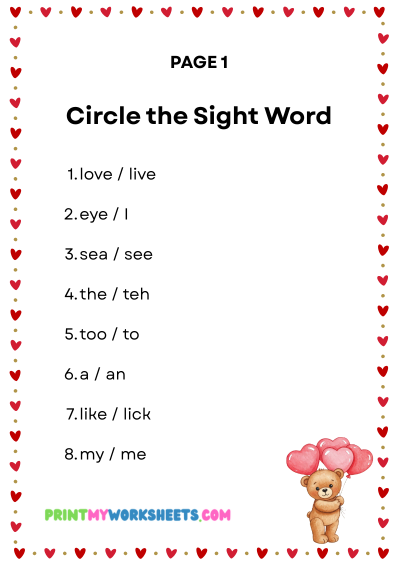
Kindergarten Valentine’s Day Sight Words Worksheets PDF – February Literacy Centers and Holiday Reading Practice
Kindergarten Valentine’s Day Sight Words Worksheets PDF
Seasonal learning activities can be a powerful way to keep young learners engaged while reinforcing essential skills. These Kindergarten Valentine’s Day Sight Words Worksheets PDF are designed to help children practice high-frequency words in a fun, age-appropriate way while staying focused on meaningful reading development. Created for U.S. parents, classroom teachers, and homeschool families, this free printable resource blends early literacy instruction with a familiar seasonal theme that children enjoy.
Sight words are a core part of kindergarten reading instruction. At this stage, students are learning to recognize common words automatically so they can read simple sentences with confidence and fluency. These worksheets provide structured practice that supports that goal without relying on distractions or complex instructions. By combining sight word review with a Valentine’s Day theme, children stay motivated while reinforcing skills they need throughout the school year. This printable set works well as supplemental practice, review, or small-group instruction during the winter months.
What Students Will Learn ?
This worksheet set focuses on strengthening sight word recognition, an essential kindergarten literacy skill. Students practice identifying, reading, and engaging with commonly used words that appear frequently in early reading materials. The activities are designed to help children recognize these words quickly and accurately, supporting smoother reading experiences.
The worksheets include a variety of age-appropriate tasks that encourage repeated exposure to sight words in different formats. Students may trace, read, match, or identify words within simple contexts, helping reinforce memory through consistent practice. Each activity supports structured learning by focusing on one skill at a time, which is important for young learners still developing attention and focus.
These worksheets align with kindergarten expectations in U.S. classrooms by reinforcing foundational reading skills without overwhelming students. The layout is clear and predictable, allowing children to work independently or with light guidance. By completing these activities, students build familiarity with essential words while developing confidence and early reading habits that support long-term academic success.
Educational Value & Skill Development
Sight word practice plays a key role in early literacy development, and using themed resources can increase student engagement without compromising instructional value. The Kindergarten Valentine’s Day Sight Words Worksheets PDF support academic growth by helping students recognize high-frequency words automatically, which is critical for reading fluency.
As children practice these words, they strengthen visual memory, attention to detail, and word recognition skills. Automatic sight word recall reduces cognitive load, allowing students to focus on comprehension rather than decoding every word. This progression supports smoother transitions into sentence reading and early comprehension activities.
Beyond academics, these worksheets also promote independence and confidence. Completing familiar tasks successfully helps children feel capable and motivated to continue learning. The consistent structure allows students to understand expectations quickly, making the worksheets suitable for independent practice, review, or small-group instruction. Over time, repeated exposure to sight words through varied activities supports long-term retention and prepares students for more advanced reading tasks in later grades.
Why Focus on Kindergarten Valentine’s Day Sight Words Worksheets ?
Why Focus on Kindergarten Valentine’s Day Sight Words Worksheets? Sight words form the backbone of early reading instruction. In kindergarten, students are expected to recognize many common words instantly, without sounding them out. This ability directly supports reading fluency and comprehension.
Seasonal worksheets offer an effective way to provide repetition while maintaining student interest. When children are engaged, they are more likely to stay focused and complete practice activities with care. Valentine’s Day-themed worksheets provide a familiar context that feels enjoyable while still reinforcing core skills.
Regular, guided practice is essential for mastery. Sight words require repeated exposure in multiple formats to move from short-term recognition to long-term memory. These worksheets support early learning standards commonly used in U.S. schools by emphasizing consistent review, skill reinforcement, and gradual progression. By focusing on sight words at this stage, educators and parents help students build a strong foundation for reading success in first grade and beyond.
How to Use These Worksheets ?
These worksheets are flexible and easy to integrate into different learning environments. In homeschool settings, parents can use them as part of a daily reading routine or as a seasonal literacy activity. Teachers may include them in classroom literacy centers, morning work, or small-group instruction focused on sight word review.
The worksheets also work well for independent practice, allowing students to reinforce skills at their own pace. Because they are provided as a free printable PDF, downloading and printing is simple. Pages can be reused for review by placing them in sheet protectors or laminating for repeated practice.
For families and educators looking for themed literacy support, Kindergarten Valentine’s Day Sight Words Worksheets PDF offer a practical way to reinforce essential skills while keeping learning engaging. They are suitable for review, reinforcement, or extra practice throughout the Valentine’s Day season.
What’s Included in This PDF ?
This printable worksheet set is designed to be simple, effective, and easy to use in any learning setting. Each page focuses on clear skill practice without unnecessary distractions. Inside this PDF, you’ll find:
Multiple printable worksheets focused on kindergarten sight words
Activities that support reading recognition and recall
A clean, kid-friendly layout for young learners
Black-and-white pages for print-friendly use
Worksheets aligned with U.S. kindergarten literacy expectations
A free downloadable PDF format for quick access
You may also like:
[gallery ids="6839,6689,6603"]Related Worksheets / Extensions
If you are looking to extend learning beyond this set, consider pairing these pages with additional sight word or early reading resources. Alphabet review worksheets, sentence reading practice, or phonics activities can complement sight word instruction and provide balanced literacy support.
You may also explore other seasonal or holiday-themed reading printables designed for kindergarten learners. Resources like Kindergarten Valentine’s Day Sight Words Worksheets PDF work well alongside year-round sight word practice, helping students stay engaged while reinforcing essential reading skills through consistent, meaningful practice.
Frequently Asked Questions
Q1. What format is this worksheet available in?This worksheet is available as a printable PDF file. It is black-and-white, printer-friendly, and works on any standard home or classroom printer using A4 or US Letter paper.Q2. Is this worksheet free to download?Yes, this worksheet is 100% free to download and print. No account, subscription, or payment is required. Click the Download Now button to get your free PDF instantly.Q3. Can I use this worksheet for both classroom and home learning?Yes, these worksheets are designed for use by classroom teachers, homeschool parents, and tutors. They can be used as morning work, homework, revision practice, or learning centre activities.Q4. Is this worksheet aligned with Common Core ELA standards?Yes, this English worksheet is aligned with U.S. Common Core English Language Arts standards and supports foundational literacy development.Q5. Can this worksheet be used for phonics instruction?Yes, this worksheet supports phonics-based reading instruction and is suitable for early readers building letter-sound recognition skills.Kindergarten Valentine’s Day Sight Words Worksheets PDF – February Literacy Centers and Holiday Reading Practice
Kindergarten Valentine’s Day Sight Words Worksheets PDF
Seasonal learning activities can be a powerful way to keep young learners engaged while reinforcing essential skills. These Kindergarten Valentine’s Day Sight Words Worksheets PDF are designed to help children practice high-frequency words in a fun, age-appropriate way while staying focused on meaningful reading development. Created for U.S. parents, classroom teachers, and homeschool families, this free printable resource blends early literacy instruction with a familiar seasonal theme that children enjoy.
Sight words are a core part of kindergarten reading instruction. At this stage, students are learning to recognize common words automatically so they can read simple sentences with confidence and fluency. These worksheets provide structured practice that supports that goal without relying on distractions or complex instructions. By combining sight word review with a Valentine’s Day theme, children stay motivated while reinforcing skills they need throughout the school year. This printable set works well as supplemental practice, review, or small-group instruction during the winter months.
What Students Will Learn ?
This worksheet set focuses on strengthening sight word recognition, an essential kindergarten literacy skill. Students practice identifying, reading, and engaging with commonly used words that appear frequently in early reading materials. The activities are designed to help children recognize these words quickly and accurately, supporting smoother reading experiences.
The worksheets include a variety of age-appropriate tasks that encourage repeated exposure to sight words in different formats. Students may trace, read, match, or identify words within simple contexts, helping reinforce memory through consistent practice. Each activity supports structured learning by focusing on one skill at a time, which is important for young learners still developing attention and focus.
These worksheets align with kindergarten expectations in U.S. classrooms by reinforcing foundational reading skills without overwhelming students. The layout is clear and predictable, allowing children to work independently or with light guidance. By completing these activities, students build familiarity with essential words while developing confidence and early reading habits that support long-term academic success.
Educational Value & Skill Development
Sight word practice plays a key role in early literacy development, and using themed resources can increase student engagement without compromising instructional value. The Kindergarten Valentine’s Day Sight Words Worksheets PDF support academic growth by helping students recognize high-frequency words automatically, which is critical for reading fluency.
As children practice these words, they strengthen visual memory, attention to detail, and word recognition skills. Automatic sight word recall reduces cognitive load, allowing students to focus on comprehension rather than decoding every word. This progression supports smoother transitions into sentence reading and early comprehension activities.
Beyond academics, these worksheets also promote independence and confidence. Completing familiar tasks successfully helps children feel capable and motivated to continue learning. The consistent structure allows students to understand expectations quickly, making the worksheets suitable for independent practice, review, or small-group instruction. Over time, repeated exposure to sight words through varied activities supports long-term retention and prepares students for more advanced reading tasks in later grades.
Why Focus on Kindergarten Valentine’s Day Sight Words Worksheets ?
Why Focus on Kindergarten Valentine’s Day Sight Words Worksheets? Sight words form the backbone of early reading instruction. In kindergarten, students are expected to recognize many common words instantly, without sounding them out. This ability directly supports reading fluency and comprehension.
Seasonal worksheets offer an effective way to provide repetition while maintaining student interest. When children are engaged, they are more likely to stay focused and complete practice activities with care. Valentine’s Day-themed worksheets provide a familiar context that feels enjoyable while still reinforcing core skills.
Regular, guided practice is essential for mastery. Sight words require repeated exposure in multiple formats to move from short-term recognition to long-term memory. These worksheets support early learning standards commonly used in U.S. schools by emphasizing consistent review, skill reinforcement, and gradual progression. By focusing on sight words at this stage, educators and parents help students build a strong foundation for reading success in first grade and beyond.
How to Use These Worksheets ?
These worksheets are flexible and easy to integrate into different learning environments. In homeschool settings, parents can use them as part of a daily reading routine or as a seasonal literacy activity. Teachers may include them in classroom literacy centers, morning work, or small-group instruction focused on sight word review.
The worksheets also work well for independent practice, allowing students to reinforce skills at their own pace. Because they are provided as a free printable PDF, downloading and printing is simple. Pages can be reused for review by placing them in sheet protectors or laminating for repeated practice.
For families and educators looking for themed literacy support, Kindergarten Valentine’s Day Sight Words Worksheets PDF offer a practical way to reinforce essential skills while keeping learning engaging. They are suitable for review, reinforcement, or extra practice throughout the Valentine’s Day season.
What’s Included in This PDF ?
This printable worksheet set is designed to be simple, effective, and easy to use in any learning setting. Each page focuses on clear skill practice without unnecessary distractions. Inside this PDF, you’ll find:
Multiple printable worksheets focused on kindergarten sight words
Activities that support reading recognition and recall
A clean, kid-friendly layout for young learners
Black-and-white pages for print-friendly use
Worksheets aligned with U.S. kindergarten literacy expectations
A free downloadable PDF format for quick access
You may also like:
[gallery ids="6839,6689,6603"]Related Worksheets / Extensions
If you are looking to extend learning beyond this set, consider pairing these pages with additional sight word or early reading resources. Alphabet review worksheets, sentence reading practice, or phonics activities can complement sight word instruction and provide balanced literacy support.
You may also explore other seasonal or holiday-themed reading printables designed for kindergarten learners. Resources like Kindergarten Valentine’s Day Sight Words Worksheets PDF work well alongside year-round sight word practice, helping students stay engaged while reinforcing essential reading skills through consistent, meaningful practice.
Frequently Asked Questions
Q1. What format is this worksheet available in?This worksheet is available as a printable PDF file. It is black-and-white, printer-friendly, and works on any standard home or classroom printer using A4 or US Letter paper.Q2. Is this worksheet free to download?Yes, this worksheet is 100% free to download and print. No account, subscription, or payment is required. Click the Download Now button to get your free PDF instantly.Q3. Can I use this worksheet for both classroom and home learning?Yes, these worksheets are designed for use by classroom teachers, homeschool parents, and tutors. They can be used as morning work, homework, revision practice, or learning centre activities.Q4. Is this worksheet aligned with Common Core ELA standards?Yes, this English worksheet is aligned with U.S. Common Core English Language Arts standards and supports foundational literacy development.Q5. Can this worksheet be used for phonics instruction?Yes, this worksheet supports phonics-based reading instruction and is suitable for early readers building letter-sound recognition skills.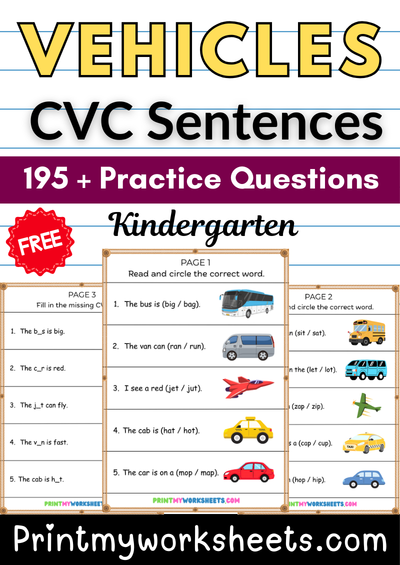
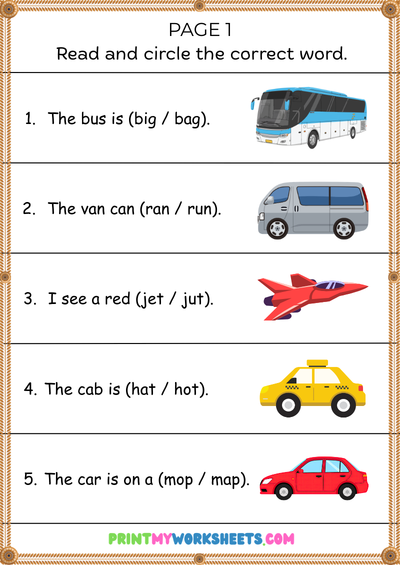
Kindergarten Vehicles CVC Sentences Worksheets PDF – Build Early Blending and Fluency Skills
Kindergarten Vehicles CVC Sentences Worksheets PDF
The Kindergarten Vehicles CVC Sentences Worksheets PDF is designed to help young learners build early reading confidence through simple, engaging sentence practice. This free printable PDF is perfect for U.S. parents, teachers, and homeschool families who want structured phonics support using fun vehicle-themed content.
In kindergarten, students begin blending consonant-vowel-consonant (CVC) words to read short sentences independently. Practicing with familiar topics, such as cars, buses, vans, and jets, keeps children motivated while strengthening foundational literacy skills. These worksheets focus on decoding short vowel words within simple, repetitive sentence structures.
The activities encourage children to read, circle, fill in blanks, and choose correct CVC words. With consistent practice, students improve decoding fluency, sentence comprehension, and word recognition. This resource supports early reading development in a clear, age-appropriate format that aligns with U.S. kindergarten literacy expectations.
What Students Will Learn?
These kindergarten CVC sentence worksheets focus on early phonics development and simple sentence reading. Students practice blending short vowel sounds to read and understand complete sentences about vehicles.
Children will learn to:
Decode short vowel CVC words
Identify correct word choices within a sentence
Complete sentences using missing CVC words
Strengthen word recognition skills
Build reading fluency with repetitive structures
Improve comprehension through picture-word connections
The activities are carefully structured to support emerging readers. Sentences are short and predictable, allowing students to focus on decoding without feeling overwhelmed. For example, children may read a sentence and circle the correct word from two similar options. Other pages may require filling in missing letters to complete a word.
These worksheets align with U.S. kindergarten phonics standards, which emphasize short vowel recognition, blending sounds, and reading simple sentences. By combining phonics instruction with engaging vehicle themes, students practice reading in a meaningful and motivating way.
Educational Value & Skill Development
The Kindergarten Vehicles CVC Sentences Worksheets PDF provides strong educational value by reinforcing foundational literacy skills. Mastery of CVC words is one of the most important early reading milestones in kindergarten.
Academically, these worksheets strengthen decoding skills. Students learn to recognize sound patterns and apply phonics rules when reading short words. This repeated exposure helps solidify short vowel sounds such as a, e, i, o, and u.
Cognitively, children improve their ability to discriminate between similar words, such as “bag” and “big.” This sharpens visual and auditory processing skills, which are critical for reading development.
Reading full sentences—even simple ones—builds comprehension skills. Students begin to understand that sentences communicate complete ideas. Recognizing how words fit together strengthens overall literacy understanding.
Confidence grows as children successfully read sentences on their own. Independent reading experiences motivate students to continue practicing. Through structured repetition and engaging content, learners develop fluency and automatic word recognition, setting a strong foundation for first-grade reading expectations.
Why Focus on Vehicles CVC Sentences?
CVC sentence practice is essential in kindergarten because it bridges the gap between isolated word reading and full sentence comprehension. Once students master blending sounds, they must apply that skill within meaningful text.
Using vehicle vocabulary makes learning enjoyable and relatable. Many young learners are naturally interested in cars, buses, trucks, and planes. Connecting phonics practice to familiar topics increases engagement and focus.
Repetition is key in early literacy development. Practicing similar sentence patterns with different CVC words helps strengthen automatic decoding skills. When children repeatedly see words like “bus,” “van,” and “cab,” recognition becomes faster and more confident.
This type of practice also aligns with U.S. kindergarten reading standards, which emphasize reading simple, decodable sentences. Structured phonics work ensures students are prepared for more complex texts in first grade.
How to Use These Worksheets?
The Kindergarten Vehicles CVC Sentences Worksheets PDF can be used in classrooms, homeschool settings, and literacy centers. Teachers may introduce a short vowel sound during a phonics lesson, then assign a worksheet page for guided practice.
In small groups, educators can read sentences aloud with students before allowing independent completion. This builds fluency and ensures understanding. In homeschool environments, parents can review letter sounds and blending strategies before beginning the worksheet.
Because this resource is a free printable PDF, it is easy to download and print as needed. Pages may be reused for review throughout the school year. Students benefit from repeated practice over time.
These worksheets also work well for independent reading stations. The predictable sentence patterns help students practice decoding with minimal frustration while reinforcing phonics skills.
Related Worksheets / Extensions:
You may also like:
Kindergarten CVC word worksheets
Short vowel sound practice worksheets
Kindergarten sight word sentence worksheets
Beginning reader fluency pages
First grade phonics sentence worksheets
The Kindergarten Vehicles CVC Sentences Worksheets PDF pairs well with additional short vowel and sight word practice resources. Combining word-level phonics with sentence reading creates a balanced literacy routine. With consistent guided practice, young learners build decoding fluency, improve comprehension, and develop the confidence needed for independent reading success.
You may also like:
[gallery ids="7175,7066,6839"]Frequently Asked Questions
Q1. Is this worksheet free to download?Yes, this worksheet is 100% free to download and print. No account, subscription, or payment is required. Click the Download Now button to get your free PDF instantly.Q2. What format is this worksheet available in?This worksheet is available as a printable PDF file. It is black-and-white, printer-friendly, and works on any standard home or classroom printer using A4 or US Letter paper.Q3. Do I need to create an account to download this worksheet?No account or sign-up is required. All worksheets on Print My Worksheets are freely accessible to teachers, parents, and homeschool families without any registration.Q4. Can this worksheet be used for phonics instruction?Yes, this worksheet supports phonics-based reading instruction and is suitable for early readers building letter-sound recognition skills.Q5. Is this worksheet suitable for ESL or ELL students?This worksheet can be used as a supplemental resource for ESL and ELL students, particularly for vocabulary building and language pattern practice.Kindergarten Vehicles CVC Sentences Worksheets PDF – Build Early Blending and Fluency Skills
Kindergarten Vehicles CVC Sentences Worksheets PDF
The Kindergarten Vehicles CVC Sentences Worksheets PDF is designed to help young learners build early reading confidence through simple, engaging sentence practice. This free printable PDF is perfect for U.S. parents, teachers, and homeschool families who want structured phonics support using fun vehicle-themed content.
In kindergarten, students begin blending consonant-vowel-consonant (CVC) words to read short sentences independently. Practicing with familiar topics, such as cars, buses, vans, and jets, keeps children motivated while strengthening foundational literacy skills. These worksheets focus on decoding short vowel words within simple, repetitive sentence structures.
The activities encourage children to read, circle, fill in blanks, and choose correct CVC words. With consistent practice, students improve decoding fluency, sentence comprehension, and word recognition. This resource supports early reading development in a clear, age-appropriate format that aligns with U.S. kindergarten literacy expectations.
What Students Will Learn?
These kindergarten CVC sentence worksheets focus on early phonics development and simple sentence reading. Students practice blending short vowel sounds to read and understand complete sentences about vehicles.
Children will learn to:
Decode short vowel CVC words
Identify correct word choices within a sentence
Complete sentences using missing CVC words
Strengthen word recognition skills
Build reading fluency with repetitive structures
Improve comprehension through picture-word connections
The activities are carefully structured to support emerging readers. Sentences are short and predictable, allowing students to focus on decoding without feeling overwhelmed. For example, children may read a sentence and circle the correct word from two similar options. Other pages may require filling in missing letters to complete a word.
These worksheets align with U.S. kindergarten phonics standards, which emphasize short vowel recognition, blending sounds, and reading simple sentences. By combining phonics instruction with engaging vehicle themes, students practice reading in a meaningful and motivating way.
Educational Value & Skill Development
The Kindergarten Vehicles CVC Sentences Worksheets PDF provides strong educational value by reinforcing foundational literacy skills. Mastery of CVC words is one of the most important early reading milestones in kindergarten.
Academically, these worksheets strengthen decoding skills. Students learn to recognize sound patterns and apply phonics rules when reading short words. This repeated exposure helps solidify short vowel sounds such as a, e, i, o, and u.
Cognitively, children improve their ability to discriminate between similar words, such as “bag” and “big.” This sharpens visual and auditory processing skills, which are critical for reading development.
Reading full sentences—even simple ones—builds comprehension skills. Students begin to understand that sentences communicate complete ideas. Recognizing how words fit together strengthens overall literacy understanding.
Confidence grows as children successfully read sentences on their own. Independent reading experiences motivate students to continue practicing. Through structured repetition and engaging content, learners develop fluency and automatic word recognition, setting a strong foundation for first-grade reading expectations.
Why Focus on Vehicles CVC Sentences?
CVC sentence practice is essential in kindergarten because it bridges the gap between isolated word reading and full sentence comprehension. Once students master blending sounds, they must apply that skill within meaningful text.
Using vehicle vocabulary makes learning enjoyable and relatable. Many young learners are naturally interested in cars, buses, trucks, and planes. Connecting phonics practice to familiar topics increases engagement and focus.
Repetition is key in early literacy development. Practicing similar sentence patterns with different CVC words helps strengthen automatic decoding skills. When children repeatedly see words like “bus,” “van,” and “cab,” recognition becomes faster and more confident.
This type of practice also aligns with U.S. kindergarten reading standards, which emphasize reading simple, decodable sentences. Structured phonics work ensures students are prepared for more complex texts in first grade.
How to Use These Worksheets?
The Kindergarten Vehicles CVC Sentences Worksheets PDF can be used in classrooms, homeschool settings, and literacy centers. Teachers may introduce a short vowel sound during a phonics lesson, then assign a worksheet page for guided practice.
In small groups, educators can read sentences aloud with students before allowing independent completion. This builds fluency and ensures understanding. In homeschool environments, parents can review letter sounds and blending strategies before beginning the worksheet.
Because this resource is a free printable PDF, it is easy to download and print as needed. Pages may be reused for review throughout the school year. Students benefit from repeated practice over time.
These worksheets also work well for independent reading stations. The predictable sentence patterns help students practice decoding with minimal frustration while reinforcing phonics skills.
Related Worksheets / Extensions:
You may also like:
Kindergarten CVC word worksheets
Short vowel sound practice worksheets
Kindergarten sight word sentence worksheets
Beginning reader fluency pages
First grade phonics sentence worksheets
The Kindergarten Vehicles CVC Sentences Worksheets PDF pairs well with additional short vowel and sight word practice resources. Combining word-level phonics with sentence reading creates a balanced literacy routine. With consistent guided practice, young learners build decoding fluency, improve comprehension, and develop the confidence needed for independent reading success.
You may also like:
[gallery ids="7175,7066,6839"]Frequently Asked Questions
Q1. Is this worksheet free to download?Yes, this worksheet is 100% free to download and print. No account, subscription, or payment is required. Click the Download Now button to get your free PDF instantly.Q2. What format is this worksheet available in?This worksheet is available as a printable PDF file. It is black-and-white, printer-friendly, and works on any standard home or classroom printer using A4 or US Letter paper.Q3. Do I need to create an account to download this worksheet?No account or sign-up is required. All worksheets on Print My Worksheets are freely accessible to teachers, parents, and homeschool families without any registration.Q4. Can this worksheet be used for phonics instruction?Yes, this worksheet supports phonics-based reading instruction and is suitable for early readers building letter-sound recognition skills.Q5. Is this worksheet suitable for ESL or ELL students?This worksheet can be used as a supplemental resource for ESL and ELL students, particularly for vocabulary building and language pattern practice.
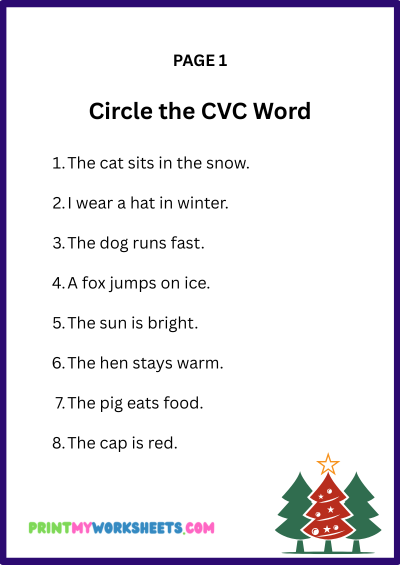
Kindergarten Winter CVC Words Worksheets PDF – Build Early Literacy Skills This Winter
Kindergarten Winter CVC Words Worksheets PDF
Seasonal themes can make early reading practice more engaging while still supporting core literacy goals. These Kindergarten Winter CVC Words Worksheets PDF are designed to help young learners practice consonant-vowel-consonant word patterns in a calm, structured, and age-appropriate way. Created for U.S. parents, classroom teachers, and homeschool families, this free printable resource combines foundational reading skills with a winter theme that feels familiar and motivating for kindergarten students.
CVC words play a critical role in early phonics instruction. In kindergarten, children are learning how individual letter sounds blend together to form simple words. Mastery of these patterns helps students move from letter recognition to confident early reading. These worksheets provide consistent practice with short, decodable words while keeping tasks clear and manageable. With simple directions and a predictable layout, this printable set supports early reading development while building confidence and independence during the winter months.
What Students Will Learn ?
This worksheet set focuses on strengthening early decoding skills through consistent practice with CVC words. Students will learn how to blend beginning, middle, and ending sounds to read simple three-letter words. This skill is a key milestone in kindergarten literacy and supports the transition from recognizing letters to reading words.
The worksheets include a range of structured activities that reinforce learning in multiple ways. Students may practice reading CVC words, matching sounds to letters, completing simple word-building tasks, or identifying words within short, controlled contexts. Each activity targets one clear objective, helping young learners stay focused and successful.
The design of these worksheets aligns with age-appropriate expectations for kindergarten students in the United States. Tasks are short, instructions are clear, and visual layouts are uncluttered. Whether used independently or with adult guidance, these activities support daily phonics routines while helping children develop accuracy, confidence, and early reading habits.
Educational Value & Skill Development
Consistent CVC word practice provides meaningful academic benefits, and the Kindergarten Winter CVC Words Worksheets PDF support early literacy development in several important ways. Academically, these worksheets help students strengthen decoding skills by reinforcing sound-letter relationships and blending strategies. This foundation is essential for reading fluency in later grades.
Cognitively, working with CVC words supports phonemic awareness, memory, and attention. Students learn to listen carefully to sounds, recognize patterns, and apply those patterns to new words. These processes build essential language skills that extend beyond reading.
The worksheets also encourage independence and confidence. Familiar formats and predictable routines help students understand expectations and complete tasks with minimal support. As children experience success, they become more willing to engage with reading activities. Over time, repeated practice with simple word patterns supports skill progression, preparing students for more complex phonics concepts and longer words as they advance through kindergarten and into first grade.
Why Focus on Kindergarten Winter CVC Words Worksheets ?
CVC words are one of the first word patterns children learn to read independently. Understanding these simple structures helps students grasp how sounds work together in written language.
In kindergarten, reading instruction emphasizes phonics and decoding. CVC words provide an ideal starting point because they follow consistent sound patterns that are easy for young learners to practice and remember. Focusing on these words helps students build confidence as they begin reading real words instead of isolated sounds.
Repetition and guided practice are especially important at this stage. Children need multiple opportunities to see, say, and read CVC words before the skill becomes automatic. These worksheets support early learning standards commonly used in U.S. schools by reinforcing foundational phonics skills through structured, repeatable activities. Seasonal themes add interest without distracting from instructional goals, helping students stay engaged while practicing essential reading skills.
How to Use These Worksheets ?
These worksheets are flexible and easy to use across different learning environments. In homeschool settings, parents can introduce one page at a time as part of a daily reading routine. Reading words aloud together and discussing sounds can deepen understanding and reinforce learning.
In classrooms, teachers can use the worksheets during literacy centers, small-group phonics instruction, or independent work time. They are also effective for review and reinforcement, allowing students to revisit CVC patterns they have already learned.
Because the resource is provided as a free printable PDF, it is simple to download and print as needed. Pages can be reused by placing them in sheet protectors or laminating for repeated practice. For educators and families looking for seasonal phonics support, Kindergarten Winter CVC Words Worksheets PDF offer a practical way to reinforce early reading skills in a structured, student-friendly format.
What’s Included in This PDF ?
This printable worksheet set is designed to support kindergarten phonics instruction with clarity and consistency. Each page focuses on meaningful skill practice without unnecessary distractions. Inside this PDF, you’ll find:
Multiple printable worksheets focused on CVC word practice
Activities that reinforce blending and decoding skills
A clean, kid-friendly layout suitable for young learners
Black-and-white pages for easy, print-friendly use
Content aligned with U.S. kindergarten literacy expectations
A free downloadable PDF format for quick and convenient access
Related Worksheets / Extensions
To support continued reading development, you may want to pair these worksheets with other early literacy resources. Sight word practice, beginning sound activities, and short vowel worksheets can complement CVC word instruction and provide balanced phonics support.
You may also explore additional seasonal reading resources for kindergarten learners. Resources like Kindergarten Winter CVC Words Worksheets PDF work well alongside year-round phonics practice, helping students strengthen decoding skills through consistent, engaging activities that support early reading success.
Frequently Asked Questions
Q1. What format is this worksheet available in?This worksheet is available as a printable PDF file. It is black-and-white, printer-friendly, and works on any standard home or classroom printer using A4 or US Letter paper.Q2. Is this worksheet free to download?Yes, this worksheet is 100% free to download and print. No account, subscription, or payment is required. Click the Download Now button to get your free PDF instantly.Q3. Can I use this worksheet for both classroom and home learning?Yes, these worksheets are designed for use by classroom teachers, homeschool parents, and tutors. They can be used as morning work, homework, revision practice, or learning centre activities.Q4. Can this worksheet be used for phonics instruction?Yes, this worksheet supports phonics-based reading instruction and is suitable for early readers building letter-sound recognition skills.Q5. Is this worksheet suitable for ESL or ELL students?This worksheet can be used as a supplemental resource for ESL and ELL students, particularly for vocabulary building and language pattern practice.Kindergarten Winter CVC Words Worksheets PDF – Build Early Literacy Skills This Winter
Kindergarten Winter CVC Words Worksheets PDF
Seasonal themes can make early reading practice more engaging while still supporting core literacy goals. These Kindergarten Winter CVC Words Worksheets PDF are designed to help young learners practice consonant-vowel-consonant word patterns in a calm, structured, and age-appropriate way. Created for U.S. parents, classroom teachers, and homeschool families, this free printable resource combines foundational reading skills with a winter theme that feels familiar and motivating for kindergarten students.
CVC words play a critical role in early phonics instruction. In kindergarten, children are learning how individual letter sounds blend together to form simple words. Mastery of these patterns helps students move from letter recognition to confident early reading. These worksheets provide consistent practice with short, decodable words while keeping tasks clear and manageable. With simple directions and a predictable layout, this printable set supports early reading development while building confidence and independence during the winter months.
What Students Will Learn ?
This worksheet set focuses on strengthening early decoding skills through consistent practice with CVC words. Students will learn how to blend beginning, middle, and ending sounds to read simple three-letter words. This skill is a key milestone in kindergarten literacy and supports the transition from recognizing letters to reading words.
The worksheets include a range of structured activities that reinforce learning in multiple ways. Students may practice reading CVC words, matching sounds to letters, completing simple word-building tasks, or identifying words within short, controlled contexts. Each activity targets one clear objective, helping young learners stay focused and successful.
The design of these worksheets aligns with age-appropriate expectations for kindergarten students in the United States. Tasks are short, instructions are clear, and visual layouts are uncluttered. Whether used independently or with adult guidance, these activities support daily phonics routines while helping children develop accuracy, confidence, and early reading habits.
Educational Value & Skill Development
Consistent CVC word practice provides meaningful academic benefits, and the Kindergarten Winter CVC Words Worksheets PDF support early literacy development in several important ways. Academically, these worksheets help students strengthen decoding skills by reinforcing sound-letter relationships and blending strategies. This foundation is essential for reading fluency in later grades.
Cognitively, working with CVC words supports phonemic awareness, memory, and attention. Students learn to listen carefully to sounds, recognize patterns, and apply those patterns to new words. These processes build essential language skills that extend beyond reading.
The worksheets also encourage independence and confidence. Familiar formats and predictable routines help students understand expectations and complete tasks with minimal support. As children experience success, they become more willing to engage with reading activities. Over time, repeated practice with simple word patterns supports skill progression, preparing students for more complex phonics concepts and longer words as they advance through kindergarten and into first grade.
Why Focus on Kindergarten Winter CVC Words Worksheets ?
CVC words are one of the first word patterns children learn to read independently. Understanding these simple structures helps students grasp how sounds work together in written language.
In kindergarten, reading instruction emphasizes phonics and decoding. CVC words provide an ideal starting point because they follow consistent sound patterns that are easy for young learners to practice and remember. Focusing on these words helps students build confidence as they begin reading real words instead of isolated sounds.
Repetition and guided practice are especially important at this stage. Children need multiple opportunities to see, say, and read CVC words before the skill becomes automatic. These worksheets support early learning standards commonly used in U.S. schools by reinforcing foundational phonics skills through structured, repeatable activities. Seasonal themes add interest without distracting from instructional goals, helping students stay engaged while practicing essential reading skills.
How to Use These Worksheets ?
These worksheets are flexible and easy to use across different learning environments. In homeschool settings, parents can introduce one page at a time as part of a daily reading routine. Reading words aloud together and discussing sounds can deepen understanding and reinforce learning.
In classrooms, teachers can use the worksheets during literacy centers, small-group phonics instruction, or independent work time. They are also effective for review and reinforcement, allowing students to revisit CVC patterns they have already learned.
Because the resource is provided as a free printable PDF, it is simple to download and print as needed. Pages can be reused by placing them in sheet protectors or laminating for repeated practice. For educators and families looking for seasonal phonics support, Kindergarten Winter CVC Words Worksheets PDF offer a practical way to reinforce early reading skills in a structured, student-friendly format.
What’s Included in This PDF ?
This printable worksheet set is designed to support kindergarten phonics instruction with clarity and consistency. Each page focuses on meaningful skill practice without unnecessary distractions. Inside this PDF, you’ll find:
Multiple printable worksheets focused on CVC word practice
Activities that reinforce blending and decoding skills
A clean, kid-friendly layout suitable for young learners
Black-and-white pages for easy, print-friendly use
Content aligned with U.S. kindergarten literacy expectations
A free downloadable PDF format for quick and convenient access
Related Worksheets / Extensions
To support continued reading development, you may want to pair these worksheets with other early literacy resources. Sight word practice, beginning sound activities, and short vowel worksheets can complement CVC word instruction and provide balanced phonics support.
You may also explore additional seasonal reading resources for kindergarten learners. Resources like Kindergarten Winter CVC Words Worksheets PDF work well alongside year-round phonics practice, helping students strengthen decoding skills through consistent, engaging activities that support early reading success.
Frequently Asked Questions
Q1. What format is this worksheet available in?This worksheet is available as a printable PDF file. It is black-and-white, printer-friendly, and works on any standard home or classroom printer using A4 or US Letter paper.Q2. Is this worksheet free to download?Yes, this worksheet is 100% free to download and print. No account, subscription, or payment is required. Click the Download Now button to get your free PDF instantly.Q3. Can I use this worksheet for both classroom and home learning?Yes, these worksheets are designed for use by classroom teachers, homeschool parents, and tutors. They can be used as morning work, homework, revision practice, or learning centre activities.Q4. Can this worksheet be used for phonics instruction?Yes, this worksheet supports phonics-based reading instruction and is suitable for early readers building letter-sound recognition skills.Q5. Is this worksheet suitable for ESL or ELL students?This worksheet can be used as a supplemental resource for ESL and ELL students, particularly for vocabulary building and language pattern practice.
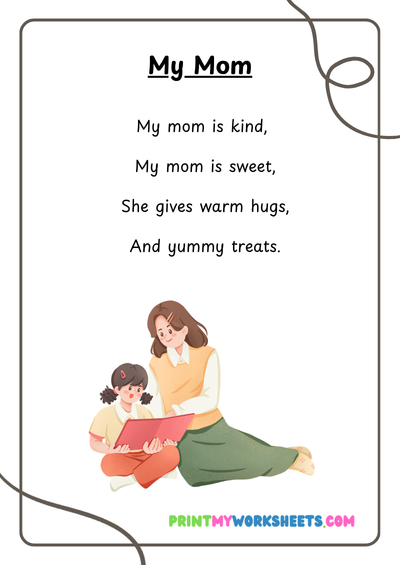
Mother Poems Reading Worksheets PDF | Free Downloadable
Celebrate love and appreciation with our Mother Poems Reading Worksheets PDF , designed to help children express emotions through meaningful poetry and creative activities. These free downloadable PDF worksheets are perfect for U.S. homeschool parents, classroom teachers, tutors, and kids who enjoy reading and writing heartfelt poems.
These worksheets include simple and engaging poetry activities focused on mothers, family love, gratitude, and kindness. Children can read poems, answer comprehension questions, complete writing prompts, and even create their own special poem for their mother. The activities encourage creativity while strengthening literacy skills.
Learning through poetry helps children improve reading fluency, vocabulary, and comprehension. Poetry also supports emotional expression and helps students connect language with feelings and experiences. Writing poems encourages imagination, confidence, and communication skills.
The worksheets feature fun and thoughtful activities that make learning enjoyable and meaningful for children.
Ideal for Mother’s Day activities, literacy lessons, homework assignments, independent practice, or homeschool learning, these worksheets align with U.S. language arts standards. Download instantly, print easily, and help children celebrate their mothers while building strong reading and writing skills—completely free and ready to use.
Frequently Asked Questions
Q1. Is this worksheet free to download?Yes, this worksheet is 100% free to download and print. No account, subscription, or payment is required. Click the Download Now button to get your free PDF instantly.Q2. What format is this worksheet available in?This worksheet is available as a printable PDF file. It is black-and-white, printer-friendly, and works on any standard home or classroom printer using A4 or US Letter paper.Q3. Do I need to create an account to download this worksheet?No account or sign-up is required. All worksheets on Print My Worksheets are freely accessible to teachers, parents, and homeschool families without any registration.Q4. Is this worksheet aligned with Common Core ELA standards?Yes, this English worksheet is aligned with U.S. Common Core English Language Arts standards and supports foundational literacy development.Q5. Can this worksheet be used for phonics instruction?Yes, this worksheet supports phonics-based reading instruction and is suitable for early readers building letter-sound recognition skills.Mother Poems Reading Worksheets PDF | Free Downloadable
Celebrate love and appreciation with our Mother Poems Reading Worksheets PDF , designed to help children express emotions through meaningful poetry and creative activities. These free downloadable PDF worksheets are perfect for U.S. homeschool parents, classroom teachers, tutors, and kids who enjoy reading and writing heartfelt poems.
These worksheets include simple and engaging poetry activities focused on mothers, family love, gratitude, and kindness. Children can read poems, answer comprehension questions, complete writing prompts, and even create their own special poem for their mother. The activities encourage creativity while strengthening literacy skills.
Learning through poetry helps children improve reading fluency, vocabulary, and comprehension. Poetry also supports emotional expression and helps students connect language with feelings and experiences. Writing poems encourages imagination, confidence, and communication skills.
The worksheets feature fun and thoughtful activities that make learning enjoyable and meaningful for children.
Ideal for Mother’s Day activities, literacy lessons, homework assignments, independent practice, or homeschool learning, these worksheets align with U.S. language arts standards. Download instantly, print easily, and help children celebrate their mothers while building strong reading and writing skills—completely free and ready to use.
Frequently Asked Questions
Q1. Is this worksheet free to download?Yes, this worksheet is 100% free to download and print. No account, subscription, or payment is required. Click the Download Now button to get your free PDF instantly.Q2. What format is this worksheet available in?This worksheet is available as a printable PDF file. It is black-and-white, printer-friendly, and works on any standard home or classroom printer using A4 or US Letter paper.Q3. Do I need to create an account to download this worksheet?No account or sign-up is required. All worksheets on Print My Worksheets are freely accessible to teachers, parents, and homeschool families without any registration.Q4. Is this worksheet aligned with Common Core ELA standards?Yes, this English worksheet is aligned with U.S. Common Core English Language Arts standards and supports foundational literacy development.Q5. Can this worksheet be used for phonics instruction?Yes, this worksheet supports phonics-based reading instruction and is suitable for early readers building letter-sound recognition skills.
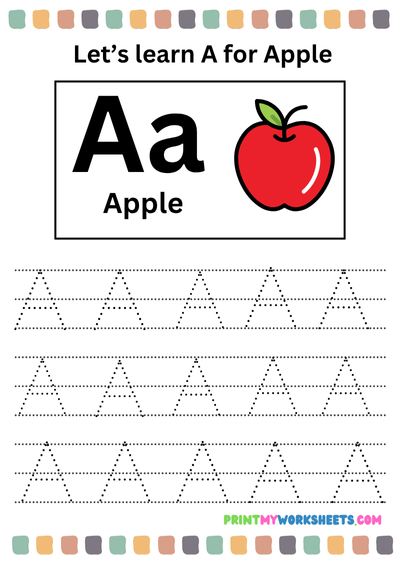
Pre-K A to Z Tracing Letter Worksheets PDF – Alphabet Handwriting Practice with Answer Guide
Pre-K A to Z Tracing Letter Worksheets PDF
These worksheets are created especially for US homeschool parents, teachers, and early learners! ✏️📚 These engaging and educational worksheets make handwriting practice fun, helping kids build confidence as they learn to trace and recognize every letter from A to Z.
Each worksheet features uppercase and lowercase letter tracing, adorable illustrations, and easy-to-follow dotted lines to guide proper handwriting formation. Kids will also associate each letter with a fun image — like A for Apple or B for Ball — enhancing phonics, vocabulary, and early reading skills.
Why learn alphabet tracing?
Tracing letters improves fine motor control, hand-eye coordination, and pre-writing skills, setting the foundation for future literacy and writing success. These worksheets make learning interactive and enjoyable while helping children understand letter sounds and shapes.
Perfect for classroom learning, homeschool lessons, or at-home practice, this free printable PDF turns alphabet mastery into an engaging activity.
Download your Pre-K A to Z Tracing Letter Worksheets PDF today and let your little one start their handwriting journey with creativity, confidence, and fun!
Frequently Asked Questions
Q1. Is this worksheet free to download?Yes, this worksheet is 100% free to download and print. No account, subscription, or payment is required. Click the Download Now button to get your free PDF instantly.Q2. Can I use this worksheet for both classroom and home learning?Yes, these worksheets are designed for use by classroom teachers, homeschool parents, and tutors. They can be used as morning work, homework, revision practice, or learning centre activities.Q3. What format is this worksheet available in?This worksheet is available as a printable PDF file. It is black-and-white, printer-friendly, and works on any standard home or classroom printer using A4 or US Letter paper.Q4. Can this worksheet be used for phonics instruction?Yes, this worksheet supports phonics-based reading instruction and is suitable for early readers building letter-sound recognition skills.Q5. Is this worksheet suitable for ESL or ELL students?This worksheet can be used as a supplemental resource for ESL and ELL students, particularly for vocabulary building and language pattern practice.Pre-K A to Z Tracing Letter Worksheets PDF – Alphabet Handwriting Practice with Answer Guide
Pre-K A to Z Tracing Letter Worksheets PDF
These worksheets are created especially for US homeschool parents, teachers, and early learners! ✏️📚 These engaging and educational worksheets make handwriting practice fun, helping kids build confidence as they learn to trace and recognize every letter from A to Z.
Each worksheet features uppercase and lowercase letter tracing, adorable illustrations, and easy-to-follow dotted lines to guide proper handwriting formation. Kids will also associate each letter with a fun image — like A for Apple or B for Ball — enhancing phonics, vocabulary, and early reading skills.
Why learn alphabet tracing?
Tracing letters improves fine motor control, hand-eye coordination, and pre-writing skills, setting the foundation for future literacy and writing success. These worksheets make learning interactive and enjoyable while helping children understand letter sounds and shapes.
Perfect for classroom learning, homeschool lessons, or at-home practice, this free printable PDF turns alphabet mastery into an engaging activity.
Download your Pre-K A to Z Tracing Letter Worksheets PDF today and let your little one start their handwriting journey with creativity, confidence, and fun!
Frequently Asked Questions
Q1. Is this worksheet free to download?Yes, this worksheet is 100% free to download and print. No account, subscription, or payment is required. Click the Download Now button to get your free PDF instantly.Q2. Can I use this worksheet for both classroom and home learning?Yes, these worksheets are designed for use by classroom teachers, homeschool parents, and tutors. They can be used as morning work, homework, revision practice, or learning centre activities.Q3. What format is this worksheet available in?This worksheet is available as a printable PDF file. It is black-and-white, printer-friendly, and works on any standard home or classroom printer using A4 or US Letter paper.Q4. Can this worksheet be used for phonics instruction?Yes, this worksheet supports phonics-based reading instruction and is suitable for early readers building letter-sound recognition skills.Q5. Is this worksheet suitable for ESL or ELL students?This worksheet can be used as a supplemental resource for ESL and ELL students, particularly for vocabulary building and language pattern practice.
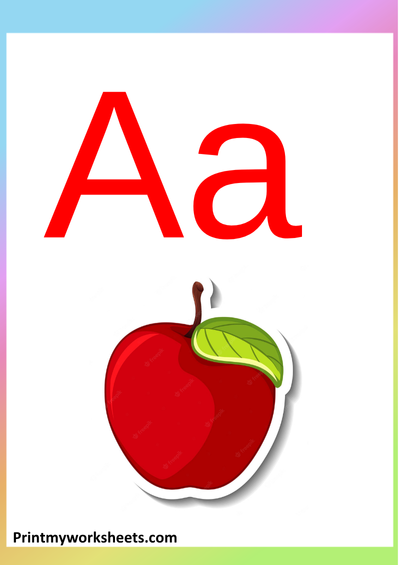
Pre-K Alphabet Wall Poster PDF | Free Downloadable
Pre-K Alphabet Wall Poster PDF Introduce your little learners to the magical world of letters with our English A–Z Wall Poster | Free Downloadable PDF for Pre-Kindergarten. This beautifully designed alphabet chart is tailored for children ages 3–5 and supports early childhood educators, homeschool parents, and caregivers who want to create a strong literacy foundation right from the start.
Learning the alphabet is one of the most important early milestones for preschoolers. Our A–Z wall poster is not just decorative — it’s a powerful learning tool. Featuring large, bold uppercase and lowercase letters, colorful illustrations for each letter (like A for Apple, B for Ball, and so on), and a layout that’s easy on the eyes and great for daily practice, this poster makes alphabet learning fun, visual, and memorable.
Whether you're a teacher creating a literacy-rich classroom environment, a homeschool parent building a reading nook, or simply a parent wanting to decorate a learning wall at home, this free A–Z PDF poster is ideal. It encourages letter recognition, reinforces phonics, and builds vocabulary — all while keeping your space engaging and kid-friendly.
This poster supports:
Alphabet mastery: Kids will begin to recognize letters and associate them with sounds and objects.
Letter-sound correspondence: Essential for phonemic awareness and reading readiness.
Visual learning: Each letter is paired with a matching image, aiding memory and understanding.
Independent learning: Children can self-review and explore at their own pace.
Perfect for printing in home, preschool, daycare, or kindergarten settings, this poster can be displayed on a wall, added to a binder, or used as a placemat during letter review.
Why this matters: According to early literacy research, visual aids like alphabet posters greatly enhance letter recognition and retention among young learners. They also provide consistent exposure that supports reading and spelling success in the long run.
What’s included:
Full A–Z chart in one high-resolution PDF page
Uppercase and lowercase letter formats
Visual aids for each letter sound
Friendly layout and bright Pre-K color palette
Download and print today to give your little learners the head start they deserve!
Frequently Asked Questions
Q1. What format is this worksheet available in?This worksheet is available as a printable PDF file. It is black-and-white, printer-friendly, and works on any standard home or classroom printer using A4 or US Letter paper.Q2. Is this worksheet free to download?Yes, this worksheet is 100% free to download and print. No account, subscription, or payment is required. Click the Download Now button to get your free PDF instantly.Q3. Can I use this worksheet for both classroom and home learning?Yes, these worksheets are designed for use by classroom teachers, homeschool parents, and tutors. They can be used as morning work, homework, revision practice, or learning centre activities.Q4. Can this worksheet be used for phonics instruction?Yes, this worksheet supports phonics-based reading instruction and is suitable for early readers building letter-sound recognition skills.Q5. Is this worksheet suitable for ESL or ELL students?This worksheet can be used as a supplemental resource for ESL and ELL students, particularly for vocabulary building and language pattern practice.Pre-K Alphabet Wall Poster PDF | Free Downloadable
Pre-K Alphabet Wall Poster PDF Introduce your little learners to the magical world of letters with our English A–Z Wall Poster | Free Downloadable PDF for Pre-Kindergarten. This beautifully designed alphabet chart is tailored for children ages 3–5 and supports early childhood educators, homeschool parents, and caregivers who want to create a strong literacy foundation right from the start.
Learning the alphabet is one of the most important early milestones for preschoolers. Our A–Z wall poster is not just decorative — it’s a powerful learning tool. Featuring large, bold uppercase and lowercase letters, colorful illustrations for each letter (like A for Apple, B for Ball, and so on), and a layout that’s easy on the eyes and great for daily practice, this poster makes alphabet learning fun, visual, and memorable.
Whether you're a teacher creating a literacy-rich classroom environment, a homeschool parent building a reading nook, or simply a parent wanting to decorate a learning wall at home, this free A–Z PDF poster is ideal. It encourages letter recognition, reinforces phonics, and builds vocabulary — all while keeping your space engaging and kid-friendly.
This poster supports:
Alphabet mastery: Kids will begin to recognize letters and associate them with sounds and objects.
Letter-sound correspondence: Essential for phonemic awareness and reading readiness.
Visual learning: Each letter is paired with a matching image, aiding memory and understanding.
Independent learning: Children can self-review and explore at their own pace.
Perfect for printing in home, preschool, daycare, or kindergarten settings, this poster can be displayed on a wall, added to a binder, or used as a placemat during letter review.
Why this matters: According to early literacy research, visual aids like alphabet posters greatly enhance letter recognition and retention among young learners. They also provide consistent exposure that supports reading and spelling success in the long run.
What’s included:
Full A–Z chart in one high-resolution PDF page
Uppercase and lowercase letter formats
Visual aids for each letter sound
Friendly layout and bright Pre-K color palette
Download and print today to give your little learners the head start they deserve!
Frequently Asked Questions
Q1. What format is this worksheet available in?This worksheet is available as a printable PDF file. It is black-and-white, printer-friendly, and works on any standard home or classroom printer using A4 or US Letter paper.Q2. Is this worksheet free to download?Yes, this worksheet is 100% free to download and print. No account, subscription, or payment is required. Click the Download Now button to get your free PDF instantly.Q3. Can I use this worksheet for both classroom and home learning?Yes, these worksheets are designed for use by classroom teachers, homeschool parents, and tutors. They can be used as morning work, homework, revision practice, or learning centre activities.Q4. Can this worksheet be used for phonics instruction?Yes, this worksheet supports phonics-based reading instruction and is suitable for early readers building letter-sound recognition skills.Q5. Is this worksheet suitable for ESL or ELL students?This worksheet can be used as a supplemental resource for ESL and ELL students, particularly for vocabulary building and language pattern practice.

Pre-K Animals Tracing Worksheets PDF | Free English Downloadable
Pre-K Animals Tracing Worksheets PDF
The Pre-K Animals Tracing Worksheets PDF is a fun and engaging activity designed to help preschool learners practice tracing skills while exploring familiar animal illustrations. This free printable PDF is created for U.S. parents, preschool teachers, and homeschool families who want to support early writing readiness through enjoyable hands-on learning.
Tracing activities are an important part of early childhood education because they help children strengthen the small muscles in their hands that are necessary for writing. At the Pre-K level, guided tracing exercises allow children to practice pencil control in a structured and supportive way.
The Pre-K Animals Tracing Worksheets PDF combines tracing practice with animal-themed drawings such as cats, dogs, birds, and other recognizable creatures. Children follow dotted lines to trace shapes and outlines while improving coordination and focus. These activities help young learners develop confidence with pencils and crayons while preparing for future handwriting tasks.
Animal-themed worksheets also keep children interested and motivated, making tracing practice both educational and enjoyable.
What Students Will Learn?
Animal tracing worksheets provide preschool learners with opportunities to develop several foundational early learning skills. These activities introduce tracing in a simple way that helps children build confidence while practicing motor control.
Students will learn to follow dotted lines and outlines to trace the shapes of different animals. This helps strengthen fine motor coordination and teaches children how to guide their hand movements carefully along a path.
Children will also practice visual recognition. By tracing familiar animals, students become more aware of shapes, outlines, and simple details that form the pictures. Recognizing these features supports visual learning and observation skills.
Tracing activities also help develop concentration. Preschool learners must focus on the lines they are following, which encourages attention and patience. Completing the entire tracing task helps children build persistence and confidence.
The worksheets include simple animal illustrations that are easy for young learners to recognize and trace. These images help children connect the activity to real-world experiences, making learning more engaging.
Through repeated tracing practice, preschool students gradually improve hand control and develop the coordination needed for future writing activities in kindergarten.
Educational Value & Skill Development:
The Pre-K Animals Tracing Worksheets PDF provides valuable opportunities for preschool learners to strengthen both physical and cognitive developmental skills. Tracing is widely used in early childhood classrooms because it builds essential foundations for writing and drawing.
One of the most important benefits is fine motor development. When children trace shapes and outlines, they strengthen the muscles in their hands and fingers. These muscles are necessary for holding pencils correctly and forming letters in the future.
Tracing also improves hand-eye coordination. Children learn to guide their hands based on what they see on the page. Following lines carefully helps them practice precision and control.
Another key benefit is increased focus. Preschool learners practice paying attention to the tracing lines and completing the activity step by step. This helps develop patience and concentration, which are important for many school tasks.
The Pre-K Animals Tracing Worksheets PDF also encourages creativity. After tracing the animal shapes, children can color the pictures and add their own creative touches. This combination of tracing and coloring keeps learners engaged while reinforcing the activity.
By practicing these exercises regularly, children develop stronger motor control and greater confidence in their early writing skills.
Why Focus on Animals Tracing?
Animal-themed tracing activities are particularly effective for preschool learners because animals are familiar and interesting to young children. When students recognize the pictures they are tracing, they become more engaged and motivated to complete the activity.
Animals also provide simple shapes that are suitable for beginners. Rounded outlines and basic forms make tracing easier for small hands that are still developing motor control.
Tracing animal shapes also encourages observation. Children begin noticing details such as ears, tails, and wings while following the lines. These observations help strengthen visual awareness and pattern recognition.
Animal activities also support language development. Teachers and parents can talk about the animals shown on the worksheets, discussing their sounds, habitats, and characteristics. This expands vocabulary while children complete the tracing tasks.
Regular tracing practice helps children build muscle memory in their hands. As their movements become more controlled, they become better prepared for writing letters and numbers during kindergarten learning.
How to Use These Worksheets?
The Pre-K Animals Tracing Worksheets PDF can be used in many educational settings, making it a flexible resource for teachers and parents.
In preschool classrooms, teachers may include these worksheets as part of a fine motor development center. Students can trace animal outlines and then color the pictures, combining tracing practice with creative expression.
Homeschool families can use the worksheets during daily learning routines. Parents may introduce the animals on each page and talk about them before children begin tracing the shapes.
Because the worksheets are available as a free printable PDF, they can be downloaded and printed quickly whenever needed. Teachers can print multiple copies for classroom activities, and parents can reuse the worksheets for additional practice.
These worksheets also work well for independent learning time. The simple tracing lines are easy for preschool learners to follow without complicated instructions. This makes the activity suitable for quiet work periods, early learning sessions, or creative practice time.
Related Worksheets / Extensions:
Frequently Asked Questions
Q1. Is this worksheet free to download?Yes, this worksheet is 100% free to download and print. No account, subscription, or payment is required. Click the Download Now button to get your free PDF instantly.Q2. What format is this worksheet available in?This worksheet is available as a printable PDF file. It is black-and-white, printer-friendly, and works on any standard home or classroom printer using A4 or US Letter paper.Q3. Can I use this worksheet for both classroom and home learning?Yes, these worksheets are designed for use by classroom teachers, homeschool parents, and tutors. They can be used as morning work, homework, revision practice, or learning centre activities.Q4. Can this coloring worksheet be used as a classroom activity?Yes, this worksheet works well as a quiet time activity, early finisher work, morning warm-up, or take-home creative activity.Q5. Is this coloring worksheet themed around learning content?Yes, our coloring worksheets are designed to combine creative activity with educational content such as alphabet recognition, numbers, animals, and seasonal themes.Pre-K Animals Tracing Worksheets PDF | Free English Downloadable
Pre-K Animals Tracing Worksheets PDF
The Pre-K Animals Tracing Worksheets PDF is a fun and engaging activity designed to help preschool learners practice tracing skills while exploring familiar animal illustrations. This free printable PDF is created for U.S. parents, preschool teachers, and homeschool families who want to support early writing readiness through enjoyable hands-on learning.
Tracing activities are an important part of early childhood education because they help children strengthen the small muscles in their hands that are necessary for writing. At the Pre-K level, guided tracing exercises allow children to practice pencil control in a structured and supportive way.
The Pre-K Animals Tracing Worksheets PDF combines tracing practice with animal-themed drawings such as cats, dogs, birds, and other recognizable creatures. Children follow dotted lines to trace shapes and outlines while improving coordination and focus. These activities help young learners develop confidence with pencils and crayons while preparing for future handwriting tasks.
Animal-themed worksheets also keep children interested and motivated, making tracing practice both educational and enjoyable.
What Students Will Learn?
Animal tracing worksheets provide preschool learners with opportunities to develop several foundational early learning skills. These activities introduce tracing in a simple way that helps children build confidence while practicing motor control.
Students will learn to follow dotted lines and outlines to trace the shapes of different animals. This helps strengthen fine motor coordination and teaches children how to guide their hand movements carefully along a path.
Children will also practice visual recognition. By tracing familiar animals, students become more aware of shapes, outlines, and simple details that form the pictures. Recognizing these features supports visual learning and observation skills.
Tracing activities also help develop concentration. Preschool learners must focus on the lines they are following, which encourages attention and patience. Completing the entire tracing task helps children build persistence and confidence.
The worksheets include simple animal illustrations that are easy for young learners to recognize and trace. These images help children connect the activity to real-world experiences, making learning more engaging.
Through repeated tracing practice, preschool students gradually improve hand control and develop the coordination needed for future writing activities in kindergarten.
Educational Value & Skill Development:
The Pre-K Animals Tracing Worksheets PDF provides valuable opportunities for preschool learners to strengthen both physical and cognitive developmental skills. Tracing is widely used in early childhood classrooms because it builds essential foundations for writing and drawing.
One of the most important benefits is fine motor development. When children trace shapes and outlines, they strengthen the muscles in their hands and fingers. These muscles are necessary for holding pencils correctly and forming letters in the future.
Tracing also improves hand-eye coordination. Children learn to guide their hands based on what they see on the page. Following lines carefully helps them practice precision and control.
Another key benefit is increased focus. Preschool learners practice paying attention to the tracing lines and completing the activity step by step. This helps develop patience and concentration, which are important for many school tasks.
The Pre-K Animals Tracing Worksheets PDF also encourages creativity. After tracing the animal shapes, children can color the pictures and add their own creative touches. This combination of tracing and coloring keeps learners engaged while reinforcing the activity.
By practicing these exercises regularly, children develop stronger motor control and greater confidence in their early writing skills.
Why Focus on Animals Tracing?
Animal-themed tracing activities are particularly effective for preschool learners because animals are familiar and interesting to young children. When students recognize the pictures they are tracing, they become more engaged and motivated to complete the activity.
Animals also provide simple shapes that are suitable for beginners. Rounded outlines and basic forms make tracing easier for small hands that are still developing motor control.
Tracing animal shapes also encourages observation. Children begin noticing details such as ears, tails, and wings while following the lines. These observations help strengthen visual awareness and pattern recognition.
Animal activities also support language development. Teachers and parents can talk about the animals shown on the worksheets, discussing their sounds, habitats, and characteristics. This expands vocabulary while children complete the tracing tasks.
Regular tracing practice helps children build muscle memory in their hands. As their movements become more controlled, they become better prepared for writing letters and numbers during kindergarten learning.
How to Use These Worksheets?
The Pre-K Animals Tracing Worksheets PDF can be used in many educational settings, making it a flexible resource for teachers and parents.
In preschool classrooms, teachers may include these worksheets as part of a fine motor development center. Students can trace animal outlines and then color the pictures, combining tracing practice with creative expression.
Homeschool families can use the worksheets during daily learning routines. Parents may introduce the animals on each page and talk about them before children begin tracing the shapes.
Because the worksheets are available as a free printable PDF, they can be downloaded and printed quickly whenever needed. Teachers can print multiple copies for classroom activities, and parents can reuse the worksheets for additional practice.
These worksheets also work well for independent learning time. The simple tracing lines are easy for preschool learners to follow without complicated instructions. This makes the activity suitable for quiet work periods, early learning sessions, or creative practice time.
Related Worksheets / Extensions:
Frequently Asked Questions
Q1. Is this worksheet free to download?Yes, this worksheet is 100% free to download and print. No account, subscription, or payment is required. Click the Download Now button to get your free PDF instantly.Q2. What format is this worksheet available in?This worksheet is available as a printable PDF file. It is black-and-white, printer-friendly, and works on any standard home or classroom printer using A4 or US Letter paper.Q3. Can I use this worksheet for both classroom and home learning?Yes, these worksheets are designed for use by classroom teachers, homeschool parents, and tutors. They can be used as morning work, homework, revision practice, or learning centre activities.Q4. Can this coloring worksheet be used as a classroom activity?Yes, this worksheet works well as a quiet time activity, early finisher work, morning warm-up, or take-home creative activity.Q5. Is this coloring worksheet themed around learning content?Yes, our coloring worksheets are designed to combine creative activity with educational content such as alphabet recognition, numbers, animals, and seasonal themes.
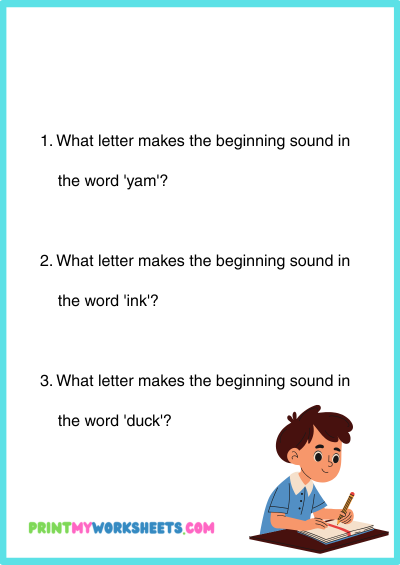
Pre-K Beginning Letter Sounds Worksheets PDF – Phonics Practice Pack for Early Literacy and Alphabet Recognition
Pre-K Beginning Letter Sounds Worksheets PDF
Early literacy begins with strong sound awareness, and helping young learners recognize beginning sounds is one of the most important steps in Pre-K reading readiness. These Pre-K Beginning Letter Sounds Worksheets PDF are designed to support children as they learn to connect letters with the sounds they hear in words. Created specifically for Pre-K students, this free printable resource is ideal for U.S. parents, preschool teachers, and homeschool families who want structured, age-appropriate phonics practice.
Beginning letter sounds form the foundation for phonemic awareness, early reading, and future spelling skills. At the Pre-K level, children are just starting to notice how spoken words are made up of sounds. With guided, repeated practice, they can begin identifying the first sound in familiar words and matching it to the correct letter. This worksheet set offers simple, clear activities that encourage listening, thinking, and early letter recognition without overwhelming young learners. Whether used at home or in the classroom, these worksheets support confident early learning in a developmentally appropriate way.
What Students Will Learn ?
These worksheets focus on helping Pre-K learners build essential early phonics skills through structured and engaging practice. Children will learn how to listen carefully to spoken words and identify the first sound they hear. This skill supports early reading development and helps children understand how language works.
The activities included encourage students to match beginning sounds to letters, recognize common letter-sound relationships, and build familiarity with the alphabet. Learners practice with simple, familiar words that are easy to say and recognize, making the activities accessible for young children. The worksheets are designed with a clear layout so students can focus on the task without distractions.
By working through these pages, children also develop important learning habits such as following directions, focusing on one task at a time, and completing age-appropriate independent work. The progression of activities supports gradual skill development while allowing flexibility for different learning paces. These worksheets align well with typical Pre-K expectations in U.S. early childhood programs and provide meaningful practice that supports early literacy growth.
Educational Value & Skill Development
Using Pre-K Beginning Letter Sounds Worksheets PDF as part of early literacy instruction offers strong educational benefits beyond letter recognition. Identifying beginning sounds strengthens phonemic awareness, which is a key predictor of later reading success. As children learn to hear and isolate sounds, they build the foundation needed for blending sounds into words in kindergarten and beyond.
These worksheets also support cognitive development by encouraging children to listen carefully, process information, and make simple connections. Completing the activities helps improve attention span, visual discrimination, and early problem-solving skills. For young learners, successfully identifying sounds and letters builds confidence and encourages a positive attitude toward learning.
From an instructional standpoint, the worksheets provide consistent practice that supports skill progression. Children move from listening and identifying to matching and recognizing, reinforcing learning through repetition without boredom. Teachers and parents can easily observe progress and identify areas where a child may need extra support. Overall, this resource promotes independence while reinforcing essential early literacy skills in a structured, child-friendly format.
Why Focus on Beginning Letter Sounds ?
Why Focus on Pre-K Beginning Letter Sounds Worksheets? Beginning letter sounds are one of the first phonics skills children learn, and they play a crucial role in early reading development. When children can recognize the first sound in a word, they begin to understand that words are made up of individual sounds.
This skill directly supports later abilities such as blending sounds to read simple words and segmenting sounds for spelling. Without a strong foundation in sound awareness, children may struggle as reading expectations increase in kindergarten and first grade. Practicing beginning sounds helps bridge the gap between spoken language and written text.
Repetition and guided practice are especially important at the Pre-K level. Young learners benefit from seeing and hearing the same letter-sound relationships multiple times in a variety of formats. These worksheets support early learning standards commonly used in U.S. preschool programs and provide the consistency children need to build confidence and readiness for the next stage of literacy instruction.
How to Use These Worksheets ?
These worksheets are flexible and easy to use in a variety of learning environments. In homeschool settings, parents can introduce one worksheet at a time, working alongside their child and discussing each word aloud. In classrooms, teachers can use the pages for literacy centers, small-group instruction, or independent practice during phonics time.
The worksheets also work well for intervention or review, allowing children to revisit beginning sounds as needed. Because they are provided as a free printable PDF, they are easy to download, print, and reuse. Laminating the pages allows for repeated practice with dry-erase markers.
For families and educators looking for structured phonics support, Pre-K Beginning Letter Sounds Worksheets PDF offer a simple way to reinforce skills consistently. The clear format makes them suitable for independent work, while the focused activities ensure meaningful practice without unnecessary distractions.
What’s Included in This PDF ?
This printable resource is designed to be practical and easy to use for both educators and families. Each worksheet focuses on a single skill to keep learning clear and manageable. Inside this worksheet set, you’ll find:
Multiple printable worksheets focused on beginning letter sounds
Activities that reinforce letter-sound recognition
A kid-friendly, uncluttered layout
Black-and-white pages for easy printing
Print-friendly design suitable for home or classroom use
Content aligned with U.S. Pre-K learning expectations
A free downloadable PDF format for quick access
You may also like:
[gallery ids="6743,6696,6392"]Related Worksheets / Extensions :
If your child or students are ready for more phonics practice, you may also like exploring related early literacy resources. Consider pairing this set with alphabet recognition worksheets, letter tracing activities, or simple CVC sound practice designed for preschool learners. You can also extend learning by using similar activities for letter identification or matching uppercase and lowercase letters.
For families and teachers building a complete phonics toolkit, Pre-K Beginning Letter Sounds Worksheets PDF work well alongside other Pre-K literacy printables. Using related worksheets together helps reinforce skills through varied practice while keeping learning engaging and age-appropriate.
Frequently Asked Questions
Q1. What format is this worksheet available in?This worksheet is available as a printable PDF file. It is black-and-white, printer-friendly, and works on any standard home or classroom printer using A4 or US Letter paper.Q2. Is this worksheet free to download?Yes, this worksheet is 100% free to download and print. No account, subscription, or payment is required. Click the Download Now button to get your free PDF instantly.Q3. Can I use this worksheet for both classroom and home learning?Yes, these worksheets are designed for use by classroom teachers, homeschool parents, and tutors. They can be used as morning work, homework, revision practice, or learning centre activities.Q4. Is this worksheet aligned with Common Core ELA standards?Yes, this English worksheet is aligned with U.S. Common Core English Language Arts standards and supports foundational literacy development.Q5. Can this worksheet be used for phonics instruction?Yes, this worksheet supports phonics-based reading instruction and is suitable for early readers building letter-sound recognition skills.Pre-K Beginning Letter Sounds Worksheets PDF – Phonics Practice Pack for Early Literacy and Alphabet Recognition
Pre-K Beginning Letter Sounds Worksheets PDF
Early literacy begins with strong sound awareness, and helping young learners recognize beginning sounds is one of the most important steps in Pre-K reading readiness. These Pre-K Beginning Letter Sounds Worksheets PDF are designed to support children as they learn to connect letters with the sounds they hear in words. Created specifically for Pre-K students, this free printable resource is ideal for U.S. parents, preschool teachers, and homeschool families who want structured, age-appropriate phonics practice.
Beginning letter sounds form the foundation for phonemic awareness, early reading, and future spelling skills. At the Pre-K level, children are just starting to notice how spoken words are made up of sounds. With guided, repeated practice, they can begin identifying the first sound in familiar words and matching it to the correct letter. This worksheet set offers simple, clear activities that encourage listening, thinking, and early letter recognition without overwhelming young learners. Whether used at home or in the classroom, these worksheets support confident early learning in a developmentally appropriate way.
What Students Will Learn ?
These worksheets focus on helping Pre-K learners build essential early phonics skills through structured and engaging practice. Children will learn how to listen carefully to spoken words and identify the first sound they hear. This skill supports early reading development and helps children understand how language works.
The activities included encourage students to match beginning sounds to letters, recognize common letter-sound relationships, and build familiarity with the alphabet. Learners practice with simple, familiar words that are easy to say and recognize, making the activities accessible for young children. The worksheets are designed with a clear layout so students can focus on the task without distractions.
By working through these pages, children also develop important learning habits such as following directions, focusing on one task at a time, and completing age-appropriate independent work. The progression of activities supports gradual skill development while allowing flexibility for different learning paces. These worksheets align well with typical Pre-K expectations in U.S. early childhood programs and provide meaningful practice that supports early literacy growth.
Educational Value & Skill Development
Using Pre-K Beginning Letter Sounds Worksheets PDF as part of early literacy instruction offers strong educational benefits beyond letter recognition. Identifying beginning sounds strengthens phonemic awareness, which is a key predictor of later reading success. As children learn to hear and isolate sounds, they build the foundation needed for blending sounds into words in kindergarten and beyond.
These worksheets also support cognitive development by encouraging children to listen carefully, process information, and make simple connections. Completing the activities helps improve attention span, visual discrimination, and early problem-solving skills. For young learners, successfully identifying sounds and letters builds confidence and encourages a positive attitude toward learning.
From an instructional standpoint, the worksheets provide consistent practice that supports skill progression. Children move from listening and identifying to matching and recognizing, reinforcing learning through repetition without boredom. Teachers and parents can easily observe progress and identify areas where a child may need extra support. Overall, this resource promotes independence while reinforcing essential early literacy skills in a structured, child-friendly format.
Why Focus on Beginning Letter Sounds ?
Why Focus on Pre-K Beginning Letter Sounds Worksheets? Beginning letter sounds are one of the first phonics skills children learn, and they play a crucial role in early reading development. When children can recognize the first sound in a word, they begin to understand that words are made up of individual sounds.
This skill directly supports later abilities such as blending sounds to read simple words and segmenting sounds for spelling. Without a strong foundation in sound awareness, children may struggle as reading expectations increase in kindergarten and first grade. Practicing beginning sounds helps bridge the gap between spoken language and written text.
Repetition and guided practice are especially important at the Pre-K level. Young learners benefit from seeing and hearing the same letter-sound relationships multiple times in a variety of formats. These worksheets support early learning standards commonly used in U.S. preschool programs and provide the consistency children need to build confidence and readiness for the next stage of literacy instruction.
How to Use These Worksheets ?
These worksheets are flexible and easy to use in a variety of learning environments. In homeschool settings, parents can introduce one worksheet at a time, working alongside their child and discussing each word aloud. In classrooms, teachers can use the pages for literacy centers, small-group instruction, or independent practice during phonics time.
The worksheets also work well for intervention or review, allowing children to revisit beginning sounds as needed. Because they are provided as a free printable PDF, they are easy to download, print, and reuse. Laminating the pages allows for repeated practice with dry-erase markers.
For families and educators looking for structured phonics support, Pre-K Beginning Letter Sounds Worksheets PDF offer a simple way to reinforce skills consistently. The clear format makes them suitable for independent work, while the focused activities ensure meaningful practice without unnecessary distractions.
What’s Included in This PDF ?
This printable resource is designed to be practical and easy to use for both educators and families. Each worksheet focuses on a single skill to keep learning clear and manageable. Inside this worksheet set, you’ll find:
Multiple printable worksheets focused on beginning letter sounds
Activities that reinforce letter-sound recognition
A kid-friendly, uncluttered layout
Black-and-white pages for easy printing
Print-friendly design suitable for home or classroom use
Content aligned with U.S. Pre-K learning expectations
A free downloadable PDF format for quick access
You may also like:
[gallery ids="6743,6696,6392"]Related Worksheets / Extensions :
If your child or students are ready for more phonics practice, you may also like exploring related early literacy resources. Consider pairing this set with alphabet recognition worksheets, letter tracing activities, or simple CVC sound practice designed for preschool learners. You can also extend learning by using similar activities for letter identification or matching uppercase and lowercase letters.
For families and teachers building a complete phonics toolkit, Pre-K Beginning Letter Sounds Worksheets PDF work well alongside other Pre-K literacy printables. Using related worksheets together helps reinforce skills through varied practice while keeping learning engaging and age-appropriate.